Frozen Vegetable Market is expanding rapidly as urban lifestyles and demand for convenient, nutritious foods drive global adoption across retail and foodservice sectors.
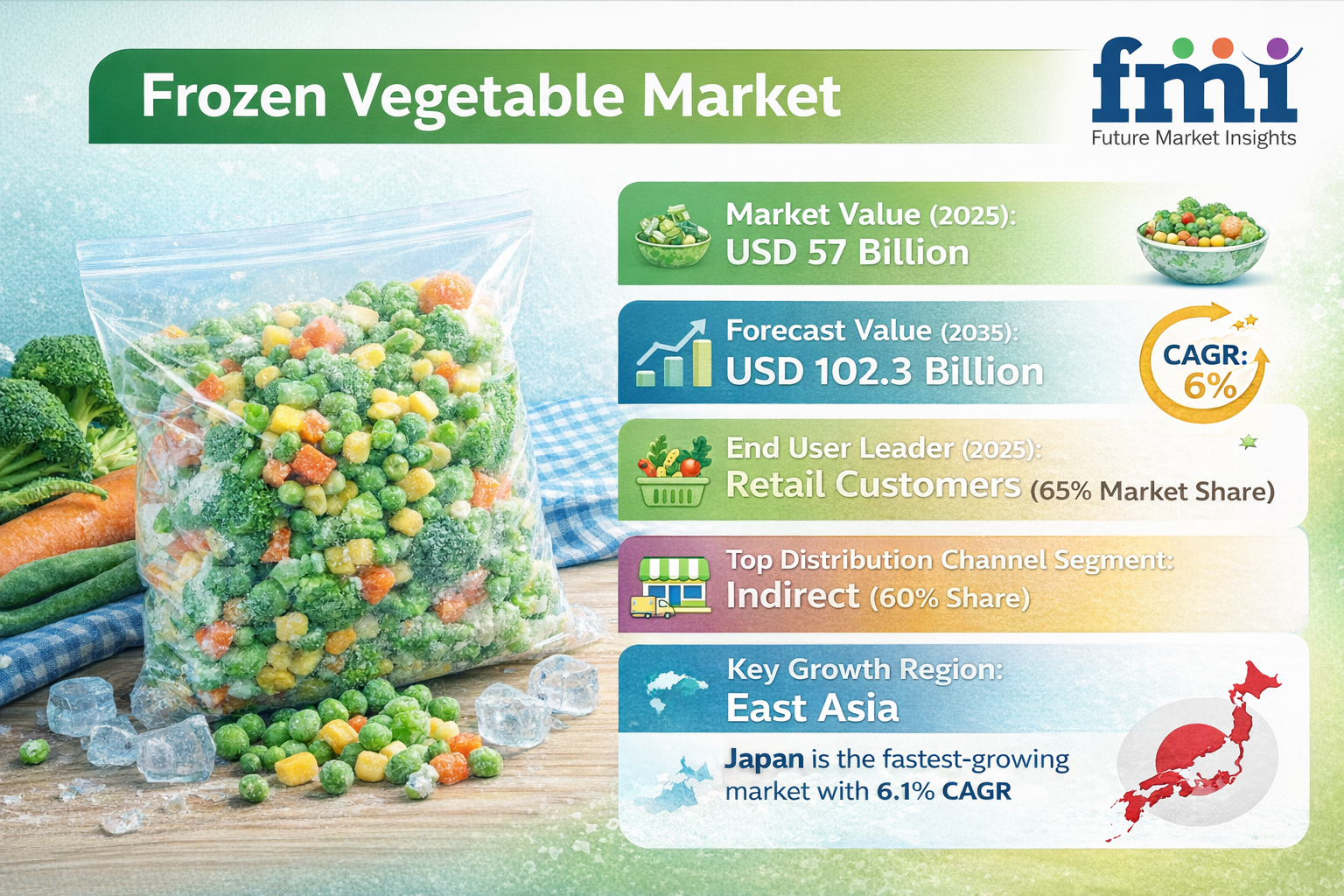
NEWARK, DELAWARE / ACCESS Newswire / March 5, 2026 / The global food industry is witnessing a transformation as consumers increasingly prioritize convenience, nutrition, and long shelf life in their daily food choices. Against this backdrop, the Frozen Vegetable Market is projected to grow from USD 57 billion in 2025 to USD 102.3 billion by 2035, registering a CAGR of 6% during the forecast period. According to the latest industry outlook from Future Market Insights (FMI), the market expansion is largely fueled by rising urbanization, hectic lifestyles, and growing demand for ready-to-cook meal solutions that retain nutritional value.
Frozen vegetables are rapidly becoming a staple across both households and commercial kitchens. Advances in freezing technology, improved packaging innovations, and enhanced cold chain logistics are enabling manufacturers to deliver high-quality products that preserve taste, texture, and nutritional content, making frozen vegetables a practical alternative to fresh produce.
Discover Growth Opportunities in the Market - Get Your Sample Report Now! https://www.futuremarketinsights.com/reports/sample/rep-gb-15255
Frozen Vegetable Market Snapshot (2025-2035)
Metric |
Value |
|---|---|
Market Value (2025) |
USD 57 Billion |
Forecast Value (2035) |
USD 102.3 Billion |
Forecast CAGR |
6% |
Leading End User Segment |
Retail Customers (65% Share) |
Top Distribution Channel |
Indirect (60% Share) |
Fastest Growing Market |
Japan (6.1% CAGR) |
Convenience Meets Nutrition: A Shift in Consumer Eating Habits
Modern consumers are increasingly seeking food options that combine convenience with health benefits. Frozen vegetables are uniquely positioned to meet this demand because they offer extended shelf life while preserving essential nutrients through advanced freezing techniques.
Health-conscious eating trends are also encouraging consumers to adopt frozen vegetables as reliable substitutes for fresh produce, particularly in urban households where time constraints influence purchasing decisions. Ready-to-cook vegetables simplify meal preparation and reduce food waste, further strengthening their appeal.
Currently, retail customers dominate the end-user segment with a 65% market share, reflecting strong household demand for packaged frozen produce. The rising popularity of meal preparation and home cooking has also reinforced the role of frozen vegetables in everyday diets.
Market Position Within the Global Food Ecosystem
The frozen vegetable sector holds a strong position across several parent markets, highlighting its importance within the global food supply chain.
Accounts for 25% of the global frozen food market
Contributes nearly 5% of the processed food market
Represents about 4% of the packaged food market
Holds approximately 1% share of the broader food and beverage market
These figures illustrate the category's steady integration into mainstream food consumption, particularly in developed markets where frozen food infrastructure is well established.
Technological Innovations Strengthening Product Quality
Continuous improvements in freezing technologies-such as individual quick freezing (IQF) and flash freezing-are significantly improving product quality and consumer perception. These techniques help preserve the original texture, flavor, and nutritional content of vegetables while extending shelf life.
In addition to freezing technologies, packaging innovations and cold chain advancements are playing a crucial role in expanding market reach. Improved logistics networks ensure that frozen vegetables maintain consistent quality throughout transportation and storage.
Regional Outlook: Japan Emerging as the Fastest-Growing Market
Demand for frozen vegetables varies across regions depending on lifestyle patterns, cold storage infrastructure, and dietary preferences.
Japan is projected to be the fastest-growing market, expanding at a CAGR of 6.1% between 2025 and 2035. The country's aging population, growing demand for convenient food solutions, and strong cold chain infrastructure are major drivers of growth.
Other major markets are also witnessing steady expansion:
Germany: 5.6% CAGR
France: 5.4% CAGR
United Kingdom: 5.2% CAGR
United States: 5% CAGR
In these regions, frozen vegetables are widely used in both household cooking and food service applications due to their reliability and year-round availability.
Consumption Trends: Developed Markets Lead
Per capita consumption of frozen vegetables is highest in developed countries where consumers prioritize convenience and efficient food storage.
In markets such as the United States, United Kingdom, and Germany, strong supermarket networks and advanced cold storage infrastructure encourage frequent purchases of frozen produce. Consumers in these regions often rely on frozen vegetables as practical alternatives during seasonal shortages.
Emerging markets such as India, Brazil, and South Africa are gradually increasing consumption as urbanization expands and cold chain infrastructure improves. Rising awareness about nutrition and convenience is expected to further accelerate adoption in these regions.
Distribution Dynamics: Indirect Channels Dominate
The indirect distribution channel currently holds around 60% market share, driven by the widespread presence of supermarkets, hypermarkets, and online grocery platforms.
These retail outlets provide consumers with easy access to diverse frozen vegetable options and promotional pricing strategies that encourage bulk purchases. Online grocery platforms are also gaining traction as digital shopping habits expand globally.
Leading Product Segment: Broccoli Takes the Lead
Among product categories, broccoli is projected to lead the frozen vegetable segment with an 18% market share by 2025.
This growth is attributed to its strong nutritional profile and rising demand among health-conscious consumers. Broccoli is also widely used in plant-based diets and vegan meal preparations, which continue to gain popularity worldwide.
Navigating Challenges: Supply Volatility and Infrastructure Costs
Despite positive growth prospects, the market faces certain structural challenges. Climate change and agricultural uncertainties can lead to fluctuations in the availability and pricing of raw vegetables, impacting production costs.
Additionally, maintaining cold chain infrastructure requires significant investment in storage facilities and transportation systems. These operational expenses can pose barriers for smaller producers and retailers attempting to enter the market.
Competitive Landscape: Innovation and Product Expansion
The global frozen vegetable market is moderately consolidated, with leading companies focusing on product innovation and portfolio expansion.
Key players include Nestle, Bonduelle SCA, Conagra Foods Inc., General Mills Inc., and Ardo N.V., which offer diverse frozen vegetable portfolios for both retail and food service sectors. Many companies are investing in advanced packaging technologies and expanding ready-to-cook product lines to meet evolving consumer preferences.
Recent industry developments further highlight the sector's innovation momentum. In September 2024, Green Giant introduced several new frozen vegetable products such as Crispy Smashed Potatoes and Veggie Ramen. Meanwhile, Conagra Brands launched more than 50 new frozen offerings in June 2024, including vegetables, meals, and snacks designed for convenience-driven consumers.
The Outlook: A Staple for the Future of Convenient Nutrition
Looking ahead, frozen vegetables are expected to play an increasingly important role in global food consumption patterns. As urban populations grow and consumers seek quick yet nutritious meal solutions, frozen vegetables will continue to gain prominence across retail and food service channels.
By 2035, the category is likely to become an even more essential component of the modern food supply chain-bridging the gap between convenience, sustainability, and nutritional value in everyday diets.
For an in-depth analysis of evolving formulation trends and to access the complete strategic outlook for the Frozen Vegetable Market through 2035, Full Report Request - https://www.futuremarketinsights.com/reports/frozen-vegetables-market
Related Reports:
Frozen Fruits and Vegetables Market: https://www.futuremarketinsights.com/reports/frozen-fruits-and-vegetables-market
Frozen Ready Meals Market: https://www.futuremarketinsights.com/reports/frozen-ready-meal-market
Frozen Food Market: https://www.futuremarketinsights.com/reports/frozen-food-market
Frozen Potatoes Market: https://www.futuremarketinsights.com/reports/frozen-potatoes-market
Frozen Snacks Market: https://www.futuremarketinsights.com/reports/frozen-snacks-market
About Future Market Insights (FMI)
Future Market Insights (FMI) is a leading provider of market intelligence and consulting services, serving clients in over 150 countries. Headquartered in Delaware, USA, with a global delivery center in India and offices in the UK and UAE, FMI delivers actionable insights to businesses across industries including automotive, technology, consumer products, manufacturing, energy, and chemicals.
An ESOMAR-certified research organization, FMI provides custom and syndicated market reports and consulting services, supporting both Fortune 1,000 companies and SMEs. Its team of 300+ experienced analysts ensures credible, data-driven insights to help clients navigate global markets and identify growth opportunities.
For Press & Corporate Inquiries
Rahul Singh
AVP - Marketing and Growth Strategy
Future Market Insights, Inc.
+91 8600020075
For Sales - sales@futuremarketinsights.com
For Media - Rahul.singh@futuremarketinsights.com
For web - https://www.futuremarketinsights.com/
SOURCE: Future Market Insights, Inc.
View the original press release on ACCESS Newswire