Berkshire Hathaway's (BRK.A) (BRK.B) new CEO, Greg Abel, recently disclosed that he would use all the after-tax proceeds from his salary to buy his own company's stock while he leads the firm, and he got the ball rolling with an initial purchase of $15.3 million of BRK.A. Abel will certainly have a great deal of incentive to attempt to boost the share price. However, given his unproven investment record, a questionable decision coming out of the gate by the new CEO, Berkshire's unimpressive fourth-quarter financial results, an assessment of Berkshire by a veteran, prominent investor, and a key long-term threat to Berkshire, I don't recommend that investors buy the shares at this point.
About Berkshire Hathaway
Berkshire owns many subsidiaries that are engaged in a wide variety of businesses, including electricity generation, insurance, food, and chemicals. Additionally, BRK.A has an investment portfolio that's worth about $318 billion. In Q4, the conglomerate's earnings from operations tumbled over 29% versus the same period a year earlier to $10.2 billion. while its insurance underwriting profits retreated 54% year-over-year (YOY) to $1.56 billion. Its total profits, which include the impact from the performance of its stocks, dropped to $19.2 billion from $19.7 billion.
Berkshire's trailing price-earnings ratio is 24.27 times, while its market capitalization is $1.075 trillion.
A Questionable Early Decision by Abel
Of course, one of Berkshire's biggest strengths for many decades has been the former great investments made by its long-time CEO, Warren Buffett. Now that Buffett is no longer running the company, it's difficult to determine whether Abel can be nearly as successful as his mentor. Indeed, while Abel reportedly averaged a commendable rate of return of about 12% during his tenure as CEO of BRK.A's Berkshire Hathaway Energy subsidiary as of last September, his ability to effectively buy and sell the stocks of many large, publicly traded firms is unproven.
Compounding my own uncertainty about Abel, the new CEO told CNBC that Berkshire does not intend to reduce its $7.9 billion stake in Kraft Heinz (KHC). In light of the latter company's many weaknesses, which I outlined in two previous columns, I view this decision as somewhat puzzling.
Less-Than-Stellar Q4 Results and Tilson's Assessment of Berkshire's Value
Obviously, the large YOY declines in Berkshire's earnings from operations and insurance underwriting profits last quarter, along with the significant drop of its overall bottom line in Q4, suggest that its businesses are not growing a great deal and indicate that they may have significant problems.
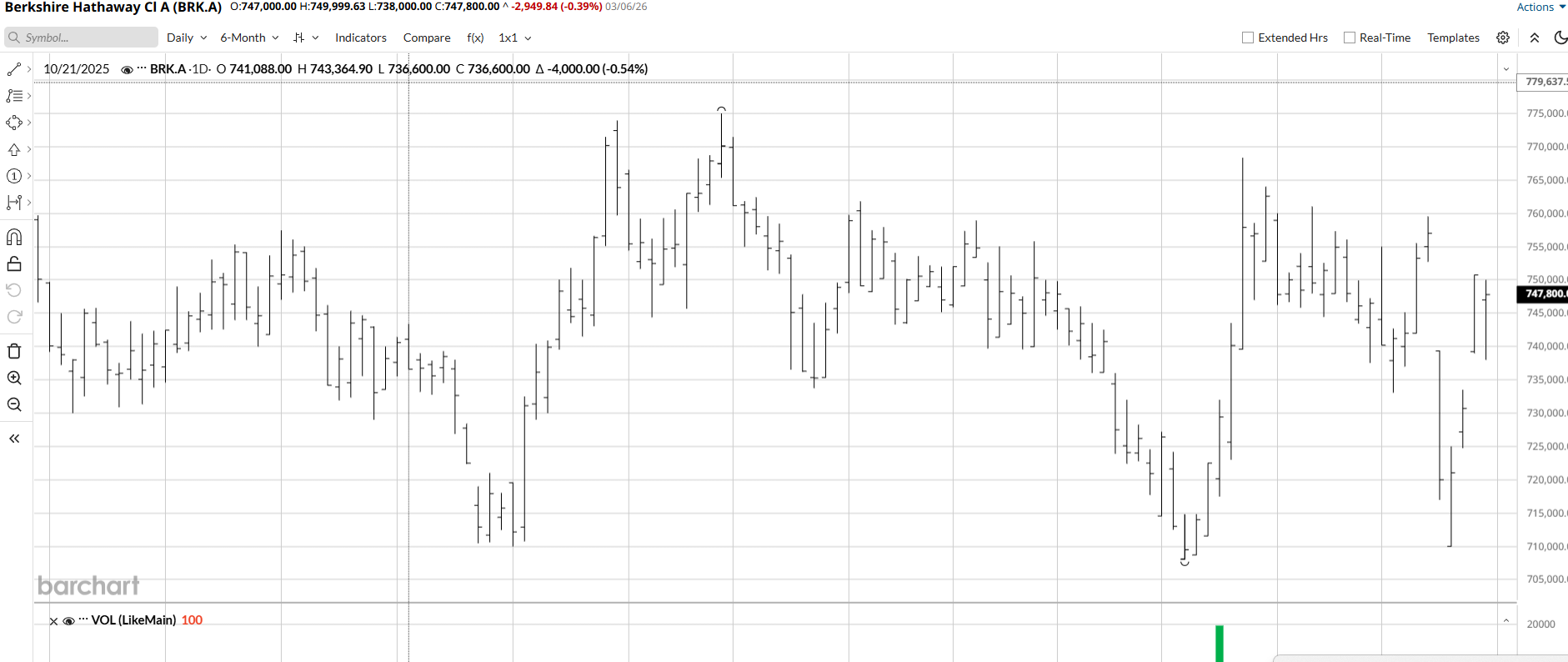
Meanwhile, a prominent investor and former hedge fund manager, Whitney Tilson, recently estimated that the company's A shares were worth about $801,000 per share, versus the current share price of $747,800. That's a spread of only roughly 6.6%. Given the significant questions about Abel's investment abilities and the company's uninspiring Q4 performance, Tilson's assessment indicates that Berkshire's valuation is not especially attractive.
The Long-Term Threat Facing Berkshire's' Auto-Insurance Business
In 2025, GEICO, Berkshire's auto-insurance subsidiary, generated $6.8 billion of pre-tax underwriting profits, while Berkshire's operating earnings came in at $44.5 billion. Consequently, a large decline in GEICO's earnings could constitute a meaningful drag on Berkshire's profits, and the proliferation of robotaxis, which is starting to get underway, is a major long-term threat for Berkshire. Consider, for example, that robotaxis have been deployed in five U.S. cities, while Mercedes-Benz has already developed vehicles that completely “drive (themselves) under certain conditions.”
And ominously for Berkshire, Waymo reported that “its robotaxis had 78% fewer injury-causing crashes and 79% fewer airbag deployment crashes compared to an average human driver over the same distance,” while “a spokesperson for the Insurance Information Institute” told Yahoo Finance that insurance premiums will probably fall if autonomous vehicles lower the number "and severity of car accidents.” Moreover, some have speculated that the number of people owning vehicles could plummet in the robotaxi era. If the latter scenario materializes, it may be more difficult for auto insurers to collect high premiums from the many drivers who give up their cars.
The Bottom Line
With Berkshire having reported unimpressive Q4 results, trading only slightly below Tilson's assessment of its value, and facing significant uncertainty in the medium term and the long term, now is not a good time to buy the shares.
On the date of publication, Larry Ramer did not have (either directly or indirectly) positions in any of the securities mentioned in this article. All information and data in this article is solely for informational purposes. For more information please view the Barchart Disclosure Policy here.
More news from Barchart
- Dear Oracle Stock Fans, Mark Your Calendars for March 10
- Hims & Hers Stock Is Challenging Its 50-Day Moving Average. Should You Bet on a Turnaround Here?
- Palantir Stock Forecast: Is PLTR Heading to $260 or Dropping Further From Here?
- New CEO Greg Abel Just Bought $15 Million of Berkshire Hathaway Stock. Should You?