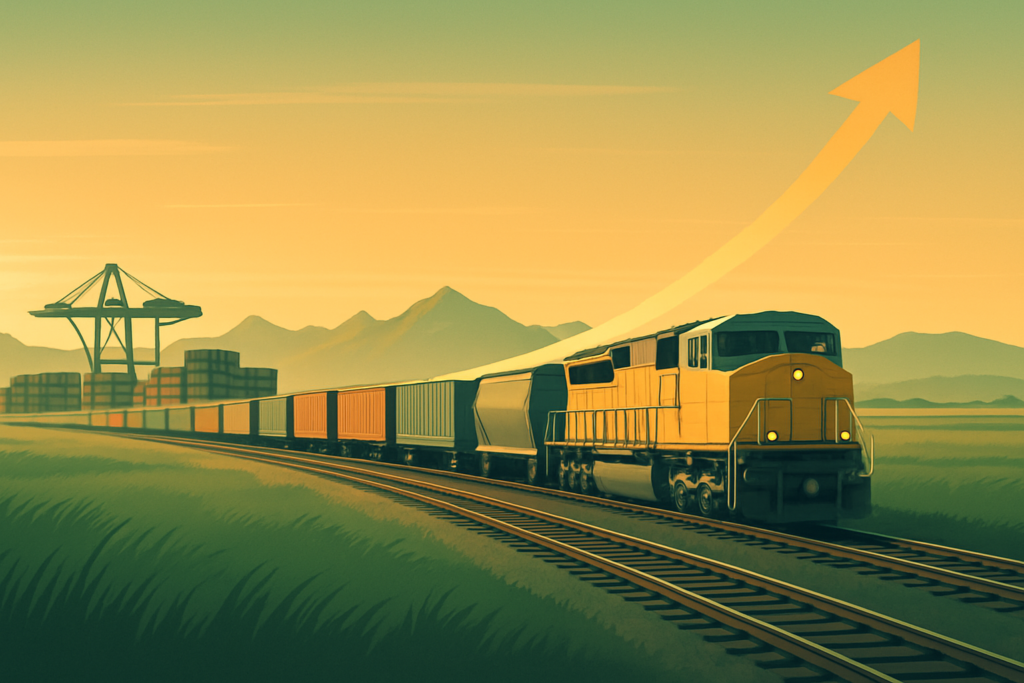
On January 23, 2026, the American rail industry finds itself at a crossroads, and no company better exemplifies this tension than Union Pacific (NYSE: UNP). Often referred to as the "Steel Interstate" of the Western United States, Union Pacific operates a critical 32,000-mile network that serves as the backbone of the U.S. economy. However, recent performance has sparked a debate among institutional investors and industry analysts.
The company is currently in the spotlight following a "nuanced" Q3 2025 earnings report. While Union Pacific managed to beat earnings-per-share (EPS) estimates through aggressive operational efficiency, it missed revenue targets—a result primarily driven by a difficult shipment mix and volatility in international trade. As the company pushes forward with a bold transcontinental merger strategy under CEO Jim Vena, investors are weighing the railroad’s massive moat and efficiency gains against a top-line growth story that remains frustratingly inconsistent.
Historical Background
Union Pacific’s history is inextricably linked to the expansion of the United States. Founded on July 1, 1862, when President Abraham Lincoln signed the Pacific Railway Act, the Union Pacific Rail Road was tasked with building the eastern half of the nation’s first transcontinental railroad. The historic completion at Promontory Summit, Utah, in 1869, marked the first time the American East and West were connected by rail, a milestone that fundamentally reshaped domestic commerce.
Over the next 150 years, the company transformed through a series of massive consolidations. Key acquisitions include the Missouri Pacific and Western Pacific in 1982, and the Chicago and North Western in 1995. However, the most defining move of the modern era was the 1996 merger with Southern Pacific. This acquisition gave Union Pacific the "Sunset Route" and solidified the current duopoly in the Western U.S. with its primary rival, BNSF Railway. Today, Union Pacific remains headquartered in Omaha, Nebraska, operating as a centralized powerhouse that links 23 states and all major West Coast and Gulf Coast ports.
Business Model
Union Pacific operates as a "Class I" railroad, generating revenue through the transportation of a diverse array of goods. Its business model is divided into three primary segments:
- Bulk (approx. 32% of revenue): This segment includes coal, grain, soda ash, and fertilizers. While coal has historically been in secular decline, it remains a vital cash cow, especially during periods of high global energy demand.
- Industrial (approx. 35% of revenue): A highly diversified category moving chemicals, plastics, forest products, metals, and specialized ores. This segment is closely tied to industrial production and the health of the housing market.
- Premium (approx. 33% of revenue): Comprising Intermodal (shipping containers) and Automotive shipments. Intermodal is the company’s primary long-term growth engine, as it competes directly with the long-haul trucking industry for retail and e-commerce traffic.
The company earns revenue through freight rates and fuel surcharges, while its profitability is measured by the "Operating Ratio" (OR)—a metric of operating expenses as a percentage of revenue.
Stock Performance Overview
Union Pacific has long been a staple of "widows and orphans" portfolios due to its dividend reliability and massive competitive moat. However, its recent performance reflects a shifting macro environment.
- 1-Year Performance: As of January 2026, UNP is down approximately 6.75% over the trailing twelve months. This underperformance relative to the S&P 500 is largely due to the Q3 revenue miss and regulatory uncertainty surrounding its proposed merger activities.
- 5-Year Performance: The stock has seen a more modest 23.4% return over five years, reflecting a period of volume stagnation in the rail industry balanced by aggressive share buybacks and dividend increases.
- 10-Year Performance: Long-term investors have been well-rewarded, with a total return of over 304%. This decade of growth was fueled by the wide-scale implementation of "Precision Scheduled Railroading" (PSR), which dramatically improved profit margins even in low-volume environments.
Financial Performance
The Q3 2025 financial results highlighted the core challenge facing Union Pacific: doing more with less. The company reported $6.24 billion in operating revenue, missing the consensus estimate of $6.31 billion. This 3% year-over-year increase was insufficient to satisfy Wall Street’s growth expectations.
The "miss" was largely a product of a challenging shipment mix. International intermodal volumes plummeted 17% as global trade routes shifted and shippers pulled volumes forward earlier in the year to avoid potential tariff changes. Furthermore, a sluggish housing market weighed heavily on lumber and forest product shipments.
Despite the revenue shortfall, Union Pacific delivered an EPS beat of $3.08 (vs. $3.02 expected). This was achieved through a record-breaking adjusted Operating Ratio of 58.5%. By improving freight car velocity by 8% and reducing terminal dwell by 9%, management was able to squeeze more profit out of every dollar of revenue, even as the top line stuttered.
Leadership and Management
In August 2023, the board brought back Jim Vena as CEO. Vena, a protégé of legendary railroader Hunter Harrison, is a staunch advocate of Precision Scheduled Railroading. His return was a clear signal to investors that the company would prioritize "operational excellence" and service reliability over the experimental strategies of the previous regime.
Vena is supported by a veteran team, including CFO Jennifer Hamann, who has been instrumental in navigating the company’s capital allocation strategy, and EVP of Operations Eric Gehringer. Under this leadership, the company has transitioned into "Phase 3" of PSR—moving beyond mere cost-cutting to a focus on "working assets harder," which has resulted in the best efficiency metrics in the company's recent history.
Products, Services, and Innovations
Union Pacific is not just a legacy carrier; it is increasingly an integrated logistics provider. Key innovations and service offerings include:
- Falcon Premium: A joint intermodal service with Canadian National (CN) and Grupo México (GMXT) that provides the fastest rail service between Chicago and Mexico, specifically targeting the "nearshoring" trend.
- Precision Railroading Tech: UNP has heavily invested in automated track inspection and predictive maintenance algorithms that reduce service disruptions and improve safety.
- Intermodal Expansion: The company is aggressively expanding its inland ramp capacity in markets like Phoenix and Chicago to capture freight that would otherwise move by truck.
Competitive Landscape
The primary competitor for Union Pacific is BNSF Railway (owned by Berkshire Hathaway). The two railroads maintain a duopoly in the Western U.S., often competing for the same coal and intermodal contracts. While BNSF has recently been more aggressive in pricing, Union Pacific has maintained a slight edge in operating efficiency.
The landscape is currently dominated by Union Pacific's proposed $85 billion merger with Norfolk Southern (NS). If approved, this would create the first true transcontinental railroad in North American history, allowing UNP to bypass the "Mississippi River barrier" and move freight from the West Coast to the East Coast on a single network. However, this move has invited intense scrutiny from both BNSF and federal regulators.
Industry and Market Trends
The rail sector in 2025-2026 is grappling with several secular shifts:
- Coal Resilience: Despite the green energy transition, coal carloads grew 18% in late 2025, driven by surging export demand from Asia and domestic grid instability.
- Nearshoring: The "Mexico Effect" is real. As manufacturing shifts from China to Mexico, Union Pacific’s cross-border gateways have become some of its most valuable assets.
- Modal Shift: Railroads are fighting to take market share from the trucking industry. As truck driver wages and fuel costs rise, the "fuel efficiency" of rail (one gallon of fuel can move a ton of freight 450 miles) becomes a more potent competitive advantage.
Risks and Challenges
- Regulatory Friction: The Surface Transportation Board (STB) has become increasingly activist. In January 2026, it labeled UNP’s merger application with Norfolk Southern as "incomplete," signaling a long and difficult road ahead for regulatory approval.
- Shipment Mix Volatility: As seen in Q3, the railroad is highly sensitive to shifts in the types of freight it carries. High-margin automotive and industrial freight can be easily derailed by interest rate hikes or consumer spending dips.
- Labor Relations: While current contracts are stable, the threat of labor disputes and the ongoing pressure to maintain staffing levels in a tight job market remains a persistent risk to the PSR model.
Opportunities and Catalysts
- The Transcontinental Dream: If the Norfolk Southern merger eventually clears regulatory hurdles, it would be a "black swan" event for the stock, likely resulting in a massive valuation re-rating.
- Truck-to-Rail Conversion: Management estimates there are 2 million truckloads currently on the highway that could be moved to UNP’s rail network. Even a small percentage of this conversion would drive significant top-line growth.
- Mexico Cross-Border Growth: As a primary gateway for Mexican imports, UNP is uniquely positioned to benefit from the continued industrialization of the Mexican economy.
Investor Sentiment and Analyst Coverage
Wall Street remains "cautiously optimistic" on Union Pacific. The consensus rating as of January 2026 is a Moderate Buy.
- The Bull Case: Analysts point to Jim Vena’s operational discipline and the record-low operating ratio as proof that UNP is the most efficient railroad in the world.
- The Bear Case: Skeptics point to the revenue miss and the STB’s recent pushback on mergers as evidence that the "growth story" is stuck in the station.
The median price target currently sits at $261.00, representing roughly 13% upside from current trading levels.
Regulatory, Policy, and Geopolitical Factors
The regulatory environment is the biggest wildcard for UNP. The Federal Railroad Administration (FRA) continues to push for stricter safety mandates following high-profile industry derailments in previous years. Furthermore, the STB's focus on "reciprocal switching"—which would force railroads to allow competitors to use their tracks—poses a threat to UNP’s pricing power. Geopolitically, any disruption in trade relations with Mexico or China immediately impacts UNP’s intermodal and agricultural carloads.
Conclusion
Union Pacific (UNP) remains an industrial titan with a nearly impenetrable moat, yet it is currently a "show-me" story for investors. The Q3 2025 revenue miss highlighted that operational efficiency alone cannot carry the stock if the shipment mix remains unfavorable. CEO Jim Vena has successfully polished the "internal engine" of the railroad, achieving record-breaking velocity and dwell metrics. However, for the stock to break out of its recent slump, the company must prove it can translate these efficiencies into consistent top-line growth.
Investors should closely monitor the STB’s decisions regarding the Norfolk Southern merger and watch for a recovery in international intermodal volumes. In the long term, Union Pacific’s role as the primary artery for North American trade makes it a formidable asset, but in the near term, the journey remains bumpy as it navigates a complex macro and regulatory landscape.
This content is intended for informational purposes only and is not financial advice.