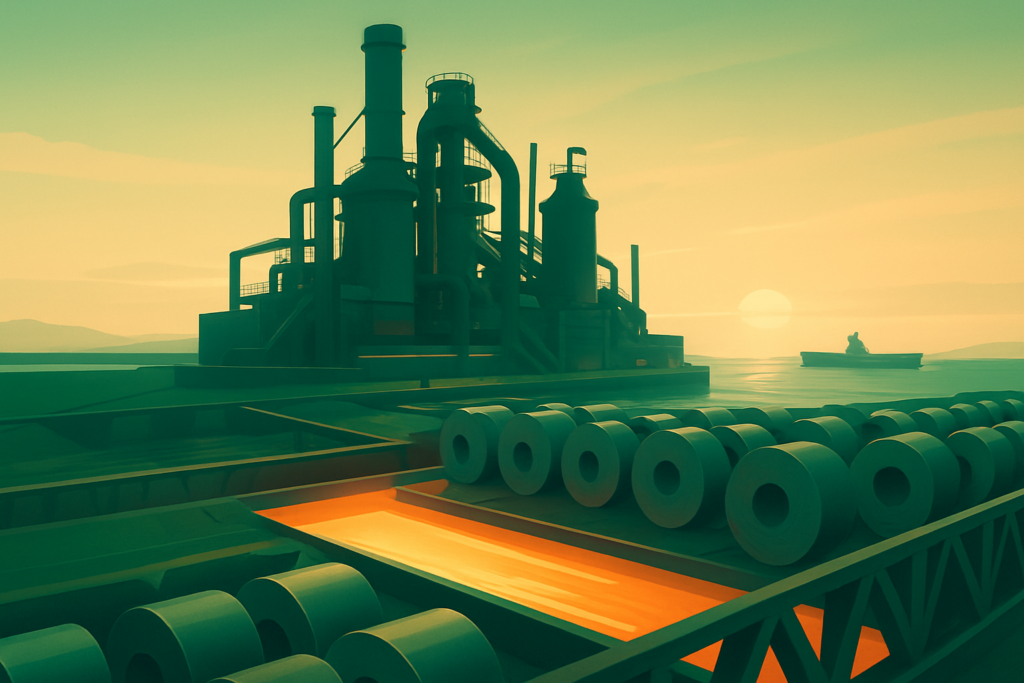
As of February 16, 2026, Cleveland-Cliffs (NYSE: CLF) stands as a polarizing sentinel of American industrial policy. Once a humble iron ore miner, the company has transformed into the largest flat-rolled steel producer in North America, a feat achieved through aggressive acquisitions and a staunch "America First" operational philosophy. Today, Cleveland-Cliffs is the focal point of a massive shift in global trade dynamics. Following a volatile 2025—a year defined by a "reset" in steel pricing and a dramatic 50% hike in Section 232 tariffs—investors are closely watching whether the company’s vertically integrated "Iron Fortress" can finally deliver the consistent profitability promised by CEO Lourenco Goncalves.
Historical Background
Founded in 1847, Cleveland-Cliffs’ history is inextricably linked to the development of the American Great Lakes region. For over 170 years, the company primarily operated as a merchant of iron ore pellets. However, the arrival of Lourenco Goncalves as CEO in 2014 sparked a radical transformation. Recognizing the vulnerability of being a mere raw material supplier, Goncalves pivoted toward steelmaking.
The most significant milestones occurred between 2020 and 2024, when the company acquired AK Steel and the U.S. assets of ArcelorMittal, followed by the landmark $2.5 billion acquisition of Canada’s Stelco Holdings Inc. in late 2024. These moves effectively closed the loop, making Cleveland-Cliffs a fully vertically integrated powerhouse capable of controlling its supply chain from the mine to the finished automotive fender.
Business Model
Cleveland-Cliffs operates a unique business model compared to its "mini-mill" rivals like Nucor. It is an integrated producer that utilizes blast furnaces and basic oxygen furnaces (BOFs), fed by its own iron ore mines in Minnesota and Michigan.
Revenue Segments:
- Steelmaking (95%+ of revenue): Primarily flat-rolled steel, including hot-rolled, cold-rolled, and coated products.
- Vertical Integration: The company produces its own Hot Briquetted Iron (HBI) and iron ore pellets, insulating it from the volatile scrap metal prices that affect its competitors.
- Key Markets: The automotive industry remains CLF's largest customer, accounting for roughly one-third of its shipments. Other major segments include infrastructure, manufacturing, and distributors.
Stock Performance Overview
The past five years have been a rollercoaster for CLF shareholders. After surging to highs during the post-pandemic commodities boom of 2021-2022, the stock faced a grueling 2024 and 2025.
- 1-Year Performance: Down roughly 12%, largely due to a $1.4 billion net loss reported for the 2025 fiscal year.
- 5-Year Performance: Up approximately 45%, reflecting the successful integration of its massive acquisitions, though significantly off its 2022 peaks.
- 10-Year Performance: An impressive 600%+ recovery from the brink of bankruptcy in 2015, highlighting the "Goncalves Era" turnaround.
As of February 2026, the stock has begun to rebound, trading around $18.50 as the market prices in a $60/ton improvement in realized steel prices for the coming quarters.
Financial Performance
2025 was a challenging year for Cleveland-Cliffs. The company reported consolidated revenues of $18.6 billion, down from $19.2 billion in 2024. The GAAP net loss of $1.4 billion was driven by three main factors:
- Weak Automotive Demand: Stagnant production volumes from North American "Big Three" automakers.
- The "Poisoned" Slab Contract: A legacy contract for Brazilian slabs became a massive liability after tariffs on those slabs were hiked to 50% in mid-2025.
- One-time Integration Costs: Expenses related to the Stelco acquisition.
However, the 2026 outlook is brighter. The company has guided for shipments of 16.5–17.0 million net tons and has successfully reduced unit costs by $40/ton over the last twelve months. The early 2026 strategic alliance with POSCO (KRX: 005490), involving a $700 million equity investment, has significantly bolstered the balance sheet.
Leadership and Management
Lourenco Goncalves remains the face of Cleveland-Cliffs. Known for his blunt, often combative earnings calls and fierce defense of American manufacturing, Goncalves has cultivated a cult-like following among retail investors and the United Steelworkers (USW) union. His strategy focuses on "environmental and social governance" (ESG) through the lens of domestic job preservation and reduced carbon intensity via HBI usage. The management team’s recent focus has shifted from M&A to debt reduction and capital returns, signaling a more mature phase of the corporate lifecycle.
Products, Services, and Innovations
Cleveland-Cliffs leads in high-end steel applications.
- Advanced High-Strength Steel (AHSS): Essential for the electric vehicle (EV) transition to reduce weight while maintaining safety.
- Grain-Oriented Electrical Steel (GOES): CLF is the sole domestic producer of this critical material used in power transformers and the aging U.S. electrical grid.
- HBI Production: Its Toledo, Ohio plant is a state-of-the-art facility that produces low-carbon iron, allowing CLF to reduce its reliance on coke and lower its carbon footprint relative to traditional integrated peers.
Competitive Landscape
The U.S. steel market is currently a triarchy:
- Nucor (NYSE: NUE): The efficiency leader. Nucor’s electric arc furnace (EAF) model allows for lower fixed costs and higher flexibility.
- Cleveland-Cliffs: The quality and integration leader. CLF dominates the automotive and high-spec industrial sectors.
- United States Steel (NYSE: X) / Nippon Steel: Following the finalized $14.2 billion merger in June 2025, U.S. Steel now operates under the umbrella of Japan’s Nippon Steel, though with heavy U.S. government oversight (the "Golden Share" provision).
While Nucor remains more profitable on a margin basis, CLF’s control over its raw materials provides a "floor" to its costs that competitors lack when scrap metal prices spike.
Industry and Market Trends
Two macro trends are currently defining the sector in 2026:
- Decarbonization: Pressure to produce "Green Steel" has led to a race for hydrogen-ready furnaces. CLF’s HBI strategy gives it a head start.
- Regionalization: The death of "Global Steel." Markets are increasingly siloed by protectionist barriers, benefiting domestic-only producers like CLF at the expense of global traders.
Risks and Challenges
- Retaliatory Tariffs: The 2025 tariff hikes led to 25% retaliatory duties from Canada, hurting the profitability of the recently acquired Stelco assets.
- Labor Relations: While currently strong, the dependence on unionized labor makes CLF vulnerable to work stoppages that could paralyze its blast furnace operations.
- Operational Sensitivity: Unlike EAFs, blast furnaces are difficult and expensive to "turn off," meaning CLF must maintain high utilization rates even when demand is soft.
Opportunities and Catalysts
- Infrastructure Spend: The continued rollout of the Infrastructure Investment and Jobs Act (IIJA) is finally hitting its peak construction phase in 2026, driving demand for heavy plate and structural steel.
- The POSCO Deal: The $700 million infusion from POSCO provides liquidity to pay down high-interest debt and potentially restart stock buybacks in late 2026.
- Grid Modernization: The desperate need for transformer steel plays directly into CLF’s monopoly on domestic GOES production.
Investor Sentiment and Analyst Coverage
Wall Street remains divided on CLF. Bulls point to the "tariff wall" as a permanent competitive advantage that will eventually force automotive OEMs to accept higher prices. Bears argue that the company is too capital-intensive and that the 2025 net loss proves the model is fragile during economic downturns. Institutional ownership remains high at 65%, with major positions held by Vanguard and BlackRock, though hedge fund activity has been volatile following the failed attempt to acquire U.S. Steel in 2024.
Regulatory, Policy, and Geopolitical Factors
This is the "X-factor" for Cleveland-Cliffs. In June 2025, the U.S. increased Section 232 tariffs from 25% to 50% on a wide range of steel imports.
- The Reaction: This move effectively locked out low-cost imports from Brazil, South Korea, and Vietnam, allowing CLF to raise prices.
- 2026 Shift: Just this month (February 2026), the administration signaled a technical easing of tariffs on "derivative products" (like auto parts and fasteners) to cool domestic inflation. While the 50% tariff on bulk steel remains, this easing could slightly reduce the "buy American" premium that CLF enjoys.
- National Security: The Department of Commerce continues to view steel as a critical national security asset, shielding CLF from traditional antitrust pressures and foreign dumping.
Conclusion
Cleveland-Cliffs enters 2026 as a survivor of a brutal industrial "reset." Its destiny is no longer tied solely to the global price of steel, but to the political willpower of Washington to maintain a high-tariff environment. For investors, CLF represents a pure-play bet on American re-industrialization and trade protectionism.
The primary metric to watch over the next 12 months is the "realized price per ton." If CLF can capture the $60/ton improvement it has forecasted, the company will quickly pivot from a $1.4 billion loss back to a multi-billion dollar EBITDA generator. However, in an era of 50% tariffs and retaliatory trade wars, the "Iron Fortress" is only as strong as the policies that defend it. Investors should remain cautious of the volatility inherent in such a politically sensitive asset but recognize the immense leverage CLF holds over the North American supply chain.
This content is intended for informational purposes only and is not financial advice.