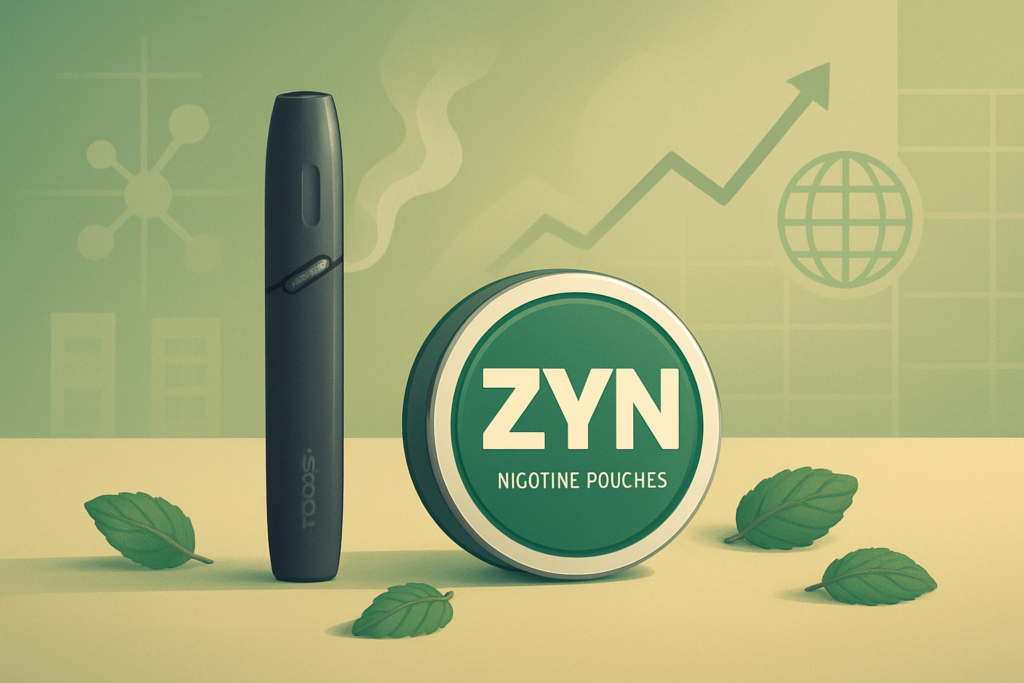
As of February 6, 2026, Philip Morris International (NYSE: PM) stands at a historic crossroads. Long regarded as the quintessential "Big Tobacco" play, the company has spent the last decade aggressively cannibalizing its own legacy combustible business to lead a global "smoke-free" revolution. Today, the results of this gamble are no longer speculative; they are foundational to the company’s valuation.
With 2025 results surpassing the $40 billion revenue mark and smoke-free products now contributing over 41% of total net revenues, PM is the focal point of a massive sector-wide pivot. The company enters 2026 with a dual-engine growth strategy: the continued international dominance of its heated tobacco system, IQOS, and the explosive, high-margin success of ZYN nicotine pouches in the United States. However, this growth has invited unprecedented competition and regulatory scrutiny. As PM forecasts double-digit profit growth for 2026, investors are weighing the company’s massive cash flows against a tightening competitive landscape and the high-stakes rollout of IQOS in the U.S. market.
Historical Background
Philip Morris International’s journey began as a London-based tobacconist in 1847, but its modern identity was forged in 2008. In one of the most significant corporate separations in history, PM was spun off from Altria Group (NYSE: MO). While Altria retained the U.S. business, PM was granted the international rights to iconic brands like Marlboro, allowing it to tap into high-growth emerging markets without the immediate overhang of U.S. litigation.
The pivotal transformation occurred in 2016 when PM announced its vision for a "Smoke-Free Future." This was not just a branding exercise but a massive R&D commitment. Since 2008, the company has invested over $12.5 billion into the development and commercialization of Reduced-Risk Products (RRPs). The 2022 acquisition of Swedish Match for approximately $16 billion was the final piece of the puzzle, providing PM with a dominant position in the oral nicotine category and, crucially, a direct re-entry into the U.S. market via the ZYN brand.
Business Model
PM’s business model is currently in a state of "positive friction" between its legacy and its future. It operates through two primary product segments:
- Combustible Tobacco: Primarily cigarettes (Marlboro, L&M, Chesterfield). While volumes in this segment are in a slow secular decline, PM’s pricing power remains exceptionally strong, providing the necessary "cash cow" to fund future investments.
- Smoke-Free Products (SFP): This includes heated tobacco units (HTUs) for the IQOS system, nicotine pouches (ZYN), and e-vapor products (VEEV).
Geographically, the company is divided into several regions: Europe, South & Southeast Asia/CIS/Middle East/Africa, East Asia & Australia, and the Americas. The 2022 Swedish Match deal transformed the "Americas" segment from a peripheral operation into a core growth engine, as the U.S. is now the world’s largest and most profitable market for nicotine pouches.
Stock Performance Overview
Over the last year (2025–2026), PM has outperformed most of its tobacco peers, buoyed by the "ZYN-sanity" phenomenon in the U.S. and a stabilizing macro environment.
- 1-Year Performance: The stock has seen a double-digit rise, fueled by consecutive earnings beats and the successful scaling of manufacturing capacity for oral nicotine.
- 5-Year Performance: On a total return basis (including dividends), PM has significantly outpaced the broader tobacco sector, as the market began to re-rate the stock from a "declining cigarette company" to a "growth-oriented consumer technology firm."
- 10-Year Performance: Long-term holders have benefited from a compounded annual growth rate (CAGR) supported by a dividend that has increased every year since the 2008 spin-off.
Historically, the stock trades at a premium to Altria and British American Tobacco (NYSE: BTI) because of its superior growth profile in RRPs and lower exposure to U.S. cigarette litigation.
Financial Performance
PM’s 2026 outlook is characterized by high-single-digit organic revenue growth and double-digit EPS expansion.
- 2025 Review: The company reported an adjusted diluted EPS of $7.54, up 14.8% from 2024. Total net revenue exceeded $40 billion, with smoke-free revenue reaching approximately $17 billion.
- 2026 Guidance: Management expects reported diluted EPS between $7.87 and $8.02. On an adjusted basis, the company is targeting growth of 11.1% to 13.1%.
- Margins: Smoke-free products carry higher gross margins (roughly 70%) compared to traditional cigarettes, meaning that as the mix shifts toward SFPs, PM’s overall profitability profile improves.
- Debt & Cash Flow: The company continues to deleverage following the Swedish Match acquisition, utilizing robust operating cash flow to fund both its dividend and R&D.
Leadership and Management
CEO Jacek Olczak, who took the helm in 2021, has been the primary architect of the "Smoke-Free" acceleration. Olczak is widely regarded by analysts as a visionary but pragmatic leader who is willing to take bold risks—such as the Swedish Match acquisition—to future-proof the company.
The management team is currently focused on "Execution 2026," a strategy centered on maximizing the U.S. ZYN opportunity, navigating the FDA's Premarket Tobacco Product Application (PMTA) process for IQOS ILUMA, and managing the cost-of-living impacts on consumers in emerging markets. Governance remains a high priority, as the company seeks to maintain its ESG-linked financing targets despite the inherent challenges of being a tobacco-related entity.
Products, Services, and Innovations
The crown jewel of PM’s portfolio is IQOS, the world’s leading heated tobacco system. Unlike traditional cigarettes, IQOS heats tobacco without burning it, significantly reducing the levels of harmful chemicals. The latest generation, IQOS ILUMA, uses induction heating technology, eliminating the need for a heating blade and reducing device maintenance.
ZYN has become a cultural and financial juggernaut. It is a tobacco-free nicotine pouch that has captured nearly 70% of the U.S. market share. PM’s innovation pipeline also includes VEEV (e-vapor) and Bonds, a specialized heated tobacco device for emerging markets. The company holds thousands of patents related to aerosol technology and nicotine delivery, creating a formidable "moat" against smaller competitors.
Competitive Landscape
Competition is intensifying as rivals attempt to claw back market share in the reduced-risk category.
- Altria (MO): After several failed attempts in the e-vapor space (Juul), Altria is now pushing on! PLUS pouches, which received FDA authorization in late 2025. They are also developing a heated tobacco product called Horizon.
- British American Tobacco (BTI): BAT’s Vuse remains a strong competitor in e-vapor, and its Velo pouches are a global leader, though they trail ZYN significantly in the lucrative U.S. market.
- Chinese Disposables: The proliferation of illicit, flavored disposable vapes from China remains a persistent thorn in the side of PM’s regulated e-vapor offerings.
PM’s competitive edge lies in its "first-mover" advantage in heated tobacco and the brand equity of ZYN, which has achieved "Verb status" (consumers asking for "a ZYN" rather than "a pouch").
Industry and Market Trends
The global tobacco industry is undergoing a "Grand Pivot." Consumer preferences are shifting toward "cleaner" nicotine delivery.
- Social Acceptance: Smoke-free products are generally more socially acceptable than cigarettes, expanding the potential use-cases for nicotine.
- Premiumization: In markets like Japan and Europe, IQOS is marketed as a premium tech gadget, similar to a smartphone, allowing PM to command higher price points.
- GLP-1 Impact: There has been some speculation about GLP-1 (weight loss) drugs reducing nicotine cravings, though current data shows minimal impact on PM’s volume trends as of early 2026.
Risks and Challenges
Despite the bullish outlook, PM faces significant hurdles:
- Regulatory Hurdles: The U.S. FDA’s approval of IQOS ILUMA is the most critical near-term catalyst. Delays or a denial would be a massive blow to the company's U.S. expansion plans.
- Flavor Bans: Several U.S. states and international markets are considering or have implemented bans on flavored nicotine pouches and e-liquids.
- Illicit Trade: The gray market for nicotine products continues to grow, potentially undercutting PM’s tax-paid volumes.
- Currency Fluctuations: As a company that reports in USD but earns heavily in EUR, JPY, and other currencies, PM is highly sensitive to the strength of the U.S. dollar.
Opportunities and Catalysts
- Full U.S. IQOS Launch: While PM is currently running pilot programs in cities like Austin and Fort Lauderdale, a national rollout of IQOS ILUMA (pending FDA approval) could be the largest growth event in the company's history.
- Emerging Markets: The transition to heated tobacco is only just beginning in large markets like Indonesia and Egypt.
- ZYN Capacity Expansion: The $1 billion investment in U.S. manufacturing facilities is coming fully online in 2026, which will eliminate supply shortages and allow for more aggressive marketing.
Investor Sentiment and Analyst Coverage
Wall Street remains largely positive on PM. Analysts from firms like Goldman Sachs and Morgan Stanley have highlighted PM as a "top pick" in the staples sector due to its growth profile.
- Institutional Ownership: Large institutional investors (Vanguard, BlackRock) hold significant stakes, drawn by the ~5% dividend yield and the company’s transition story.
- Retail Sentiment: ZYN’s viral popularity on social media has increased the stock’s visibility among retail investors, though this brings increased "headline risk" regarding potential youth-access controversies.
Regulatory, Policy, and Geopolitical Factors
Geopolitics continues to play a role in PM's strategy. The company has navigated the complex exit from the Russian market and is currently focusing on "pro-innovation" regulatory frameworks in the EU and Asia. In the U.S., the company’s success depends heavily on the FDA’s "Center for Tobacco Products" (CTP) and its willingness to authorize RRPs as a public health tool for harm reduction.
Conclusion
Philip Morris International enters 2026 as a drastically different company than the one that spun off in 2008. By successfully pivoting to IQOS and ZYN, PM has managed to decouple its growth from the declining cigarette market.
The 2026 profit growth forecast of 11-13% is ambitious but supported by strong pricing power in combustibles and surging volumes in smoke-free categories. However, the "easy gains" from the initial ZYN craze may be behind it as Altria and BAT bring their own premium pouches to market. For investors, PM represents a unique hybrid: a high-yield dividend payer with the R&D and growth characteristics of a tech-enabled consumer goods firm. The coming 12 months, particularly the FDA’s decision on IQOS ILUMA, will determine whether PM can truly claim victory in its quest to lead a smoke-free world.
This content is intended for informational purposes only and is not financial advice. All data and forecasts are based on market conditions as of February 6, 2026.