Intel Corporation (Nasdaq: INTC) stands today at the most critical juncture in its 58-year history. After a decade defined by manufacturing delays, market share erosion to rivals like AMD and NVIDIA, and a sweeping organizational restructuring in 2024, the "Chipzilla" of old is attempting a high-stakes resurrection. As of March 2026, the industry is no longer asking if Intel can survive; they are asking if its ambitious "IDM 2.0" strategy—transitioning into a world-class foundry while maintaining its design edge—can finally deliver consistent alpha for investors. With the high-volume launch of the 18A process node and the rise of the AI PC, Intel is no longer just a legacy processor company; it is a test case for the future of American semiconductor manufacturing.
Historical Background
Founded in 1968 by Robert Noyce and Gordon Moore, Intel was the architect of the digital age. Its shift from memory chips to microprocessors in the 1970s, led by the legendary Andy Grove, established the x86 architecture as the global standard for personal computing and data centers. For decades, "Intel Inside" was synonymous with performance leadership, underpinned by Moore’s Law.
However, the 2010s saw a period of complacency. Struggles with the 10nm and 7nm process nodes allowed Taiwan Semiconductor Manufacturing Company (TSMC) to seize the manufacturing lead, while Advanced Micro Devices (Nasdaq: AMD) utilized TSMC’s superior nodes to gain massive ground in the server and desktop markets. By the time Pat Gelsinger returned as CEO in 2021, Intel was a company in crisis, trailing in both process technology and the burgeoning AI accelerator market dominated by NVIDIA (Nasdaq: NVDA).
Business Model
Intel’s business model has undergone a radical transformation into two distinct, yet symbiotic, entities:
- Intel Products: This includes the Client Computing Group (CCG), which dominates the laptop and desktop markets; the Data Center and AI (DCAI) division, housing the Xeon processor line and Gaudi AI accelerators; and the Network and Edge (NEX) group.
- Intel Foundry: Formally separated in 2024, the Foundry operates as an independent business unit. Its goal is to manufacture chips not only for Intel but for external "fabless" giants like Microsoft and Amazon.
This "Internal Foundry" model aims to create transparency in costs and drive the manufacturing side to compete on equal footing with TSMC and Samsung.
Stock Performance Overview
The last five years have been a volatile journey for INTC shareholders. Between 2021 and late 2024, the stock was a notable laggard, losing nearly 50% of its value as investors soured on heavy capital expenditures and declining margins. The stock hit a multi-year "trough" in 2024, dipping below $20 per share during a painful restructuring.
However, 2025 marked a "U-shaped" recovery. Driven by technical milestones in the 18A node and a broader recovery in the PC market, the stock rallied approximately 85% from its lows. As of March 10, 2026, INTC is trading in the mid-$40 range. While still below its 2021 highs, the performance reflects a shift in sentiment from "terminal decline" to "speculative turnaround."
Financial Performance
Intel’s recent financial reports highlight the "cost of catching up."
- Revenue: After stabilizing in 2025, Q1 2026 revenue is projected to be flat as the company transitions to new product lines.
- Margins: Gross margins remain the primary concern, currently hovering between 38% and 42%. This is a significant drop from the 60% historical average, reflecting the massive depreciation of new fab equipment and the costs of ramping up the 18A node.
- Balance Sheet: Intel significantly bolstered its liquidity in late 2025 through a $7 billion strategic investment from SoftBank and the full disbursement of US CHIPS Act grants.
- Valuation: Trading at a forward P/E of roughly 28x, the stock is no longer a "value play" in the traditional sense; it is priced for an earnings explosion expected in 2027-2028 when the Foundry business reaches scale.
Leadership and Management
Leadership has been the catalyst for Intel’s cultural shift. While Pat Gelsinger’s "engineering-first" vision laid the groundwork, the early 2026 focus has been on operational discipline. The board of directors, now featuring semiconductor veteran Lip-Bu Tan in a heightened advisory role following his 2024 departure and subsequent re-engagement, has emphasized execution over rhetoric. The current management team is under immense pressure to prove that the "five nodes in four years" promise has been fulfilled not just in the lab, but in high-volume, profitable manufacturing.
Products, Services, and Innovations
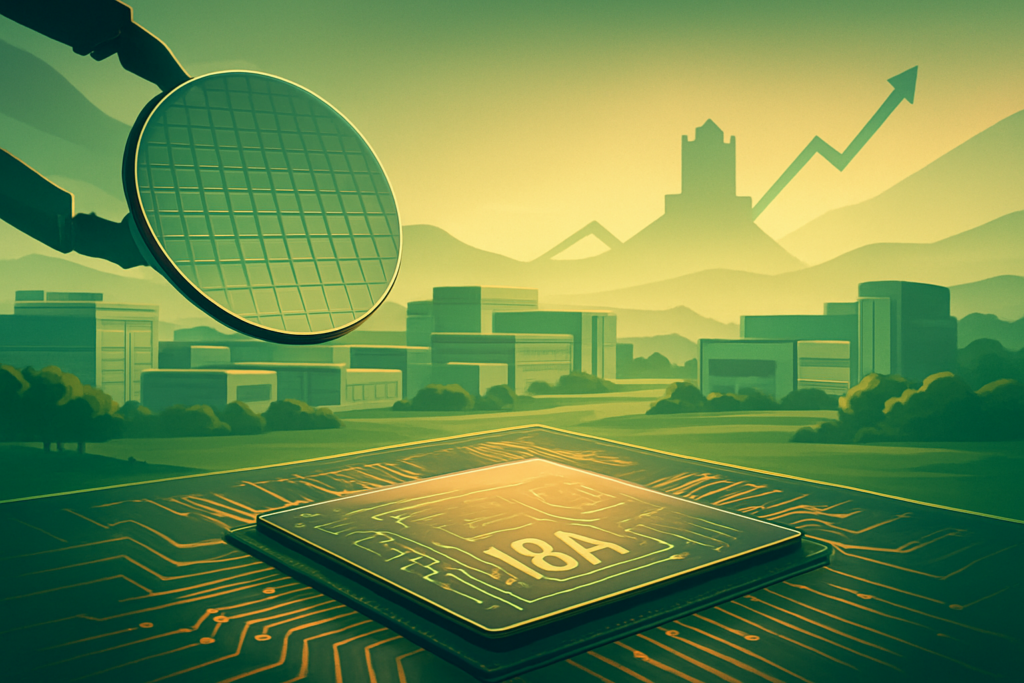
The "Star of the Show" in 2026 is the Intel 18A process. This node introduces two revolutionary technologies: PowerVia (backside power delivery) and RibbonFET (gate-all-around transistors).
- Panther Lake (Core Ultra Series 3): Launched in early 2026, these are the first consumer chips on 18A. They target the "AI PC" segment, promising 50% better multi-threaded performance and a massive leap in NPU (Neural Processing Unit) capabilities to handle local AI tasks.
- Clearwater Forest: The 2026 flagship for data centers, featuring 288 efficiency cores. It aims to reclaim the power-efficiency crown from AMD’s EPYC line, specifically for cloud-native workloads.
- Intel Foundry Services (IFS): Intel has secured "anchor customers" in Microsoft and AWS, who are utilizing 18A for their custom internal AI silicon.
Competitive Landscape
Intel faces a three-front war:
- Against AMD: AMD’s Zen 6 "Morpheus" architecture remains a formidable threat. AMD has captured nearly 30% of the server market as of early 2025, and Intel’s Xeon 6+ ramp is a defensive necessity to prevent that number from hitting 40%.
- Against NVIDIA: In the AI data center, Intel’s Gaudi 3 and follow-on "Falcon Shores" GPU are struggling to gain oxygen against NVIDIA’s newly shipping Rubin architecture.
- Against ARM-based Rivals: Qualcomm (Nasdaq: QCOM) and Apple (Nasdaq: AAPL) have successfully moved the laptop market toward ARM architecture. The Snapdragon X2 Elite, released in late 2025, poses a direct threat to Intel's mobile dominance by offering superior battery life.
Industry and Market Trends
The "AI PC" is the dominant trend of 2026. Gartner estimates that over 50% of all PCs shipped this year will be AI-capable. Intel is leaning heavily into this cycle, hoping it triggers a "refresh supercycle" similar to the mid-2000s. Additionally, the "geographical de-risking" of the supply chain is a massive tailwind. As companies seek alternatives to Taiwan-only manufacturing due to geopolitical tensions, Intel’s US and European fabs are becoming strategic assets.
Risks and Challenges
- Execution Risk: Ramping 18A to high yields (70%+) is non-negotiable. Any delay or yield "hiccup" in 2026 would be catastrophic for investor trust.
- Foundry Losses: The Foundry unit is currently losing billions of dollars annually as it builds out capacity. Investors must have the stomach for these "J-curve" losses.
- ARM on Windows: If Microsoft’s Windows-on-ARM ecosystem continues to improve, Intel’s x86 "moat" in the consumer space could evaporate.
Opportunities and Catalysts
- 14A Momentum: While 18A is the current focus, early test results for the 14A (1.4nm) node in late 2026 could signal whether Intel can actually surpass TSMC by 2027.
- Advanced Packaging: Intel’s Foveros packaging technology is being used by third parties (potentially even NVIDIA) as an alternative to TSMC’s capacity-constrained CoWoS. This "packaging-as-a-service" could be a multi-billion dollar revenue sleeper.
- M&A Potential: With a stabilized stock price, Intel may look to acquire smaller AI software or interconnect companies to bolster its data center ecosystem.
Investor Sentiment and Analyst Coverage
Wall Street remains cautious but intrigued. The consensus rating is a "Hold," with price targets ranging from $35 to $60. Institutional ownership has stabilized after a flight to quality in 2024. Hedge funds have begun "long-short" plays, often longing Intel as a recovery bet against a potentially overvalued NVIDIA. Retail sentiment on platforms like X (formerly Twitter) and Reddit remains polarized between "Intel bulls" who see a once-in-a-generation turnaround and "bears" who view it as a value trap.
Regulatory, Policy, and Geopolitical Factors
Intel is the primary beneficiary of the US CHIPS and Science Act. With $8.5 billion in direct grants and $11 billion in low-interest loans, the US government has effectively tied its domestic semiconductor ambitions to Intel’s success. Furthermore, the "Secure Enclave" program provides Intel with a steady stream of high-margin defense contracts. However, ongoing export restrictions to China remain a headwind, as China historically represented 25% of Intel’s revenue.
Conclusion
As of March 2026, Intel Corporation is no longer the "broken" company of 2024, but it is not yet the champion of the 1990s. The 18A process node is a technical triumph that has brought Intel back to "process parity" with the best in the world. However, the path to financial dominance remains obscured by high capital costs and a relentless competitive environment.
For the long-term investor, Intel represents a bet on the "American Silicon Renaissance." If the company can successfully transition its Foundry business to profitability and hold the line against AMD in the server room, the current valuation may look like a bargain by the end of the decade. For the cautious observer, the mantra remains: "Trust, but verify the yields."
This content is intended for informational purposes only and is not financial advice