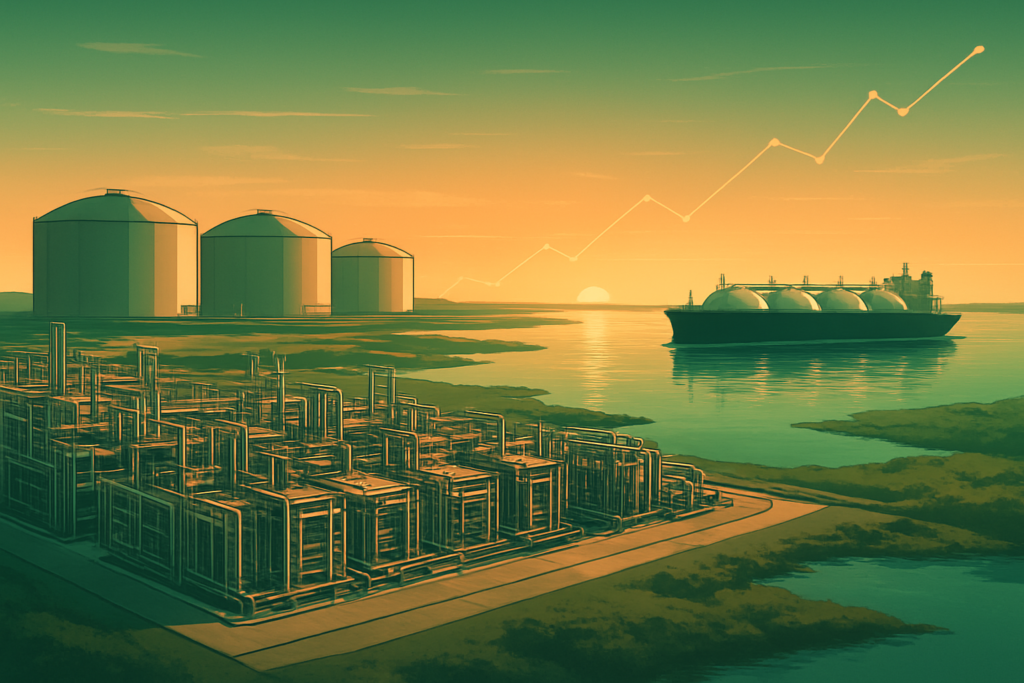
As of March 19, 2026, the global energy landscape has undergone a tectonic shift, driven by a new generation of American infrastructure titans. At the center of this transformation is Venture Global, Inc. (NYSE: VG), a company that has moved from a disruptive startup to a pillar of the U.S. "Energy Dominance" strategy in less than a decade. Following its blockbuster 2025 initial public offering, Venture Global has become a lightning rod for both investor enthusiasm and legal controversy, marking it as one of the most watched tickers on the New York Stock Exchange.
Introduction
Venture Global, Inc. (NYSE: VG) currently stands as the second-largest exporter of liquefied natural gas (LNG) in the United States, trailing only the industry pioneer Cheniere Energy (NYSE: LNG). In early 2026, the company is in focus for two primary reasons: its aggressive expansion of the massive CP2 LNG project in Louisiana and its recent, high-stakes legal victories against European energy majors like Shell and Repsol.
Operating in a world still grappling with the volatility of the mid-2020s energy crisis, Venture Global has positioned itself as the "fast-fashion" equivalent of the energy world—using a modular, factory-built construction model to bring massive gas liquefaction facilities online faster than any competitor in history. With the recent federal pivot toward accelerated energy exports, VG has become a core proxy for the U.S. natural gas bull case.
Historical Background
Founded in 2013 by Michael Sabel, a former investment banker, and Bob Pender, a high-stakes finance lawyer, Venture Global began as an industry outsider. At the time, the LNG sector was dominated by "supermajors" who built massive, bespoke facilities that frequently ran billions of dollars over budget and years behind schedule.
Sabel and Pender’s thesis was radical: treat LNG plants like manufactured goods. By partnering with Baker Hughes (NASDAQ: BKR) to create standardized, mid-scale liquefaction "trains" built in a factory and shipped to the site, Venture Global promised to slash capital costs and construction timelines.
The company’s first project, Calcasieu Pass, reached a Final Investment Decision (FID) in 2019 and began exports in record time. However, the "VG" ticker itself has a storied history; it was formerly the home of Vonage Holdings Corp before that company was acquired by Ericsson (NASDAQ: ERIC) in 2022. Venture Global reclaimed the two-letter symbol for its own public debut in January 2025, signaling its arrival as a permanent fixture of the American industrial complex.
Business Model
Venture Global’s business model is a blend of low-cost manufacturing and high-risk commodity trading. The company’s revenue is generated primarily through:
- Long-Term Sales and Purchase Agreements (SPAs): The backbone of the company’s financing involves 20-year contracts with global utilities and energy firms (e.g., CP2 has agreements with Chevron, EnBW, and Securing Energy for Europe).
- Spot Market Optimization: Unlike many peers who contract 90% of their capacity, Venture Global has historically kept a significant portion (roughly 20-30%) of its cargo capacity uncontracted. This allows the company to sell directly into the global spot market, reaping massive windfalls when global prices spike.
- Vertical Integration: By owning its own pipeline infrastructure (the Blackfin pipeline) and a growing fleet of LNG tankers (including the Venture Gator), the company captures margins across the entire value chain—from the wellhead to the overseas regasification terminal.
Stock Performance Overview
Since its IPO on January 24, 2025, VG stock has been a study in volatility.
- Initial Debut: The company went public at $25.00 per share, valuing it at approximately $66 billion.
- The 2025 Slump: Within six months, the stock tumbled nearly 50%, reaching a low of $11.40 by October 2025. This was driven by investor anxiety over a "wall of litigation" from European customers and high interest rates affecting its massive debt-service costs.
- Recent Recovery: As of March 19, 2026, the stock has rallied to $13.27. This recent 16% climb follows a crucial New York Supreme Court ruling in early March that dismissed a major challenge from Shell, alongside the announcement of a successful $8.6 billion financing round for Phase 2 of the CP2 project.
While the stock remains well below its IPO price, the upward momentum in early 2026 suggests that the "legal overhang" is finally beginning to lift.
Financial Performance
Venture Global’s 2025 fiscal year was a period of explosive top-line growth. The company reported $13.8 billion in revenue, a staggering 177% increase over 2024, largely due to the ramp-up of the Plaquemines LNG facility.
- Net Income: 2025 net income stood at $2.3 billion, though margins were squeezed by legal fees and higher-than-expected maintenance costs at the early-stage Calcasieu Pass facility.
- EBITDA: Adjusted EBITDA for 2025 was $6.3 billion. Management has guided for $8.0 billion in 2026 as Plaquemines Phase 1 reaches full commercial operation.
- Debt Profile: The company’s growth is fueled by leverage. As of early 2026, Venture Global has facilitated over $95 billion in capital market transactions to fund its three major projects. While the debt is project-level and non-recourse, the sheer scale of the interest payments remains a focal point for analysts.
Leadership and Management
Venture Global is an intensely founder-led organization. Michael Sabel serves as CEO and Executive Chairman, maintaining a reputation for being one of the most aggressive and litigious executives in the energy sector.
The company employs a dual-class share structure. Sabel and the founders hold Class B shares that carry 10 votes each, giving them nearly 98% of the total voting power. While this allows for rapid decision-making and a long-term strategic focus, it has led to some pushback from institutional investors who prefer standard corporate governance. Sabel’s strategy has consistently prioritized growth and spot-market profits over diplomatic relations with legacy European energy majors.
Products, Services, and Innovations
The core "product" is U.S. natural gas, cooled to -260°F and condensed into a liquid for export. However, the company’s competitive edge lies in its modular liquefaction technology.
Working with Baker Hughes, Venture Global uses mid-scale electric-motor-driven compressors. These units are more efficient and have a smaller environmental footprint than traditional gas-turbine-driven units. Furthermore, the company is innovating in the "Green LNG" space:
- Carbon Capture: The company is deploying Carbon Capture and Sequestration (CCS) at all its facilities, aiming to compress and inject CO2 into deep saline aquifers.
- Fleet Modernization: Its new fleet of vessels uses the latest "Mega" (M-type, Electronically Controlled, Gas Injection) engines, which significantly reduce methane slip during transport.
Competitive Landscape
Venture Global competes in an elite circle of global energy providers:
- Cheniere Energy (NYSE: LNG): The "Gold Standard" of the industry. Cheniere has a more conservative balance sheet and a better relationship with European regulators.
- Sempra (NYSE: SRE): Through its Sempra Infrastructure arm, it is a major competitor in the Gulf Coast and Pacific export markets.
- QatarEnergy: The state-owned giant of Qatar remains the low-cost leader globally, currently undergoing its own massive "North Field" expansion.
Venture Global’s "edge" is speed. While a traditional Sempra or Qatar project might take 5–7 years to move from FID to first gas, Venture Global has proven it can move in nearly half that time.
Industry and Market Trends
The "Golden Age of Gas" has been extended by several macro drivers in 2026:
- AI Power Demand: The massive expansion of AI data centers in the U.S. and Europe has kept domestic gas prices resilient, but the real prize remains the international spread (arbitrage) between U.S. Henry Hub prices and European/Asian benchmarks.
- Coal-to-Gas Switching: As nations in Southeast Asia (Vietnam, Philippines) move away from coal to meet 2030 climate goals, demand for reliable U.S. LNG has reached new heights.
- Geopolitical Security: Following the continued instability in the Middle East through 2025, U.S. LNG is increasingly viewed by the G7 as a "security of supply" necessity rather than just a commodity.
Risks and Challenges
Despite its growth, Venture Global faces significant headwinds:
- The "Commissioning Gas" Dispute: The company spent years selling "commissioning" gas from its first plant on the spot market while telling contract customers the plant wasn't ready. While it won recent rounds against Shell, it lost a $1 billion arbitration case to BP in late 2025. Future payouts could impact liquidity.
- Interest Rate Sensitivity: With tens of billions in project debt, a "higher for longer" rate environment in 2026 could severely eat into net income.
- Environmental Litigation: Though the "LNG Pause" was lifted by executive order in 2025, environmental groups continue to challenge CP2’s permits in federal court, citing impacts on local wetlands and global emissions.
Opportunities and Catalysts
- CP2 Full Commissioning: The Phase 2 FID reached on March 13, 2026, is a massive catalyst. Once CP2 is fully operational (targeted for late 2027), Venture Global’s total capacity will hit 66 MTPA, potentially making it the largest exporter in the world.
- Index Inclusion: As a relatively new large-cap stock, VG is a prime candidate for inclusion in the S&P 500 later in 2026 or 2027, which would trigger significant institutional buying.
- Delta LNG FID: The company’s next project, Delta LNG, is expected to reach a final investment decision by late 2026.
Investor Sentiment and Analyst Coverage
Wall Street remains divided on VG. Analysts at Goldman Sachs and Morgan Stanley have maintained "Buy" ratings, citing the company’s unparalleled growth profile and the strategic reversal of the LNG export pause. However, some "Value" oriented analysts remain "Neutral," wary of the founder-controlled governance and the aggressive accounting related to commissioning revenues.
Retail sentiment is cautiously optimistic, with many "bottom-fishers" entering the stock after it held the $11 support level in late 2025. The consensus view is that VG is a "high-beta" play on the LNG sector—offering more upside than Cheniere, but with significantly more legal and financial risk.
Regulatory, Policy, and Geopolitical Factors
The regulatory environment turned sharply in Venture Global’s favor in early 2025. The current administration’s "Energy Dominance" executive orders have streamlined the Department of Energy (DOE) permitting process.
On March 13, 2026, Secretary of Energy Chris Wright issued a series of authorizations allowing Venture Global to expand its export volumes to non-Free Trade Agreement nations. This policy shift effectively nullified the 2024 "LNG pause" and has cleared the way for the $20 billion CP2 project to proceed without the previous administration's climate-test hurdles.
Conclusion
Venture Global (NYSE: VG) is the quintessential "disruptor" in a sector known for its inertia. By 2026, it has proven that its modular construction model works and that it can navigate the most complex financing and legal challenges in the energy world.
For investors, the case for VG is a play on the permanence of natural gas in the global energy transition. While the company’s aggressive tactics have made it enemies in European boardrooms, they have also made it a massive cash-flow engine. The stock’s recent rally from its post-IPO lows suggests that the market is beginning to price in a future where Venture Global isn't just a participant in the LNG market—it is the market leader. Investors should watch the final damages ruling in the BP arbitration case and the construction milestones of CP2 Phase 2 as the primary indicators for the remainder of 2026.
This content is intended for informational purposes only and is not financial advice.