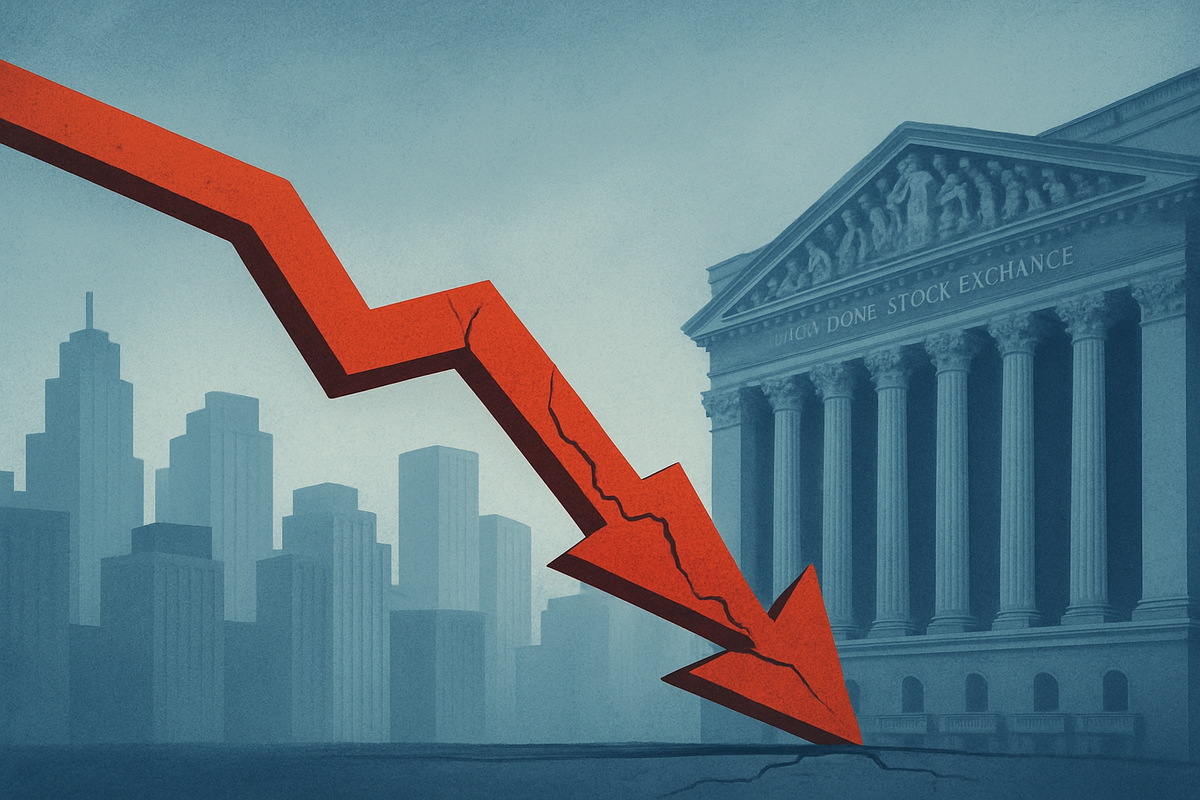
The Dow Jones Industrial Average (DJIA) finds itself at a critical juncture in December 2025, having recently scaled unprecedented heights only to face a sudden downdraft that has investors questioning the market's resilience. While the year has largely been characterized by bullish sentiment and record-setting closes, recent economic data and simmering concerns about overvaluation and specific sector vulnerabilities are casting a long shadow, prompting whispers of a potential "historic loss" that could redefine the current bull run. This delicate balance between robust performance and underlying fragility sets the stage for a period of heightened scrutiny and potential volatility.
The immediate implications are significant, as a substantial market correction or a prolonged downturn would not only erode investor wealth but also signal deeper structural issues within the economy. Public companies, particularly those within the bellwether index, face increased pressure to justify their valuations and demonstrate sustainable growth amidst a backdrop of rising interest rates, mixed labor market signals, and persistent inflationary pressures. The coming weeks and months will be crucial in determining whether the recent dips are merely a healthy correction or the harbinger of a more profound shift in market dynamics.
Unpacking the Market's Uneasy Ascent: Record Highs Meet Sudden Dips
The narrative of the Dow Jones Industrial Average in 2025 has been one of remarkable ascent, culminating in a record high of 48,458.05 points on December 12, 2025. This peak underscored a year of overall positive performance, with year-to-date returns ranging from approximately 2.29% to 13.9%. However, the market's celebratory mood was swiftly tempered by a series of pullbacks in the days immediately following this milestone. On December 15, the Dow edged down 0.1% to 48,416.56 points, followed by a more significant slide on December 16, dropping 0.5% (around 220 points) or even 0.9% (over 400 points) to approximately 48,048, as investors grappled with a barrage of mixed economic data.
This sudden shift from record highs to notable declines highlights a growing "intramarket divergence," a phenomenon where different indices within the same asset class move in opposing directions. While the Dow posted its highest weekly close on record, gaining 1.05% (503 points) for the week ending December 14, 2025, both the S&P 500 and Nasdaq experienced declines during the same period. Such divergence is often interpreted by analysts as a signal of important turning points, indicating underlying tensions despite headline strength.
A critical timeline of events leading up to this moment includes the Federal Reserve's decision to cut its benchmark interest rate three times in 2025, bringing the Federal Funds target range to 3.50%–3.75% by December. This easing policy, primarily driven by concerns about the labor market, has generally been supportive of equity markets. However, the November nonfarm payrolls report, released on December 16, 2025, painted a complex picture: 64,000 jobs were added (above expectations), but the unemployment rate surprisingly rose to 4.6%, its highest level since July 2021. This mixed data, coupled with S&P Global's "flash" indices showing a dip in both service and manufacturing companies in December, suggests a cooling economy at year-end, impacted by rising prices attributed to new tariffs and softer sales.
Key players in this unfolding scenario include the Federal Reserve, whose future rate decisions remain a subject of intense debate, and major technology companies whose valuations have been heavily scrutinized amidst fears of an "AI bubble." Initial market reactions have seen significant sell-offs in certain technology shares, notably Broadcom (NASDAQ: AVGO) and Oracle (NYSE: ORCL), following disappointing earnings or outlooks. This has prompted a rotation of capital into more cyclical and defensive stocks, as investors seek safer havens. Despite these concerns, the "buying the dip" strategy has largely been rewarded throughout 2025, creating a complex psychological dynamic where investors are hesitant to abandon a strategy that has historically paid off, even as warning signs proliferate.
Companies on the Brink: Winners and Losers in a Volatile Market
A significant downturn in the Dow Jones Industrial Average would inevitably create a clear delineation between winning and losing companies, driven by their underlying fundamentals, sector exposure, and ability to navigate economic headwinds. Companies with strong balance sheets, diversified revenue streams, and essential services are likely to fare better, while highly leveraged firms, those in discretionary sectors, or those with speculative valuations face considerable risk.
In a scenario leading to a "historic loss," the primary losers would likely be the high-growth technology companies that have seen their valuations soar on the back of artificial intelligence (AI) enthusiasm. While not all are Dow components, a broader tech correction would ripple through the market. Within the Dow, companies like Microsoft (NASDAQ: MSFT) and Apple (NASDAQ: AAPL), despite their robust fundamentals, could experience significant corrections if the "AI bubble" fears materialize or if consumer spending on high-tech devices softens. Companies heavily reliant on advertising revenue or discretionary consumer spending, such as Salesforce (NYSE: CRM) or Nike (NYSE: NKE), could also see their earnings pressured as economic activity "sags." Industrials and financial institutions, while benefiting from an initial rotation out of tech, could face headwinds if a recessionary environment takes hold, impacting lending and manufacturing output. For instance, Boeing (NYSE: BA) could see order slowdowns, and JPMorgan Chase (NYSE: JPM) might face increased loan defaults.
Conversely, companies traditionally considered defensive plays or those in sectors less susceptible to economic cycles might emerge as relative winners. Consumer staples giants like Procter & Gamble (NYSE: PG) and Coca-Cola (NYSE: KO) often demonstrate resilience during downturns as demand for their essential products remains relatively stable. Healthcare companies, such as Johnson & Johnson (NYSE: JNJ) and UnitedHealth Group (NYSE: UNH), also tend to be defensive, as healthcare spending is less discretionary. Furthermore, utilities and certain industrial stalwarts with stable dividends and strong cash flows, like Chevron (NYSE: CVX) or Caterpillar (NYSE: CAT), could attract investors seeking safety and income. The rotation out of high-growth tech into these value-oriented and defensive sectors suggests that while the overall market may suffer, these companies could see their relative performance improve, potentially even attracting new capital as investors de-risk their portfolios.
Broader Implications: Echoes of the Past and Future Uncertainties
The potential for a "historic loss" in the Dow Jones Industrial Average extends far beyond mere stock price movements, carrying wider significance for the global economy, regulatory frameworks, and societal confidence. This event, if it materializes, would fit into broader industry trends marked by unprecedented technological innovation (particularly AI), geopolitical tensions, and a complex monetary policy environment. The current concerns about an "AI bubble" and market overvaluation echo the dot-com boom and bust of 1999-2000, where speculative enthusiasm led to unsustainable valuations and a subsequent painful correction.
The ripple effects of a significant market downturn would be widespread. Competitors and partners across various industries would feel the squeeze, as reduced consumer and corporate spending impacts supply chains and demand. Smaller businesses, often reliant on credit and robust economic activity, would be particularly vulnerable. The bond market would likely see increased demand for safe-haven assets like U.S. Treasuries, potentially driving yields down in the short term, though persistent inflation concerns could complicate this dynamic. Internationally, a U.S. market correction could trigger global financial instability, given the interconnectedness of modern markets.
Regulatory and policy implications are also profound. The Federal Reserve, already navigating a delicate balance between inflation control and employment targets, would face immense pressure to intervene, potentially through further interest rate cuts or quantitative easing measures, though the effectiveness of such tools might be diminished if confidence is severely eroded. The impact of tariffs, which S&P Global suggests are contributing to rising prices and softer sales, could prompt policymakers to re-evaluate trade strategies. Historically, major market corrections have often led to increased regulatory scrutiny and reforms aimed at preventing future excesses, as seen after the 2008 financial crisis. The prospect of the Fed having to navigate "stagflation" – high inflation coupled with rising unemployment – further complicates policy responses, as remedies for one issue could exacerbate the other.
Comparing the current environment to historical precedents, the high valuations in the broader S&P 500, similar to the pre-dot-com bust era, serve as a stark warning. While the underlying economic structure and technological drivers are different, the psychology of speculative investment and the potential for a sharp re-evaluation of asset prices remain consistent themes throughout market history. The divergence between the Dow's performance and that of the S&P 500 and Nasdaq could also be reminiscent of periods preceding significant market shifts, where leadership narrows before a broader correction.
The Road Ahead: Navigating Uncertainty and Strategic Shifts
Looking ahead, the Dow Jones Industrial Average faces a range of short-term and long-term possibilities, each with significant implications for investors and public companies. In the short term, the market could continue to experience heightened volatility, characterized by sharp daily swings as investors react to incoming economic data, corporate earnings reports, and geopolitical developments. A further correction from recent highs is a distinct possibility, especially if the "AI bubble" deflates more rapidly or if the labor market continues to show signs of weakening alongside persistent inflation.
However, the long-term outlook remains complex. While a "historic loss" suggests a prolonged downturn, the market's capacity for recovery should not be underestimated. If underlying economic fundamentals remain sound and corporate earnings eventually rebound, a recovery could materialize, albeit potentially after a painful period of adjustment. Strategic pivots will be essential for companies. Those with strong balance sheets may use a downturn as an opportunity for strategic acquisitions or to invest in innovation at lower costs. Others may need to focus on cost-cutting, efficiency improvements, and shoring up their liquidity.
Market opportunities and challenges will emerge from this environment. For savvy investors, a significant correction could present opportunities to acquire high-quality companies at more attractive valuations, especially in sectors that have been unfairly punished. Conversely, the challenge lies in identifying these undervalued assets amidst widespread panic and avoiding "value traps" – companies that appear cheap but have deteriorating fundamentals. Potential scenarios range from a sharp but brief "V-shaped" recovery, to a more prolonged "L-shaped" stagnation, or a "U-shaped" recovery characterized by a gradual rebound. The likelihood of each scenario will depend heavily on the Federal Reserve's actions, the trajectory of inflation and employment, and the resolution of geopolitical tensions. Investors should prepare for a period where active management and careful stock selection become more critical than ever.
A Crucial Juncture: Key Takeaways and Investor Vigilance
The current state of the Dow Jones Industrial Average represents a crucial juncture for the financial markets, characterized by a delicate balance between past triumphs and looming uncertainties. The key takeaway is that while 2025 has seen the Dow achieve remarkable record highs, the underlying market conditions are fraught with mixed signals. Recent pullbacks, coupled with concerns over high valuations, an "AI bubble," a cooling labor market, and the impact of tariffs on economic activity, suggest that the path forward will be anything but smooth. The "intramarket divergence," where the Dow's strength contrasts with weakness in other major indices, serves as a potent warning sign that a broader market re-evaluation might be underway.
Moving forward, the market is likely to remain highly sensitive to economic data and policy decisions. Investors should assess the market with a cautious yet strategic mindset. The prospect of a "historic loss," while not a universally predicted outcome, highlights the need for vigilance and a robust investment strategy. Companies with strong fundamentals, diversified revenue streams, and defensive characteristics are likely to weather potential storms better than highly speculative or overvalued entities. The rotation of capital into more stable sectors is a trend to watch closely.
In the coming months, investors should particularly watch for further guidance from the Federal Reserve regarding interest rate policy, the evolution of inflation and unemployment figures, and any developments related to trade policies and geopolitical risks. Corporate earnings reports will also be critical indicators of business health and future outlooks. Diversification, a long-term perspective, and a willingness to adapt to changing market conditions will be paramount. This period underscores that while markets can reach extraordinary heights, they are also susceptible to significant corrections, and understanding the underlying forces at play is essential for navigating the complexities of modern finance.
This content is intended for informational purposes only and is not financial advice