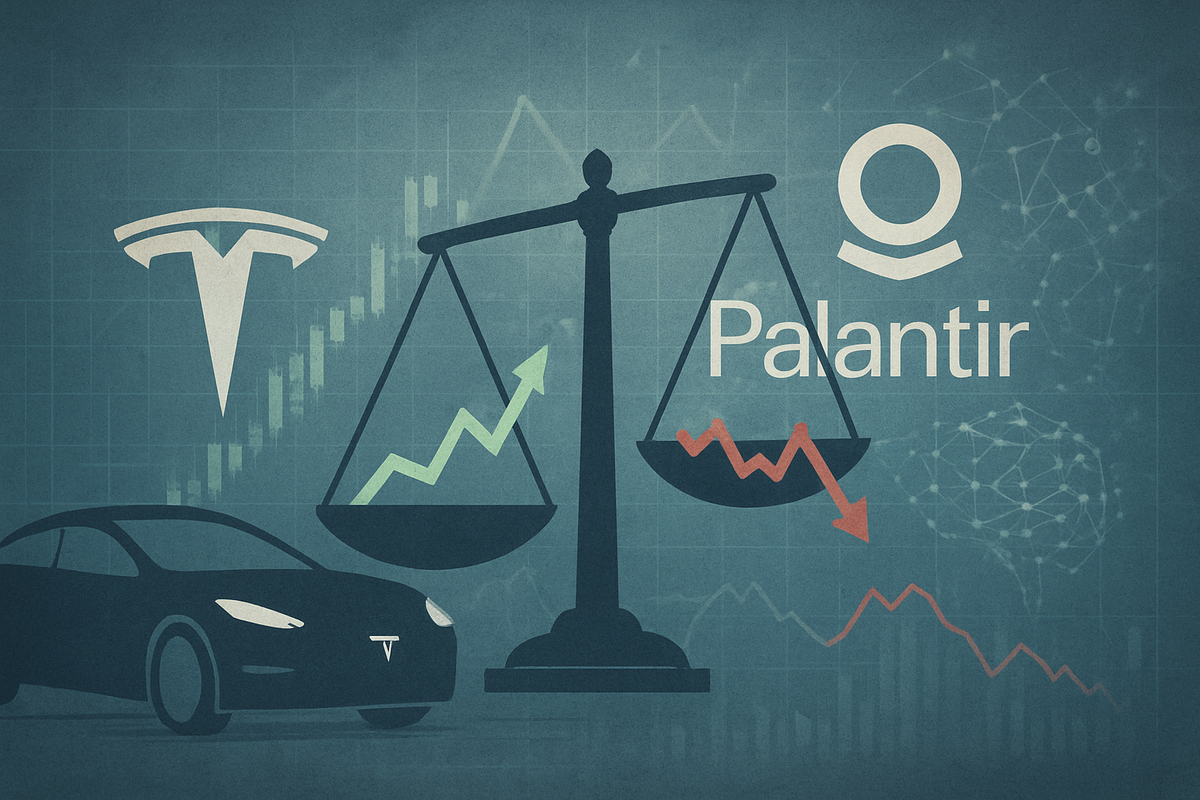
As December 16, 2025, unfolds, two prominent names in the big tech and growth sectors, Tesla (NASDAQ: TSLA) and Palantir Technologies (NYSE: PLTR), find themselves at a crucial juncture. Despite both companies boasting impressive year-to-date gains, their recent stock performance reflects a broader market recalibration, where investor sentiment is increasingly scrutinizing high valuations and demanding clearer paths to sustainable profitability. While Tesla has recently seen a significant rally driven by its AI ambitions, Palantir, after an explosive year, has experienced a slight pullback from its peak, signaling a cooling in the speculative fervor that has characterized parts of the technology sector.
The immediate implications for the broader market are a noticeable shift in leadership and a heightened focus on fundamental value over sheer growth potential. A "Great Rotation" of capital appears to be underway, with investors moving away from potentially overvalued tech and AI segments towards more stable, value-oriented sectors. This dynamic suggests a challenging environment for companies whose valuations are largely predicated on future growth rather than current earnings, prompting a re-evaluation of investment strategies across the board.
Unpacking the Performance: AI Aspirations Meet Valuation Realities
The recent trajectory of Tesla and Palantir stocks paints a complex picture of innovation, market enthusiasm, and underlying concerns. Both companies have been beneficiaries of the intense interest in artificial intelligence, yet they are now grappling with investor demands for tangible returns and sustainable business models.
Tesla (NASDAQ: TSLA) shares, trading around $475.31 as of December 16, 2025, have shown remarkable resilience, recovering significantly after a nearly 50% drop earlier in the year and even briefly touching an all-time high. This late-2025 surge, contributing to a year-to-date gain of over 25%, is largely attributed not to its traditional electric vehicle (EV) business—which has faced headwinds such as slowing global sales growth and increased competition from manufacturers like BYD—but rather to growing investor excitement for its ventures into AI, robotics, and automation. A key catalyst in December was CEO Elon Musk's confirmation of testing fully driverless robotaxis in Austin without human occupants, alongside the November approval of his substantial compensation package. However, the company's Q3 2025 earnings, reported on October 22, revealed a 12% year-over-year revenue growth to $28.1 billion but missed analyst EPS estimates, with net income falling 37%. Analysts maintain a "Hold" rating, with a median one-year price target of $386.42, indicating potential downside from current levels, and its exceptionally high price-to-earnings (P/E) ratio of approximately 300 raises significant valuation questions.
Palantir Technologies (NYSE: PLTR) has also had an explosive year, with its stock surging an impressive 141-144% year-to-date as of December 16, 2025. The company hit a 52-week high of $207.52 on November 3, 2025, following strong Q3 2025 results that saw revenue of $1.2 billion (up 62.8% year-over-year) and adjusted EPS of $0.21, both surpassing expectations. Its success in securing high-value government and commercial AI contracts, including a renewed three-year contract with France's DGSI on December 15, has been a significant driver. The launch of its Palantir AI Platform (AIP) is also seen as a key growth engine. However, the stock has slipped about 11.7% from its November peak, trading around $183.25. This pullback, despite robust fundamentals, stems from significant valuation concerns. Its price-to-sales (P/S) ratio of 119 and forward P/E ratio of 251 are considered "absurdly high" by many, suggesting that much of its rapid growth potential is already priced in. Analysts generally hold a "Hold" rating, with average price targets indicating limited further upside or even a potential "sharp valuation reset."
The broader market context is one of "conflicting signals." While the S&P 500, Nasdaq, and Dow Jones Industrial Average have seen record highs, driven by resilient corporate earnings and enthusiasm for AI, a "significant and decisive downward move" in the technology-heavy Nasdaq Composite occurred in early to mid-December 2025. This slump, fueled by "AI bubble" fears and disappointing earnings from some major tech players, saw highly speculative AI stocks facing severe corrections of 30-50%, underscoring a market demand for "tangible returns" and "sustainable business models" over "growth at all costs."
Winners and Losers in a Shifting Landscape
The current market dynamics, characterized by a cooling of speculative growth and a pivot towards value, will inevitably create a new hierarchy of winners and losers across various industries. Companies with strong fundamentals, clear profitability, and reasonable valuations are poised to gain, while those relying heavily on future potential and high-growth narratives may face continued pressure.
Companies that might win from this environment are typically those in more traditional, value-oriented sectors, or tech companies with proven, consistent profitability and less speculative valuations. For instance, established industrial giants, consumer staples companies, and certain financial institutions could see increased investor interest as capital rotates out of high-growth tech. Within the technology sector, companies demonstrating clear and immediate monetization strategies for AI, rather than just aspirational projects, might be favored. Businesses with strong free cash flow, consistent dividend payouts, and a history of navigating economic uncertainties could also become more attractive. Furthermore, competitors in the EV space that offer more cost-effective solutions or have a stronger global manufacturing footprint, potentially benefiting from Tesla's challenges in its core automotive segment, could see an advantage. Similarly, enterprise software companies with diverse client bases and less government-dependent revenue streams might offer a more stable alternative to Palantir's concentrated growth.
Conversely, companies that might lose or face continued headwinds are primarily those with stretched valuations and business models heavily reliant on aggressive future growth projections. This includes many smaller, highly speculative AI startups that lack a clear path to profitability, as well as segments of the software-as-a-service (SaaS) industry where growth has slowed but valuations remain elevated. Companies in nascent or highly competitive sectors, such as certain niches within renewable energy or emerging tech, could also struggle to attract capital. For Tesla, increased competition in the EV market, particularly from cost-efficient Chinese manufacturers, could erode market share and put further pressure on margins. For Palantir, while its government contracts are robust, over-reliance on a few large clients and the inherent lumpiness of such deals could expose it to volatility if the market continues to demand more diversified and predictable revenue streams. Any company that has been swept up in the broader "AI bubble" narrative without the underlying financial strength to justify its valuation could experience further corrections.
Wider Significance: A Reassessment of Tech's Future
The current market recalibration, evident in the performance of Tesla and Palantir, signifies a broader re-evaluation of the technology sector's future and its role within the global economy. This shift extends beyond individual stock movements, touching on industry trends, regulatory considerations, and historical parallels.
This event fits into broader industry trends by marking a potential maturation of the "growth at all costs" era for tech companies. For years, investors prioritized rapid expansion and market dominance, often overlooking profitability. However, the current environment suggests a return to more traditional valuation metrics, where earnings, cash flow, and sustainable business models are paramount. This trend could lead to a more disciplined approach to capital allocation within the tech sector, potentially slowing down the pace of highly speculative ventures and encouraging a focus on proven technologies and revenue generation. The "AI bubble" fears, specifically, highlight concerns about the widespread adoption of AI without a clear understanding of its immediate monetization potential for all players.
The ripple effects on competitors and partners are substantial. For the EV industry, Tesla's challenges in its core automotive business, coupled with increasing competition, could intensify pricing wars and force other manufacturers to innovate more rapidly in terms of cost-efficiency and battery technology. Partners relying on Tesla's dominant market position might need to diversify their client base. In the data analytics and AI software space, Palantir's high valuation scrutiny could prompt other AI solution providers to clearly articulate their value proposition and demonstrate tangible ROI for clients, rather than relying solely on the promise of AI transformation. This could also lead to consolidation in the AI software market as smaller, less profitable players struggle to compete.
Regulatory or policy implications are also at play. The ongoing "Trump-era tariff uncertainties" and new trade policy concerns, while their direct impact on inflation has been lower than predicted, continue to create volatility for global companies like Tesla. Furthermore, as AI becomes more pervasive, regulatory bodies worldwide are likely to increase scrutiny on data privacy, algorithmic bias, and the ethical deployment of AI, potentially impacting companies like Palantir that deal with sensitive government and commercial data. The push for "tangible returns" could also influence government funding for AI research and development, prioritizing projects with clear societal or economic benefits.
Historically, this period bears resemblance to previous tech market corrections, such as the dot-com bubble burst in the early 2000s. In those instances, speculative enthusiasm for nascent technologies led to inflated valuations, followed by a sharp correction when profitability failed to materialize quickly enough. While the current situation is not a direct parallel, the underlying theme of investor skepticism towards speculative growth and a flight to quality is a recurring motif in financial history. The "Great Rotation" towards value stocks also echoes past cycles where market leadership shifted from growth to value during periods of economic uncertainty or rising interest rates.
What Comes Next: Navigating the New Normal
The path forward for Tesla, Palantir, and the broader tech market will be defined by how companies adapt to this new environment of increased scrutiny and how economic factors continue to evolve. Both short-term adjustments and long-term strategic pivots will be crucial for sustained success.
In the short term, we can anticipate continued volatility in the tech sector, particularly for companies with high valuations and less predictable earnings. Investors will likely prioritize companies with strong balance sheets, consistent profitability, and clear strategies for monetizing their AI investments. For Tesla (NASDAQ: TSLA), the focus will be on the successful rollout of its robotaxi service and demonstrating tangible progress in its AI and robotics divisions to justify its lofty valuation, while also addressing the competitive pressures and demand fluctuations in its core EV business. For Palantir (NYSE: PLTR), maintaining its strong government contract momentum and expanding its commercial client base will be key, alongside demonstrating efficient cost management to improve its profitability metrics and justify its high price-to-sales ratio.
Long-term possibilities include a more mature and rational tech market where innovation is still rewarded, but with a greater emphasis on sustainable growth and profitability. This could lead to a wave of consolidation in the AI sector, as smaller players are acquired by larger, more established companies looking to integrate cutting-edge AI capabilities. Potential strategic pivots for companies like Tesla might involve a greater focus on recurring revenue streams from software and services, rather than solely relying on vehicle sales. Palantir might seek to diversify its revenue base further, reducing its reliance on large government contracts and expanding its footprint in new commercial sectors.
Market opportunities or challenges that may emerge include a renewed focus on fundamental analysis and due diligence by investors. Companies that can clearly articulate their competitive advantages, market share, and profitability pathways will attract capital. Challenges will include navigating a potentially slower growth environment for some tech segments and managing investor expectations amidst ongoing economic uncertainties, such as inflation and interest rate policies. The anticipated gradual Fed rate cuts in December 2025 and into 2026, aiming for a federal funds rate around 3% by the end of 2026, could provide a more supportive environment for equities generally, but the market will remain discerning.
Potential scenarios and outcomes range from a continued "soft landing" for the broader economy, allowing for moderate equity growth with increased sector rotation, to a more pronounced tech sector correction if "AI bubble" fears intensify or economic growth falters unexpectedly. The outcome will largely depend on corporate earnings performance, the pace of inflation moderation, and the Federal Reserve's monetary policy decisions.
Comprehensive Wrap-up: A New Era of Discerning Investment
The recent performance of Tesla and Palantir stocks serves as a potent microcosm of the broader shifts occurring in the financial markets as 2025 draws to a close. The era of unbridled enthusiasm for growth at any cost, particularly in the tech and AI sectors, appears to be yielding to a more discerning investment landscape.
Key takeaways from this event include the growing skepticism towards extremely high valuations, even for innovative companies. Investors are increasingly demanding tangible returns, clear paths to profitability, and sustainable business models over aspirational narratives. The "AI bubble" fears underscore a market-wide recalibration, where the promise of AI must be substantiated with concrete monetization strategies. The "Great Rotation" of capital from high-growth tech to more stable, value-oriented sectors is a significant trend that is reshaping market leadership.
Moving forward, the market is likely to remain dynamic and selective. While the overall outlook for U.S. equities remains generally positive due to anticipated moderate economic growth, easing inflation, and gradual Fed rate cuts, increased volatility and more modest gains are expected. This environment will reward prudent investment strategies focused on diversification and fundamental analysis.
The lasting impact of this period will likely be a more mature and rational approach to investing in technology. Companies will be pressured to demonstrate not just innovation, but also financial discipline and clear value creation. What investors should watch for in the coming months includes further clarity on corporate earnings, particularly from tech giants; the Federal Reserve's continued stance on interest rates and inflation; and any new regulatory developments impacting the AI and EV sectors. The ability of companies like Tesla and Palantir to adapt their strategies, manage investor expectations, and deliver consistent, profitable growth will be paramount in navigating this evolving market landscape.
This content is intended for informational purposes only and is not financial advice