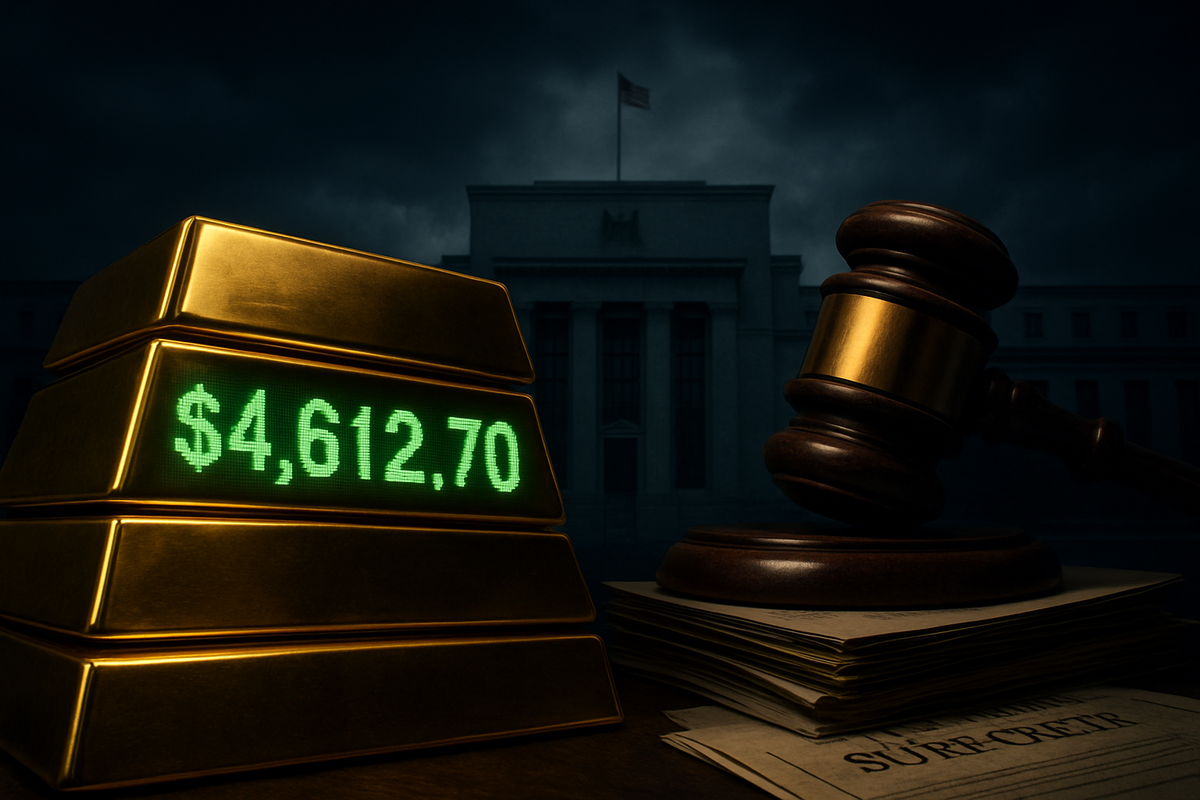
In a historic session that has sent shockwaves through global financial centers, gold prices surged to an all-time record high of $4,612.70 per ounce on January 12, 2026. The move marks a definitive "flight to safety" as investors panic-sell equities in response to a burgeoning constitutional crisis involving a Department of Justice (DOJ) criminal probe into the Federal Reserve and its Chairman, Jerome Powell.
The unprecedented rally in bullion comes as the U.S. Dollar Index (DXY) plummeted to a multi-decade low, reflecting a sudden and sharp erosion of confidence in American monetary institutions. With political uncertainty reaching a fever pitch and the DOJ serving grand jury subpoenas to the nation's central bank, the traditional "Buy America" sentiment has rapidly shifted toward a "Sell America" defensive posture, favoring hard assets over paper wealth.
The Federal Reserve Under Fire: Subpoenas and Scandals
The immediate catalyst for the market's turmoil was the public disclosure on January 11, 2026, that the DOJ has initiated a criminal investigation into the Federal Reserve. The probe centers on allegations of perjury and financial mismanagement regarding the renovation of the Fed’s Washington D.C. headquarters. What began as a budgetary dispute over costs ballooning from $1.9 billion to $2.5 billion has evolved into a full-scale legal assault, with prosecutors investigating whether Chairman Powell intentionally misled Congress about the project's scope and expenditures.
This legal escalation follows months of intensifying friction between the Fed and the executive branch. Throughout late 2025, the administration exerted public pressure on the central bank to implement aggressive interest rate cuts to sustain the equity rally. Chairman Powell, however, has characterized the DOJ probe as a "pretext" for political retribution, suggesting that the threat of criminal charges is a direct consequence of the Fed’s commitment to maintaining its institutional independence. This perceived weaponization of the justice system against the central bank has triggered what many analysts are calling a "constitutional crisis" for the U.S. financial system.
The timeline of the surge began in early January, as rumors of the subpoenas began to circulate among high-frequency traders. By the time the news was confirmed on Sunday evening, gold futures had already gapped up significantly. On the morning of January 12, spot gold prices hit the record peak of $4,612.70, representing a staggering 65% gain since the beginning of 2025. The market reaction was swift: while gold soared, Dow Jones Industrial Average and S&P 500 futures slipped as traders moved billions of dollars out of broad-market ETFs and into precious metals.
Winners and Losers in the Great Recalibration
The primary beneficiaries of this market upheaval are the major gold producers and exchange-traded funds. Newmont Corporation (NYSE: NEM) saw its stock price cross the psychological $100 mark for the first time, as it is increasingly viewed as the primary vehicle for institutional gold leverage. Similarly, Barrick Gold (NYSE: GOLD) jumped nearly 3% on the day, bringing its year-over-year gains to an eye-watering 195%. Other mining giants like Agnico Eagle Mines (NYSE: AEM) and Harmony Gold Mining Company (NYSE: HMY) also hit new 52-week highs, with Harmony surging 7.6% in a single session as investors sought out low-cost producers capable of reaping massive margins at $4,600 gold.
Conversely, the banking and financial sectors are bearing the brunt of the volatility. Major institutions such as JPMorgan Chase & Co. (NYSE: JPM) and Citigroup Inc. (NYSE: C) fell between 3% and 4% as the stability of the U.S. monetary framework was called into question. The sector was further hammered by a simultaneous administration proposal to cap credit card interest rates at 10%, which sent shares of consumer lenders like Synchrony Financial (NYSE: SYF) and Capital One Financial (NYSE: COF) into a tailspin, with both companies seeing double-digit percentage declines.
The technology sector, which had previously driven the Dow toward the 49,000 mark earlier in the month, also faced significant headwinds. High-growth names like Nvidia Corporation (NASDAQ: NVDA) saw increased selling pressure as the rising "political risk premium" forced a re-evaluation of valuation multiples. For many investors, the rotation out of the SPDR S&P 500 ETF Trust (NYSEARCA: SPY) and into the SPDR Gold Shares (NYSEARCA: GLD) has become the defining trade of early 2026.
A Global Shift Toward Hard Assets
The surge in gold is not merely a domestic phenomenon but fits into a broader global trend of "de-dollarization" and geopolitical instability. The capture of Venezuelan President Nicolás Maduro by U.S. forces on January 3, 2026, and the subsequent U.S. control over Venezuelan territory have severely strained relations with China and Russia, leading to fears of a fragmented global trade system. Furthermore, violent protests in Iran and the threat of U.S. military strikes have created an "energy supply squeeze" fear that historically drives investors toward bullion.
Historically, gold has served as the ultimate hedge against institutional failure. The current DOJ probe into the Fed draws comparisons to the 1970s inflationary crisis and the 2008 financial collapse, yet the "constitutional" nature of this event is unprecedented. Unlike previous cycles where the Fed was the solution to market instability, the central bank itself is now the source of the uncertainty. This has led to a massive influx of capital from international central banks, which are diversifying their reserves away from the U.S. Treasury market at the fastest pace in decades.
The regulatory implications are equally profound. If the DOJ probe results in the removal or resignation of Chairman Powell, the market faces the prospect of a "politicized" Fed. Such a shift would likely lead to permanent changes in how the U.S. dollar is perceived as a global reserve currency, potentially cementing gold’s role as the primary anchor of value in a multipolar world.
The Road Ahead: $5,000 Gold and Beyond?
In the short term, the market is bracing for further volatility as the legal battle between the Fed and the DOJ unfolds. Analysts at HSBC have already raised their 2026 gold targets, suggesting that if the political deadlock continues, gold could test the $5,000 per ounce level before the end of the second quarter. Investors should expect a period of "headline risk," where every development in the DOJ investigation translates into immediate swings in the price of bullion and the value of the dollar.
Long-term, the strategic pivot toward hard assets may require a permanent adaptation in portfolio construction. The "60/40" stock-bond model is under immense pressure as both equities and fixed income face risks from institutional instability. Market participants may need to consider a more significant permanent allocation to precious metals and mining equities to hedge against a potential long-term decline in the U.S. dollar's hegemony.
Final Assessment: A New Era of Risk
The events of January 12, 2026, represent a watershed moment for global finance. The convergence of a record-breaking gold price and a criminal probe into the world’s most powerful central bank marks the end of an era of perceived institutional stability. The "Great Recalibration" of capital into safe-haven assets is a clear signal that the market no longer views the U.S. financial system as an unshakeable fortress.
Moving forward, the primary metric for investors will be the integrity of the Federal Reserve's independence. Any further signs of executive overreach or successful DOJ prosecution could trigger a more profound exodus from U.S. assets. For the coming months, the focus will remain squarely on the "gold-to-equity" ratio and the ongoing developments in the DOJ’s case against the Fed. In this new landscape, gold is no longer just a commodity; it is a barometer of trust in the very foundations of the global economy.
This content is intended for informational purposes only and is not financial advice.