Wall Street drifted into negative territory on Wednesday morning, January 14, 2026, as investors grappled with a "mixed bag" start to the fourth-quarter earnings season from the nation’s largest lenders. The mood on the floor of the New York Stock Exchange was decidedly cautious, with the S&P 500 (^GSPC) retreating from record highs established just 24 hours prior. A combination of cautious guidance from banking executives and delayed economic data has left market participants questioning the sustainability of the early-year rally.
The primary catalysts for the morning slide were underwhelming outlooks from the banking sector and a long-awaited batch of inflation data that arrived hotter than anticipated. While the major indexes saw slight recoveries in midday trading, the Dow Jones Industrial Average (DJIA) bore the brunt of the selling pressure, weighed down by financial heavyweights struggling to convince shareholders that the high-interest-rate environment continues to be a tailwind.
A Volatile Morning for the Major Indexes
The trading session began with a sharp downward bias as the market reacted to the first major wave of corporate earnings for 2026. By mid-morning, the S&P 500 (NYSEARCA: SPY) fell 0.2% to 6,963.74, while the Dow Jones Industrial Average dropped nearly 400 points, or 0.8%, to 49,191.99. The Nasdaq Composite (NASDAQ: QQQ) showed more resilience, slipping only 0.1% to 23,709.87, buoyed by a slight rotation back into mega-cap technology names as yields fluctuated.
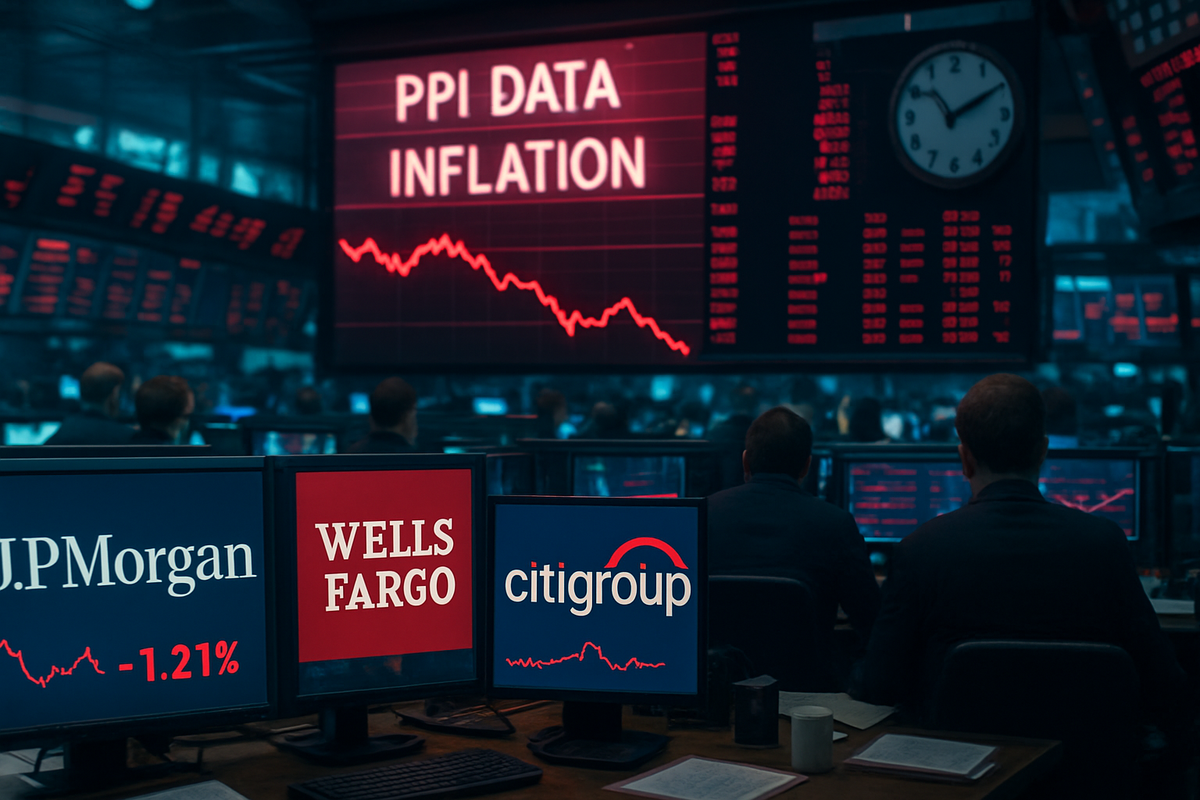
This volatility follows a turbulent period for the U.S. government, which recently emerged from a record-breaking 43-day shutdown in late 2025. The shutdown effectively "blinded" investors for weeks, and today’s release of the delayed November 2025 Producer Price Index (PPI) served as a stark reminder of the underlying inflationary pressures still present in the economy. The PPI rose 0.2% for the month, but the year-over-year figure clocked in at 3.0%, surpassing the 2.7% consensus estimate.
Key players in the morning’s narrative included the "Big Three" banks—JPMorgan Chase & Co. (NYSE: JPM), Wells Fargo & Company (NYSE: WFC), and Citigroup Inc. (NYSE: C)—all of which reported results that failed to ignite a broader market rally. Despite some bottom-line beats, the focus of the analyst calls shifted toward compressed net interest margins and rising credit card delinquencies, sparking a sector-wide sell-off in financials.
The initial market reaction was further complicated by political noise. Investors are currently weighing a Department of Justice investigation into Federal Reserve Chair Jerome Powell, which has introduced a "political risk premium" into the bond market. The 10-year Treasury yield climbed toward 4.17% in response, adding pressure to interest-rate-sensitive sectors.
The Financial Sector: Winners and Losers
JPMorgan Chase & Co. (NYSE: JPM) found itself at the center of the storm. Despite reporting an adjusted earnings per share (EPS) of $5.23—well above the $5.01 analyst forecast—shares fell more than 4% as the bank warned of potential impacts from proposed credit card interest rate caps. CEO Jamie Dimon’s cautious tone regarding the 2026 Net Interest Income (NII) projection of $103 billion suggested that the "golden era" of banking profits might be plateauing.
Wells Fargo & Company (NYSE: WFC) also struggled, with its shares slipping approximately 2% after reporting a revenue miss of $21.29 billion against a $21.60 billion forecast. The bank’s NII of $12.33 billion came in soft, and its 2026 projection of $50 billion was slightly below the market’s appetite. Meanwhile, Citigroup Inc. (NYSE: C) posted a complicated quarter; while it beat EPS estimates at $1.81, it suffered a $1.2B pre-tax loss related to the sale of its Russia unit, leaving investors uncertain about the progress of its ongoing restructuring.
Conversely, some "winners" emerged in the retail and consumer discretionary sectors. Amazon.com, Inc. (NASDAQ: AMZN) and Walmart Inc. (NYSE: WMT) saw modest gains following a surprising 0.6% jump in retail sales for November (released today due to the shutdown). This suggests that despite the 3.0% wholesale inflation rate, the American consumer remains remarkably resilient. This resilience is a double-edged sword, however, as it may force the Federal Reserve to keep interest rates higher for longer.
Other potential losers include mid-tier regional banks, which often follow the lead of the money-center giants. The SPDR S&P Regional Banking ETF (NYSEARCA: KRE) saw a synchronized dip as investors worried that if the giants are seeing margin compression, the smaller players with less diversified revenue streams may face even steeper challenges in the months ahead.
Inflation and the "Shadow Chair" Effect
The broader significance of today’s market action lies in the collision of delayed fiscal data and forward-looking monetary policy. The 3.0% year-over-year PPI print is a clear signal that the "last mile" of the inflation fight is proving to be the most difficult. For the Federal Reserve, this data complicates the narrative of a "soft landing." Most analysts now expect the Fed to hold rates steady at the January 28 meeting, with the probability of a rate cut pushed further into the second half of 2026.
This environment is uniquely defined by the "Shadow Chair" dynamic. With Jerome Powell’s term set to expire in May 2026 and a pending DOJ investigation, the market is pricing in significant uncertainty regarding central bank independence. Historically, Wall Street loathes uncertainty, and the prospect of a politically influenced Federal Reserve has caused a noticeable shift in how traders value long-dated Treasuries and bank stocks.
Furthermore, the introduction of the "One Big Beautiful Bill" (OBBB) stimulus package—set to inject $150 billion into the economy this year—creates a fiscal-monetary tug-of-war. While the stimulus supports consumer giants like Target Corporation (NYSE: TGT), it simultaneously fuels the very inflation the Fed is trying to tame. This policy mismatch is a recurring theme in 2026, echoing the stagflationary concerns of the 1970s, albeit with a much stronger labor market.
The ripple effects of today's slide extend to international partners as well. With the U.S. dollar remaining strong due to "sticky" inflation, emerging markets are feeling the pinch of debt-servicing costs. Investors are increasingly looking at the "U.S. Exceptionalism" trade with skepticism, wondering if the domestic market can continue to decouple from a slowing global economy.
The Road Ahead: PPI, Retail Sales, and the Fed
Looking forward, the short-term trajectory of the market will be dictated by the remainder of the bank earnings and the clarification of the inflation outlook. Investors will be keeping a close eye on Bank of America Corporation (NYSE: BAC) and Goldman Sachs Group, Inc. (NYSE: GS) when they report later this week. If these institutions echo JPMorgan’s cautious guidance, the financial sector could see its worst month in over a year.
The "strategic pivot" for many firms in 2026 will likely involve aggressive cost-cutting to preserve margins as NII fades. We may see an increase in automation investments across the banking and retail sectors to offset persistent labor costs and wholesale price increases. For investors, the challenge will be identifying companies with enough pricing power to pass on the 3.0% PPI increases to consumers without stifling demand.
Potential scenarios for the next quarter range from a continued "grind higher" if earnings growth manages to outpace inflation, to a more significant correction if the Fed adopts a more hawkish tone in late January. The "One Big Beautiful Bill" stimulus may provide a floor for the market, but the "ceiling" is currently being lowered by the reality of stubborn inflation and political instability.
Summary and Investor Takeaways
The mid-morning slide on January 14, 2026, serves as a reality check for a market that had perhaps grown too optimistic about the end of the inflation cycle. The key takeaway is that while the consumer is still spending, the engines of the financial sector are beginning to show signs of fatigue under the weight of high rates and regulatory uncertainty.
Moving forward, the market appears to be transitioning from a "growth-at-any-price" phase into a "show-me" phase, where actual guidance and margin sustainability carry more weight than simple earnings beats. Investors should brace for continued volatility as the "political risk premium" remains embedded in asset prices leading up to the Fed leadership transition in May.
In the coming months, the most critical indicators to watch will be the "Core PPI" trends and the Fed's commentary regarding the OBBB stimulus impact. For now, the "wait-and-see" approach adopted by many institutional traders this morning seems to be the most prudent path as the dust settles on a complicated start to the year.
This content is intended for informational purposes only and is not financial advice.