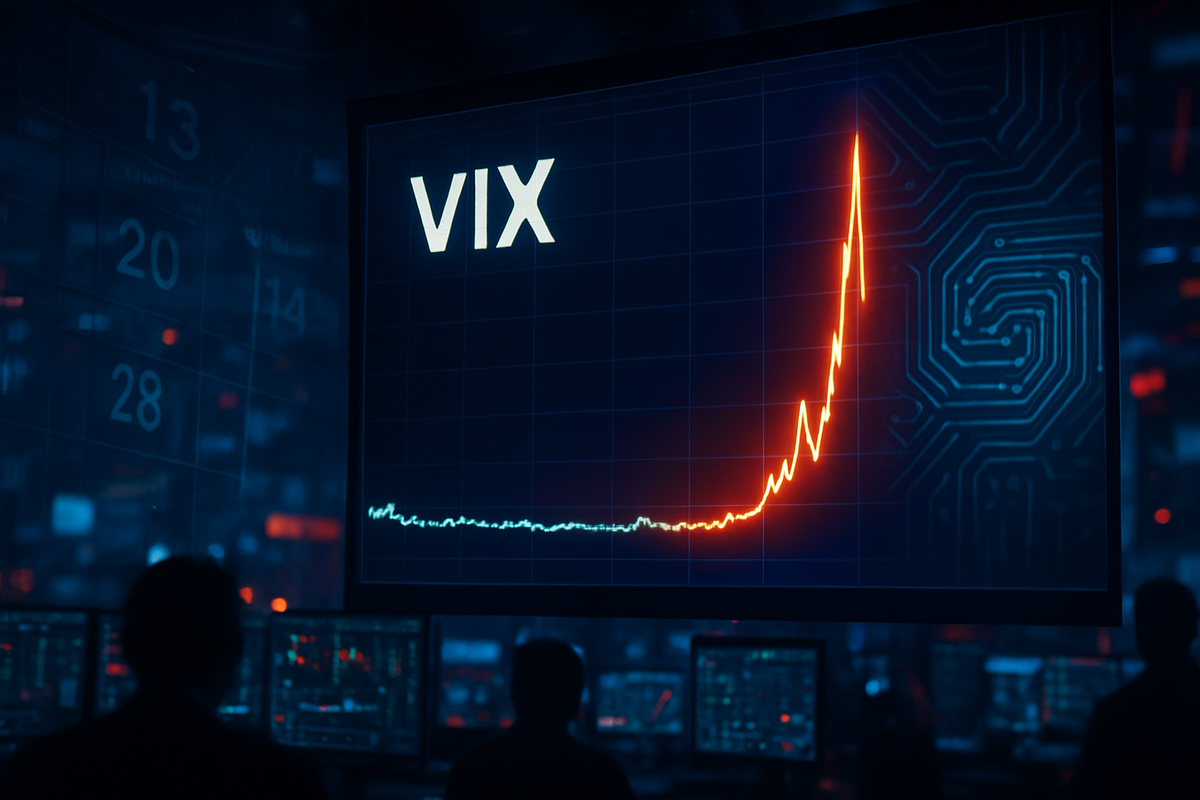
NEW YORK — As of January 15, 2026, the long-standing "volatility vacuum" that has characterized the U.S. equities market for much of the new year has finally met its match. For the first two weeks of January, investors navigated a dense thicket of economic data and geopolitical tension while the CBOE Volatility Index (VIX) remained puzzlingly suppressed, hovering near multi-year lows. That calm was shattered today, as the VIX surged over 15% intraday to reach 22.5 points, triggered by the implementation of aggressive semiconductor tariffs and a brewing legal showdown over the independence of the Federal Reserve.
The divergence between the macro-economic calendar—laden with delayed inflation data, employment reports, and a looming Supreme Court battle—and the "fear gauge" has been the central mystery for Wall Street in 2026. While the VIX’s sudden awakening marks a return to reality, the structural factors that kept it suppressed for so long highlight a fundamental shift in how markets process risk in the era of ultra-short-term options and systematic volatility selling.
The Perfect Storm: A Backlogged Calendar Meets a Policy Shock
The first half of January 2026 has been an exhausting sprint for market participants. The month opened with a "catch-up" data dump necessitated by a federal government shutdown in late 2025. On January 9, the Non-Farm Payrolls (NFP) report showed a resilient labor market with unemployment at 4.6%, followed by a Consumer Price Index (CPI) reading on January 13 that pinned annual inflation at a stubborn 2.7%. However, the real volatility catalyst arrived today, January 15, with the official implementation of a 25% tariff on high-end AI semiconductors under Section 232.
This "Silicon Surcharge" coincided with the escalating legal drama surrounding the Federal Reserve. Reports surfaced around January 10 of a Department of Justice (DOJ) grand jury subpoena for Fed Chair Jerome Powell, ostensibly regarding agency renovation costs, though many in the market view it as political pressure ahead of the January 27–28 FOMC meeting. Despite these massive headlines, the VIX spent most of the last 10 days trapped between 14 and 15, leading many to wonder if the index had become permanently broken. The reaction today, fueled by heavy selling in the tech sector, suggests the "fear gauge" was merely coiled like a spring.
Winners and Losers: The Great AI Pivot
The immediate losers of this January volatility spike are the high-growth semiconductor giants that have dominated the market for years. Nvidia Corp (NASDAQ: NVDA) and Advanced Micro Devices, Inc. (NASDAQ: AMD) saw significant sell-offs as the 25% tariff on advanced AI chips took effect today, marking what analysts call the "end of the cheap AI era." These companies now face a dual threat: increased input costs for domestic hardware and potential retaliation from international trade partners.
Conversely, the "volatility dispersion" trade that suppressed the VIX earlier this month has favored domestic industrials and traditional financial institutions. As capital rotated out of expensive tech, Caterpillar Inc. (NYSE: CAT) and GE Aerospace (NYSE: GE) have seen increased interest from investors seeking "safe haven" domestic manufacturing plays. Similarly, major banks like JPMorgan Chase & Co. (NYSE: JPM) and Wells Fargo & Co. (NYSE: WFC) reported solid Q4 2025 earnings in recent days, benefiting from a higher-for-longer interest rate environment, though their 2026 guidance remains clouded by the uncertainty surrounding the Federal Reserve's leadership.
The Mechanics of Suppression: 0DTE and the Volatility Sink
The primary reason the VIX remained suppressed despite a high-stakes macro calendar lies in the structural evolution of the options market. Zero-days-to-expiration (0DTE) options now account for approximately 59% of all S&P 500 option volume. Because the VIX is calculated using 30-day options, this massive shift toward 0DTEs has created a "volatility sink." Investors are now hedging their macro risks—such as the Jan 13 CPI print—using "instantaneous" protection that expires the same day, which does not register on the VIX.
Furthermore, institutional "short-vol" strategies have become a dominant source of yield in 2026. Many hedge funds and systematic ETFs have been selling volatility premium to harvest "theta" (time decay), effectively acting as a ceiling for the VIX. This trend was further amplified by "volatility dispersion," where the Nasdaq and S&P 500 moved in such a way that their individual components' volatilities canceled each other out at the index level. It took a systemic shock—the combination of semiconductor tariffs and the DOJ’s move against the Fed—to finally break through this mechanical suppression.
The Road Ahead: Supreme Courts and FOMC Stakes
The rest of January promises even higher stakes. On January 21, the Supreme Court is scheduled to hear oral arguments regarding the President's legal authority to remove Federal Reserve governors "at will." This case represents a potential "regime risk" that could fundamentally alter the stability of U.S. monetary policy. If the court signals a shift toward executive control over the Fed, market participants expect a significant risk premium to be permanently baked into both the bond and equity markets.
In the short term, the FOMC meeting on January 27–28 looms large. With the VIX now trading above 20, the Federal Reserve will have to balance its inflation-fighting mandate with a market that is increasingly sensitive to political instability. Traders are currently split on whether the Fed will pause or hike rates to defend the dollar against tariff-induced inflation. Strategic pivots toward "defensive growth" and domestic supply chain stocks appear likely as the market adapts to this new high-volatility regime.
Wrapping Up: A New Era of Realized Risk
The events of mid-January 2026 have effectively ended the era of "engineered calm." The suppression of the VIX through 0DTE options and systematic selling provided a veneer of stability that proved fragile in the face of significant policy and legal shocks. The surge to 22.5 today serves as a reminder that while structural mechanics can delay a market reaction, they cannot eliminate the underlying macro risks.
Moving forward, investors should watch for the Supreme Court’s lean on January 21 and the subsequent Fed rhetoric. The key takeaway for the coming months is that the "VIX at 15" environment is likely a thing of the past. As the January calendar completes its run with the PPI data on January 30, the market will likely be looking for a new "floor" for volatility—one that accounts for a more litigious and protectionist economic landscape.
This content is intended for informational purposes only and is not financial advice