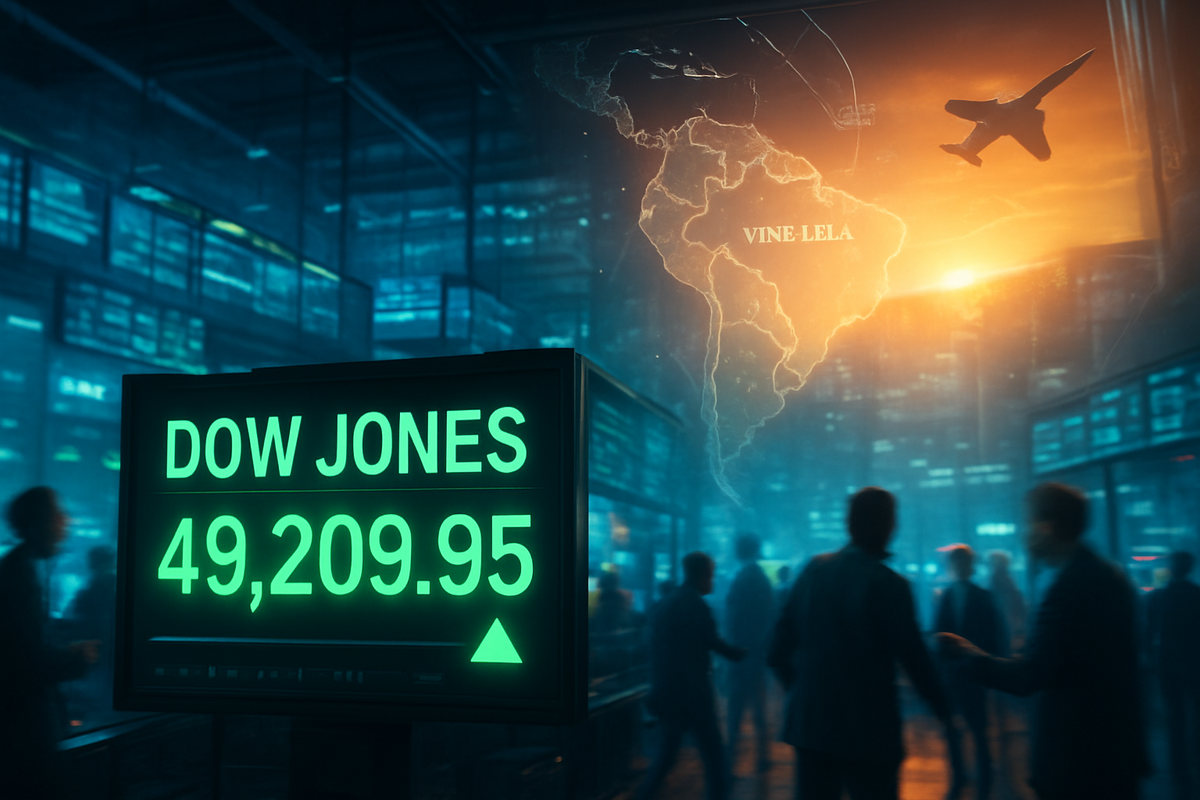
The U.S. financial markets reached unprecedented heights on Monday, January 5, 2026, as investors aggressively priced in a seismic shift in global geopolitics. The Dow Jones Industrial Average (NYSE: DJI) surged to an all-time intraday record of 49,209.95, eventually closing at 48,977.18. This massive rally followed the weekend’s dramatic military intervention in Venezuela, which resulted in the capture and removal of Nicolás Maduro, a development that has effectively promised to reopen the world’s largest proven oil reserves to Western investment.
The market’s "risk-on" appetite was palpable as the opening bell rang, with the blue-chip index gaining approximately 600 points in a single session. While the human and political implications of the military strike continue to unfold, Wall Street has signaled a clear verdict: the potential for a stabilized, U.S.-aligned Venezuela outweighs the immediate risks of regional instability. Analysts suggest that the prospect of "rebuilding" a collapsed nation’s infrastructure has provided the Dow with the momentum needed to eye the psychological 50,000-point milestone.
Operation Absolute Resolve: A Weekend of Fire and Transition
The geopolitical landscape was rewritten in the early hours of Saturday, January 3, 2026. Under the moniker "Operation Absolute Resolve," the United States launched a precision military campaign involving over 150 aircraft and elite special operations units, including Delta Force. The operation targeted critical military infrastructure across northern Venezuela, effectively neutralizing the country’s air defenses and command structures in Caracas and surrounding regions. By sunrise, Nicolás Maduro and his wife, Cilia Flores, had been apprehended at a military base and were being transported to New York City to face federal narco-terrorism charges.
The timeline of the operation was swift, catching many international observers off guard. Following the capture, U.S. Attorney General Pam Bondi announced a superseding indictment in the Southern District of New York, accusing Maduro of orchestrating a decades-long cocaine trafficking scheme. In Caracas, the Venezuelan Supreme Court ordered Vice President Delcy Rodríguez to assume the presidency, though her authority remains contested as U.S. officials, including President Donald Trump, stated that the U.S. would oversee the country’s administration until a "safe and proper transition" could be organized.
Initial market reactions were almost exclusively positive for U.S. equities, particularly in the energy and defense sectors. While oil prices initially spiked on the news of the strikes, they quickly stabilized as traders looked toward a future where Venezuelan crude—long sidelined by sanctions and mismanagement—could flood the market under U.S.-friendly management. The sentiment was bolstered by the absence of an immediate, forceful military response from Maduro’s traditional allies in Moscow and Beijing, allowing domestic investors to focus on the economic windfall of a "post-Maduro" era.
Energy and Defense Giants Lead the Charge
The primary beneficiaries of the weekend’s events were the "supermajors" and oilfield service providers. Chevron (NYSE: CVX), which has maintained a precarious but persistent presence in Venezuela for decades, saw its stock climb nearly 8%, leading the Dow’s energy components. Investors are betting that Chevron will be the primary architect of the Venezuelan oil recovery. Similarly, ConocoPhillips (NYSE: COP) and ExxonMobil (NYSE: XOM) saw gains of 7.5% and 4%, respectively, as the market anticipates a massive redistribution of drilling rights and infrastructure contracts.
The oil services sector experienced even more dramatic volatility. Halliburton (NYSE: HAL) surged 8.5%, reaching a 12-month high on massive trading volume, while SLB (NYSE: SLB) rose nearly 9%. These companies are expected to provide the technical expertise required to modernize Venezuela’s dilapidated refineries and extraction sites. Downstream players like Valero Energy (NYSE: VLO) also benefited, finishing the day up more than 9% on the prospect of cheaper, heavy Venezuelan crude eventually reaching Gulf Coast refineries.
Defense contractors also saw a significant lift as global tensions simmered. While the U.S. operation was brief, it signaled a more interventionist foreign policy that could lead to increased procurement. Lockheed Martin (NYSE: LMT) and Raytheon—now part of RTX Corporation (NYSE: RTX)—saw steady gains. Internationally, the ripple effect was felt by BAE Systems (LSE: BA) and Germany’s Rheinmetall (XETRA: RHM), which jumped 9.4% as European markets anticipated a broader shift in global security spending.
A New Paradigm for Global Energy and Policy
The ousting of Maduro represents more than just a change in leadership; it is a fundamental shift in the global energy map. For the last decade, the "energy transition" has dominated market narratives, but the sudden availability of Venezuelan oil could recalibrate the pace of that transition. By bringing the world’s largest oil reserves back into the Western fold, the U.S. has potentially secured a long-term hedge against OPEC+ production cuts, a move that fits into a broader trend of "energy nationalism" seen throughout 2025.
However, the event carries significant regulatory and policy implications. The U.S. government's stated intent to "run the country" during the transition period raises questions about international law and the potential for long-term military entanglement. This mirrors historical precedents like the 1989 invasion of Panama, but on a much larger and more economically significant scale. Investors are currently weighing the benefits of cheap oil against the risk of a "quagmire" that could eventually drain the federal treasury and spark domestic political backlash.
Furthermore, the reaction of China and Russia remains a critical "known unknown." Both nations have significant outstanding loans and strategic interests in Venezuela. While the markets chose to ignore these tensions on Monday, any move by these powers to challenge U.S. hegemony in the region could lead to a sharp reversal of the current rally. The market is currently operating on the assumption of a "clean break" from the past, but historical comparisons suggest that regime changes of this magnitude are rarely without long-tail complications.
The Road Ahead: Rebuilding and Volatility
In the short term, the market will likely remain focused on the "rebuilding" narrative. We expect to see a flurry of memoranda of understanding (MOUs) and preliminary contracts between the U.S. Department of Energy and major American corporations. The immediate challenge for these companies will be security; operating in a post-conflict zone with lingering pro-Maduro sentiment will require significant private security and insurance costs, which could eat into early profit margins.
Long-term, the strategic pivot for the U.S. will be the establishment of a stable, democratic government in Caracas that can honor new trade agreements. For investors, the opportunity lies in the "normalization" of the Venezuelan economy. Beyond oil, sectors such as telecommunications, banking, and consumer goods could see massive growth if the country’s hyperinflation is finally reined in. However, the possibility of a prolonged insurgency or a diplomatic standoff with the BRICS nations remains the primary "tail risk" that could spark a return to market volatility in the coming months.
Final Assessment: A Landmark Moment for the Dow
The Dow’s climb to nearly 49,000 marks a historic intersection of military power and market optimism. The capture of Nicolás Maduro has removed a long-standing thorn in the side of U.S. foreign policy and opened a door to economic possibilities that were unthinkable just a few years ago. The immediate market reaction suggests that investors believe the rewards of a "liberated" Venezuelan energy sector far outweigh the risks of the military intervention that secured it.
Moving forward, the market’s trajectory will depend on the stability of the transition in Caracas and the U.S. government's ability to manage the geopolitical fallout. Investors should keep a close eye on the energy sector’s quarterly earnings and any shifts in defense spending priorities in the upcoming federal budget. While the record high is a cause for celebration on Wall Street, the lasting impact of Operation Absolute Resolve will be measured not in points on an index, but in the long-term stability of the global energy supply and the success of the Venezuelan reconstruction.
This content is intended for informational purposes only and is not financial advice.