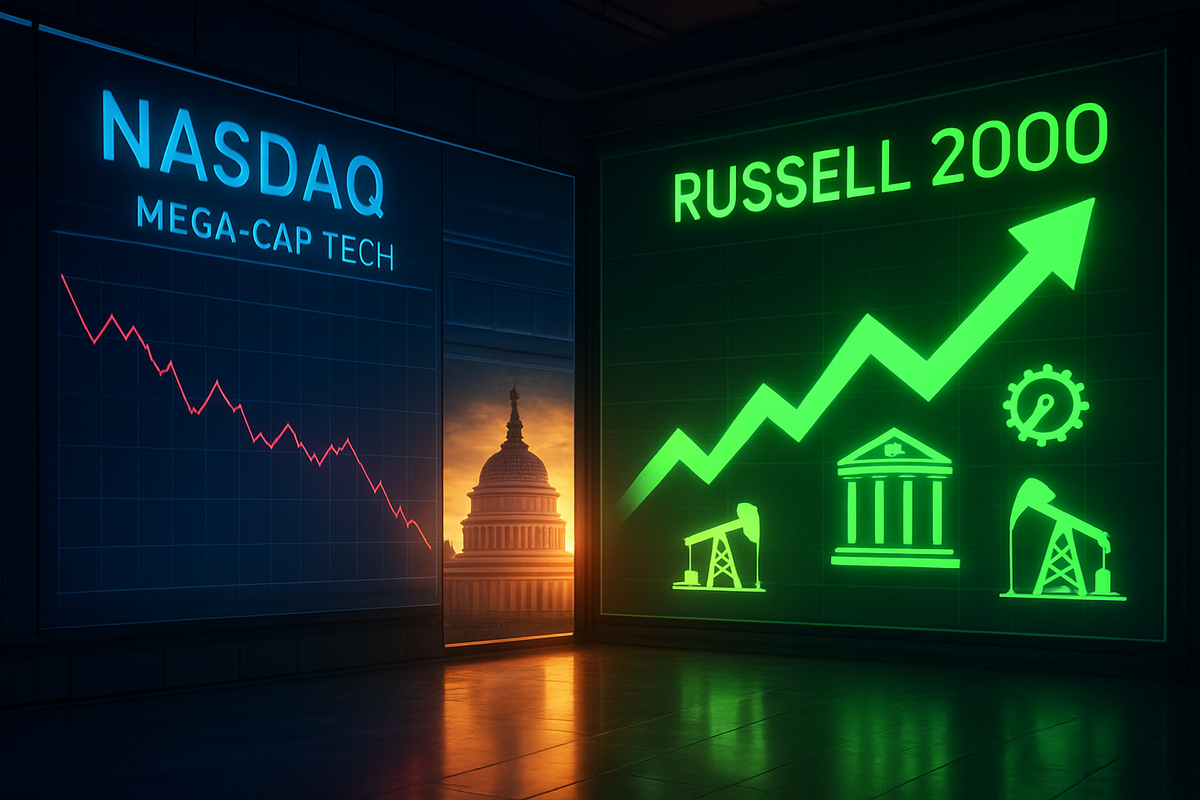
The first two weeks of February 2026 have marked a historic decoupling in the U.S. financial markets, as investors execute a massive "Great Rotation" out of the mega-cap technology giants that dominated the last decade and into the long-neglected domestic small-cap sector. The Russell 2000 Index (IWM) has surged over 8.5% since the start of the month, riding a 15-session outperformance streak against the S&P 500—the longest such run since 1996. Meanwhile, the tech-heavy Nasdaq has remained stubbornly sideways, trapped under the weight of massive capital expenditures and a shifting interest rate regime.
This seismic shift is the direct result of a policy convergence known on trading floors as "Trump Trade 2.0." Driven by a aggressive domestic legislative agenda and the surprise nomination of Kevin Warsh as the next Federal Reserve Chair, the market is pricing in a "Two-Speed Economy." While the "tangible economy" of domestic manufacturing, regional banking, and energy production is accelerating under deregulation and tax incentives, the "virtual economy" of global software and AI hardware is facing a valuation squeeze from rising long-term yields and a strengthening U.S. Dollar.
The Catalysts of Change: OBBBA and the Warsh Shock
The catalyst for this rotation began on January 30, 2026, with the nomination of Kevin Warsh to succeed Jerome Powell as Fed Chair. Dubbed the "Warsh Shock" by analysts, the nomination signaled a move toward a "Monetary Barbell Strategy." Warsh has publicly favored slashing short-term rates to fuel a productivity boom while simultaneously accelerating Quantitative Tightening (QT) to shrink the Fed’s $6.6 trillion balance sheet. This hawkish tilt on the long end of the curve sent the 10-year Treasury yield past the 4.5% mark, immediately punishing high-multiple growth stocks while steepening the yield curve to the benefit of traditional lenders.
Simultaneously, the legislative framework of "Trump Trade 2.0" reached a fever pitch with the passage of the Fair Trade Act of 2026 in the House. This followed the implementation of the "One Big Beautiful Bill Act" (OBBBA) in late 2025, which codified sweeping tax cuts for U.S.-based manufacturers and introduced a new senior deduction that has revitalized domestic consumer staples. These policies have effectively "fenced in" the American economy, creating a protected environment for domestic-only firms that are immune to the retaliatory tariffs and global supply chain disruptions plaguing multinational conglomerates.
The momentum was further fueled by "Liberation Day," a series of legal victories that began in early 2025 and culminated this February in the dismantling of several key environmental and labor mandates. For small-cap companies, which typically lack the massive legal and compliance departments of their larger peers, this "Great Regulatory Purge" has led to an immediate expansion in margins. As a result, for the first time in years, small-cap earnings growth projections for the current quarter have surpassed those of the "Magnificent Seven," forcing institutional funds to chase the rally in the Russell 2000.
Winners and Losers in the New Regime
The primary beneficiaries of this rotation have been firms with a heavy domestic footprint. Regional lenders like Huntington Bancshares (NASDAQ: HBAN) and Zions Bancorporation (NASDAQ: ZION) have seen their shares climb as the steepening yield curve restores net interest margins that were suppressed for years. In the industrial and energy sectors, Caterpillar Inc. (NYSE: CAT) has surged on the back of reshoring demand, while Valaris Ltd (NYSE: VAL) has gained over 38% this month as energy demand spikes amid a deregulated drilling environment. Even domestic consumer plays like Wolverine World Wide (NYSE: WWW) and AI-infrastructure firm Willdan Group (NASDAQ: WLDN) have reported earnings growth that significantly outpaced market expectations.
Conversely, the former "kings of the market" are facing a grueling valuation ceiling. Amazon.com, Inc. (NASDAQ: AMZN) shares fell roughly 7% following reports of a $200 billion AI capital expenditure plan that investors are now viewing with skepticism in a higher-yield environment. Nvidia Corporation (NASDAQ: NVDA) and Microsoft Corporation (NASDAQ: MSFT) have traded sideways, as the "Anthropic Effect"—the rise of efficient AI agents that reduce the need for expensive software seats—begins to cannibalize the growth of traditional Software-as-a-Service (SaaS) providers.
The rotation has also claimed casualties in the healthcare and global logistics sectors. Molina Healthcare, Inc. (NYSE: MOH) experienced a 25% crash after issuing weak guidance linked to changes in federal reimbursement structures and the broader shift away from government-linked growth stories. Investors are increasingly shunning companies that rely on global trade fluidity or high levels of government subsidy, preferring instead the "hard assets" and domestic resilience found in the small-cap industrial and financial sectors.
A Fundamental Restructuring of Market Gravity
The "Great Rotation" of early 2026 is more than a temporary trend; it represents a fundamental restructuring of the market's center of gravity. By shifting from a focus on hyper-globalization to domestic resilience, the market is acknowledging that the era of "easy money" and global tech dominance may be giving way to a more fractured, high-yield environment. This mirrors historical precedents such as the post-1996 period, where value and small caps outshone high-flying tech after a period of extreme concentration, but with the added layer of a highly interventionist "America First" trade policy.
Furthermore, the ripple effects are being felt across global markets. As the U.S. Dollar strengthens due to the "Warsh Doctrine" and attractive domestic yields, emerging markets are seeing a capital flight back to the U.S. This "vacuum effect" reinforces the strength of the Russell 2000, as small-cap domestic firms are the least affected by a strong dollar, while global tech giants see their international revenues diluted. The regulatory shift is also forcing a strategic pivot for many companies, as they move from offshore manufacturing back to the U.S. heartland to qualify for OBBBA tax credits.
The policy implications of this shift are profound. The "Great Regulatory Purge" has effectively created a lower cost of doing business for the "Tangible Economy," which includes materials, mining, and heavy manufacturing. As these sectors begin to contribute a larger share of the S&P 500's total earnings, the index's correlation with the tech sector is beginning to break. This diversification of market drivers may provide a cushion against a potential tech-led correction, though it introduces new risks related to trade volatility and the codification of tariffs into federal law.
Navigating the Warsh Doctrine and Future Risks
Looking ahead, the market must contend with the full implementation of the "Warsh Doctrine" as Kevin Warsh officially takes the helm of the Federal Reserve in May. Short-term, the momentum in small caps appears sustainable as long as domestic earnings continue to exceed the now-lowered bar for the sector. However, a potential strategic pivot may be required if the 10-year yield continues its ascent toward 5%. At that level, even the most resilient domestic industrials could see their borrowing costs begin to eat into the gains provided by deregulation.
There is also the risk of a "policy overshoot." While the "Trump Trade 2.0" has been a boon for domestic companies so far, the Fair Trade Act’s permanent tariff authority could lead to inflationary pressures that the Fed might be forced to combat with even tighter monetary policy. Investors should watch for signs of "cost-push" inflation in the coming months, which could threaten the very small-cap margins that are currently driving the rally. The market is currently in a "Goldilocks" phase for domestic value, but the transition to a high-yield, high-tariff world will likely feature significant volatility.
Summary and Investor Outlook
The market performance in February 2026 has been a masterclass in regime change. The Russell 2000's 8.5% surge is a clear signal that the dominance of the "Magnificent Seven" is being challenged by a resurgent domestic economy. Driven by the "One Big Beautiful Bill Act," sweeping deregulation, and the nomination of a hawkish yet productivity-focused Fed Chair in Kevin Warsh, the "Great Rotation" has favored regional banks, domestic manufacturers, and energy firms over global tech.
As we move forward, investors should keep a close eye on the 10-year Treasury yield and the upcoming Fed transition. The outperformance of small caps (IWM) relative to large-cap tech (QQQ) is likely to remain the defining theme of 2026. The key takeaway for the months ahead is that the "valuation disconnect" is finally closing, and the market is prioritizing "tangible" domestic earnings over "virtual" global growth. Those who remain over-indexed in global tech may find themselves on the wrong side of a historic transition in the American economic landscape.
This content is intended for informational purposes only and is not financial advice.