PALO ALTO, CA — In a startling reversal of fortune for one of the tech sector's most resilient performers, shares of AppLovin Corp (NASDAQ: APP) plummeted 18.3% on February 13, 2026. The sell-off came despite the company reporting quarterly earnings and revenue that significantly surpassed Wall Street’s expectations, marking a rare instance where a "beat-and-raise" report was met with aggressive liquidation from institutional investors.
The sharp decline reflects a deepening anxiety across global markets regarding the long-term defensibility of software platforms in an increasingly crowded artificial intelligence ecosystem. As the "AI winners vs. losers" narrative enters a volatile new chapter, AppLovin—once the poster child for AI-driven growth—has become a flashpoint for fears that the very technology that fueled its rise may now be lowering the barriers to entry for its largest competitors.
The Disconnect: Record Profits Met with a Wall of Selling
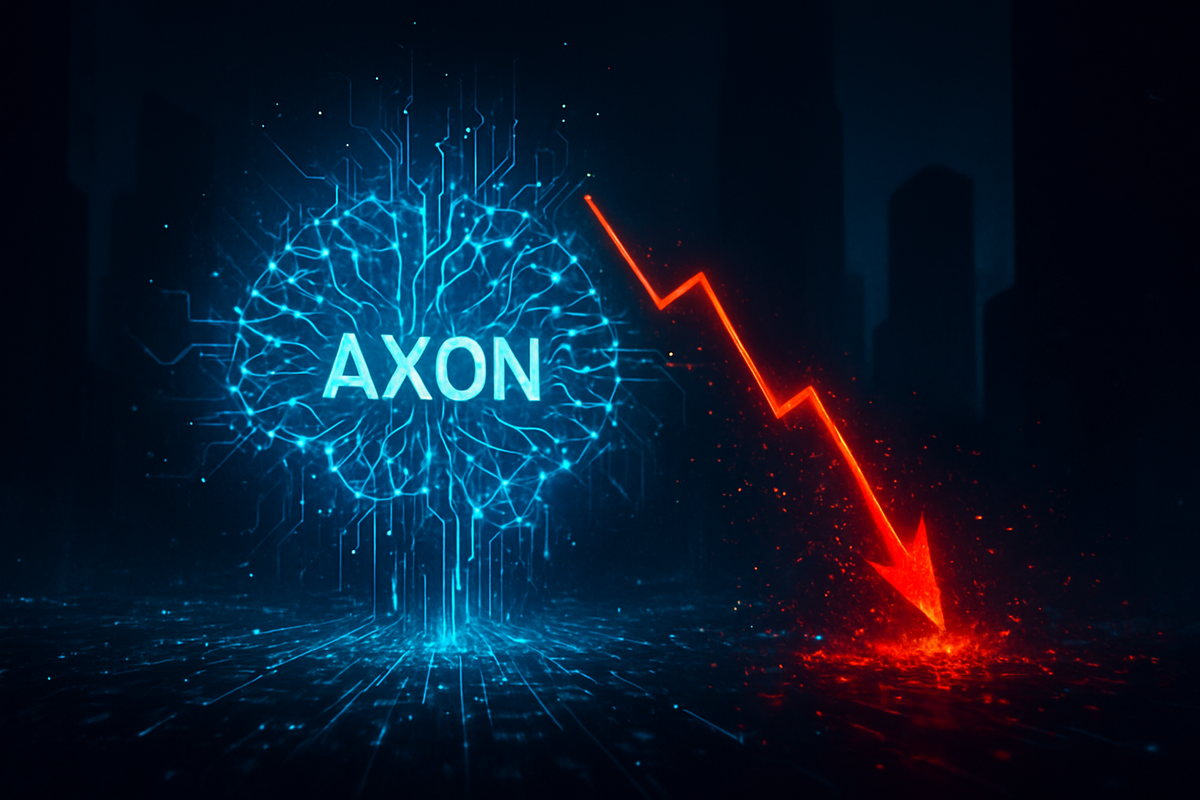
The turmoil began early Friday morning following AppLovin's fourth-quarter 2025 fiscal report. On paper, the numbers were stellar: the company posted revenue of $1.82 billion, a 28% year-over-year increase, driven largely by the continued dominance of its AXON 2.0 AI engine. Net income also reached record highs, with software-side margins hovering near a staggering 82%. However, the stock began its descent during the post-earnings conference call when management provided a cautious outlook on the competitive landscape for the second half of 2026.
The primary catalyst for the 18.3% drop was not the past quarter’s performance, but rather the market’s reaction to increased capital expenditure guidance intended to "defend and extend" the company’s AI lead. Analysts pointed to the rising cost of compute and the narrowing performance gap between AppLovin’s proprietary models and the generic generative AI tools now being deployed at scale by "Magnificent Seven" giants. By mid-day trading, APP had shed over $12 billion in market capitalization, dragging the broader ad-tech sector down in its wake.
Leading up to this moment, AppLovin had enjoyed a multi-year bull run, with its stock price quadrupling since early 2024. The company successfully pivoted from a mobile gaming publisher to a pure-play AI software powerhouse, divesting its legacy gaming studios in 2025 to focus entirely on its AXON ads manager. This singular focus, which was previously hailed as a masterstroke of corporate strategy, is now being scrutinized as a potential vulnerability as the industry moves toward "Total AI Integration."
The AI Divide: Winners, Losers, and the Squeezed Middle
The fallout from AppLovin’s tumble has immediate implications for its peers in the mobile and digital advertising space. Unity Software Inc. (NYSE: U), which has spent the last two years attempting to replicate AppLovin’s AI-first model with its "Vector" platform, saw its shares drop 9% in sympathy. Investors appear concerned that if a high-flyer like AppLovin is feeling the heat, smaller players with lower margins and less sophisticated data flywheels may be even more exposed to a "commodity trap."
On the other side of the ledger, the "AI Winners" are currently seen as those with massive first-party data ecosystems and infinite compute resources. Meta Platforms Inc. (NASDAQ: META) and Alphabet Inc. (NASDAQ: GOOGL) remained relatively stable following the news, as market sentiment shifts toward the belief that these behemoths can integrate AI more cheaply and broadly than niche providers. Meta’s "Advantage+ 3.0" automation suite is increasingly viewed as a direct threat to independent ad-tech platforms, offering similar ROAS (Return on Ad Spend) through sheer scale rather than specialized algorithms.
Independent demand-side platforms like The Trade Desk (NASDAQ: TTD) also find themselves in a complex position. While TTD benefits from its independence and lack of "walled garden" bias, the AppLovin crash suggests that "AI performance" alone is no longer enough to maintain a premium valuation. The market is now rewarding companies that own the "full stack"—the data, the model, and the distribution—leaving mid-sized software firms like Digital Turbine (NASDAQ: APPS) to prove they aren't merely a temporary feature that Big Tech will eventually subsume.
A Wider Significance: The Commoditization of the Algorithm
This event signals a major shift in how the market values AI-centric software. From 2023 to 2025, any company that successfully implemented AI to drive efficiency was rewarded with an "AI Premium." However, by early 2026, the novelty of AI-driven optimization has begun to wear off. The broader industry trend is moving toward the "commoditization of the algorithm," where the underlying technology is no longer the differentiator, but the access to proprietary, high-integrity data is.
Historically, this mirrors the "SaaS Crash" of 2022, where the market realized that while software was eating the world, not all software companies had a sustainable moat. AppLovin’s current predicament draws comparisons to the early days of the cloud computing transition; once every company has "moved to the cloud" (or in this case, "integrated AI"), the competitive advantage returns to the players who control the infrastructure or the end-user relationship.
Furthermore, regulatory pressures are complicating the narrative. As Google and Apple continue to refine their privacy frameworks, the "signal loss" that AppLovin’s AXON 2.0 was designed to circumvent is becoming more expensive to navigate. The 18.3% drop may represent the market’s realization that even the most advanced AI cannot fully outrun the structural changes being imposed by platform owners and global regulators.
What Comes Next: Consolidation and the Search for "New Data"
In the short term, AppLovin is expected to use its remaining $2 billion share repurchase authorization to stem the bleeding, but a strategic pivot may be necessary to regain long-term investor confidence. Analysts suggest that the company may look toward further vertical integration, possibly acquiring more direct-to-consumer (DTC) brands or e-commerce platforms to secure "first-party signal" that cannot be disrupted by changes in the mobile operating system landscape.
Another likely scenario is a wave of consolidation. If software valuations remain depressed, private equity or larger tech conglomerates may see the current dip as an opportunity to acquire advanced AI talent and refined ad-tech infrastructure at a discount. For AppLovin, the challenge will be to prove that its "Data Flywheel" is still unique. If the company can successfully expand AXON into new verticals like Connected TV (CTV) or autonomous vehicle interfaces, it may yet reclaim its status as a growth leader.
However, if the gap between specialized AI models and general-purpose models from companies like OpenAI or Google continues to close, the "Software Platform" segment of the market may face a prolonged re-rating. Investors will be watching closely to see if AppLovin can maintain its 80% margins in a world where AI-driven advertising tools are becoming a standard, low-cost feature rather than a high-priced premium service.
Wrap-Up: A Turning Point for Tech Investors
The February 13th collapse of AppLovin serves as a stark reminder that in the AI era, performance is only half the battle; the other half is permanence. While AppLovin remains a highly profitable and technologically advanced enterprise, the market’s sudden rejection of its "AI moat" highlights a growing skepticism toward any software company whose primary value proposition is an algorithm that can be mimicked or marginalized by Big Tech.
Moving forward, the market is likely to be much more discerning. The "AI winners" of the next phase will not just be those who use the technology best, but those who own the "hard assets" of the digital age: exclusive data sets, deep hardware integration, and direct consumer relationships. For AppLovin, the road to recovery involves proving that its AXON engine is more than just a faster calculator—that it is an irreplaceable piece of the digital commerce infrastructure.
In the coming months, investors should watch for AppLovin’s customer churn rates and any potential entry into the CTV or retail media sectors. The 18.3% tumble is a painful correction, but it also resets the bar for the entire industry. The "AI gold rush" is over; the "AI endurance race" has begun.
This content is intended for informational purposes only and is not financial advice.