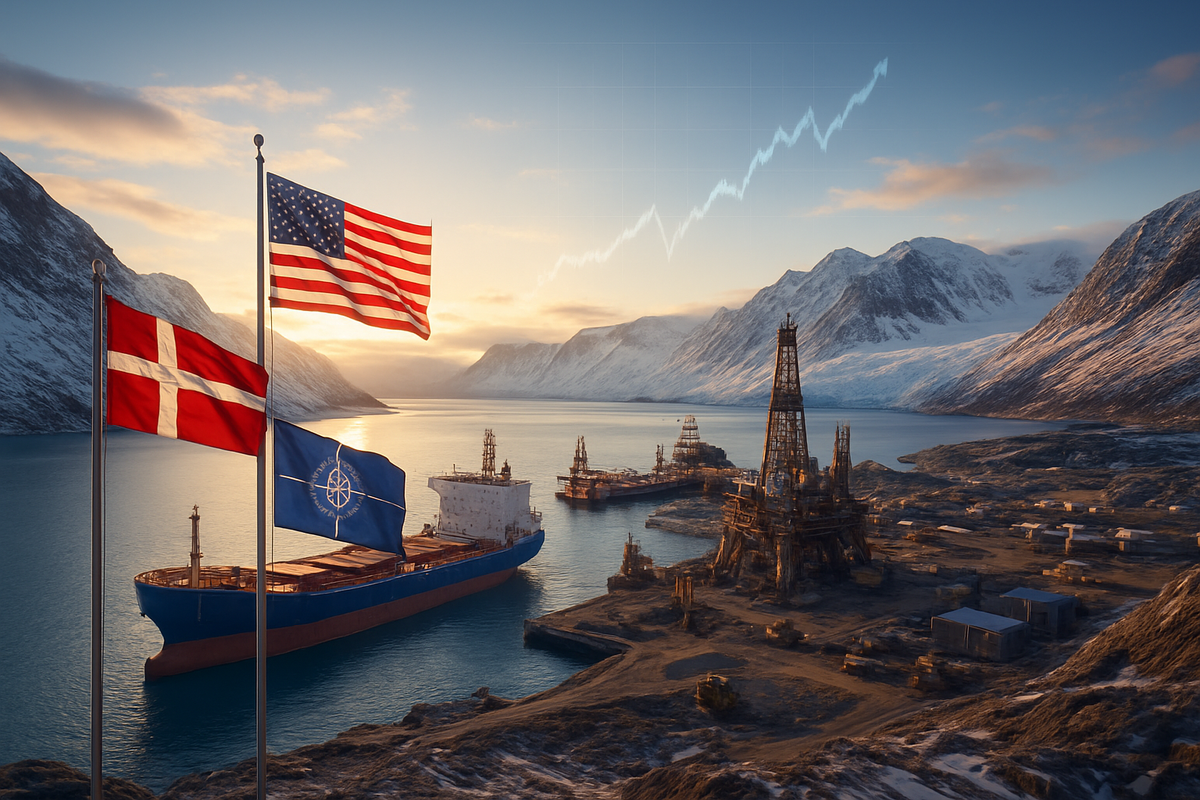
NEW YORK — Financial markets are breathing a collective sigh of relief this week as the White House officially pivoted from a confrontational "purchase-or-tariff" stance regarding Greenland toward a collaborative diplomatic framework. The shift, dubbed the "Arctic Thaw" by analysts, has effectively dismantled a looming trade war with European allies and sparked a significant rally in sectors ranging from green energy to aerospace.
By moving away from the threat of broad-based tariffs on European nations, the administration has secured a "Security-for-Trade" agreement that ensures Western access to Greenland’s vast untapped mineral wealth without the geopolitical friction of territorial annexation. This move has not only stabilized the Euro and the U.S. Dollar but has also injected a fresh wave of optimism into the global supply chain for critical earth elements, which are essential for the next generation of high-tech manufacturing.
The Path from Friction to the "Davos Framework"
The current easing of tensions follows a tumultuous start to 2026. On January 18, the White House shocked global markets by announcing a 10% "Arctic Sovereignty" tariff on eight European nations, including Denmark, Germany, and the Netherlands. The administration’s stated goal was to pressure Denmark into negotiating a "complete and total purchase" of Greenland, a strategic move aimed at securing the Arctic's resource-rich landscape. The threat of these tariffs escalating to 25% by June 1, 2026, sent the S&P 500 into a tailspin during the final weeks of January, as investors braced for a massive disruption in transatlantic trade.
However, the tide turned during the World Economic Forum in Davos in late January. Following intense back-channel negotiations involving NATO Secretary General Mark Rutte and key European leaders, a new diplomatic architecture emerged. The resulting "Security-for-Trade" agreement rescinded the tariff threats in exchange for a formalized partnership. This framework grants the U.S. and its NATO allies guaranteed access to Greenland’s strategic ports and resource deposits while strictly prohibiting non-NATO powers—most notably China—from acquiring further mining or infrastructure rights on the island.
This transition from coercion to cooperation has restored confidence in international trade norms. Key stakeholders, including the Danish government and Greenland's local authorities, have welcomed the shift, viewing it as a recognition of Greenland’s sovereignty while acknowledging the mutual benefits of Western investment. The immediate market reaction has been overwhelmingly positive, with the Dow Jones Industrial Average recovering nearly all its January losses as the risk of a retaliatory €93 billion tariff package from the European Union evaporated.
The Winners and Losers of the Greenland Pivot
The primary beneficiaries of this diplomatic resolution are the mining and logistics firms directly involved in Greenland’s industrialization. Critical Metals Corp (NASDAQ: CRML) saw its stock surge by double digits following reports that the U.S. Export-Import (EXIM) Bank would move forward with a $120 million loan for its Tanbreez rare earth project. As the most "deal-ready" project on the island, Tanbreez is now positioned to become a cornerstone of the Western rare earth supply chain, with a pilot plant expected to open in May 2026.
Similarly, Amaroq Minerals (TSXV:AMRQ) and Greenland Resources Inc (NEO:MOLY) have seen increased investor interest as the political risk discount associated with Arctic mining begins to fade. Amaroq, which operates the Nalunaq gold mine, and Greenland Resources, which is developing a world-class molybdenum project, stand to benefit from streamlined permitting processes and the new joint Arctic security initiatives. In the aviation sector, United Airlines (NASDAQ: UAL) is reaping the rewards of its early bet on the region; the carrier’s direct Newark-to-Nuuk route, launched in 2025, is seeing a surge in bookings from both business travelers and the growing "expeditionary tourism" market as the region becomes more accessible.
Conversely, the shift is a setback for companies heavily invested in non-NATO mining ventures that had hoped to exploit the previous administrative friction to gain a foothold in the Arctic. Chinese firms, which had been attempting to bid on infrastructure projects in Nuuk and Ilulissat, now find themselves effectively locked out of the region by the new security protocols. Furthermore, companies that had positioned themselves to profit from trade-war volatility, such as certain commodity-linked hedge funds, have had to rapidly deleverage as the "Arctic Thaw" stabilized currency markets.
A New Era for Arctic Geopolitics and Supply Chains
The "Arctic Thaw" fits into a broader global trend of "friend-shoring," where major powers seek to secure critical supplies within a circle of trusted allies. By formalizing Greenland’s role as a strategic partner rather than a territorial objective, the U.S. is signaling a preference for long-term supply chain security over short-term geopolitical posturing. This event mirrors the historical precedents of the Cold War era but with a modern focus on the "green transition." The minerals found in Greenland—neodymium, praseodymium, and dysprosium—are the lifeblood of companies like Tesla (NASDAQ: TSLA) and Apple (NASDAQ: AAPL), which require these materials for high-performance magnets and electronics.
The regulatory implications of this shift are also profound. The "Security-for-Trade" framework likely serves as a blueprint for future U.S. interactions with resource-rich but strategically vulnerable nations. It moves the needle from "globalization" toward a more segmented "alliance-based trade" model. This provides a clear roadmap for other Arctic nations, such as Norway and Canada, to align their resource management strategies with NATO’s security priorities, potentially leading to a more unified Western Arctic policy that could challenge Russian dominance in the Northern Sea Route.
Historically, the U.S. interest in Greenland dates back to the 1940s, but the 2026 pivot represents the first time that economic policy (tariffs) and industrial policy (critical minerals) have been so explicitly linked to Arctic sovereignty. The move has effectively neutralized a potential fissure within NATO, reinforcing the alliance's cohesion at a time when energy security and mineral independence have become paramount for national defense and economic competitiveness.
Looking Ahead: The Road to 2027
In the short term, investors should watch for the official signing ceremony of the "Thule Accords," expected later this spring, which will formalize the investment protections for U.S. firms in Greenland. A critical milestone will be the completion of the new 2,200-meter runways in Nuuk and Ilulissat later this year. These infrastructure improvements will drastically lower the cost of doing business in the Arctic, potentially inviting larger diversified miners like Rio Tinto (NYSE: RIO) or Freeport-McMoRan (NYSE: FCX) to explore larger-scale joint ventures in the region.
Longer-term, the challenge for the market will be the actual execution of these massive mining and energy projects. The harsh Arctic environment remains a formidable barrier, and any delays in the Tanbreez pilot plant or the Jameson Land Basin oil exploration could dampen the current enthusiasm. Strategically, the White House must maintain its diplomatic balance; any return to aggressive rhetoric could quickly undo the progress made in Davos and reignite trade tensions with the European Union.
Market participants should also monitor the potential for a "mineral OPEC" emerging among Arctic nations. If the U.S.-led diplomatic success in Greenland can be replicated elsewhere, it could lead to a consolidated Western control over the rare earth market, finally breaking the decade-long monopoly held by external powers. For now, however, the focus remains on the "Thaw" and the immediate boost it provides to a global economy that was previously on the brink of a trade-induced slowdown.
Summary of the Market Impact
The pivot to diplomacy regarding Greenland marks a pivotal moment for the 2026 market landscape. By choosing a path of cooperation over confrontation, the White House has removed a significant tail risk for the global economy. The de-escalation of tariff threats has stabilized international relations and provided a clear green light for massive capital investment into the Arctic’s mineral-rich interior.
Moving forward, the market is likely to reward companies with direct exposure to this "Arctic Renaissance." Investors should keep a close eye on the mid-year milestones for infrastructure and pilot-plant operations, as these will be the true tests of whether the diplomatic success can translate into industrial reality. While geopolitical risks are never entirely absent, the "Arctic Thaw" provides a rare example of how strategic diplomacy can create a "win-win" scenario for both national security and global financial markets.
This content is intended for informational purposes only and is not financial advice.