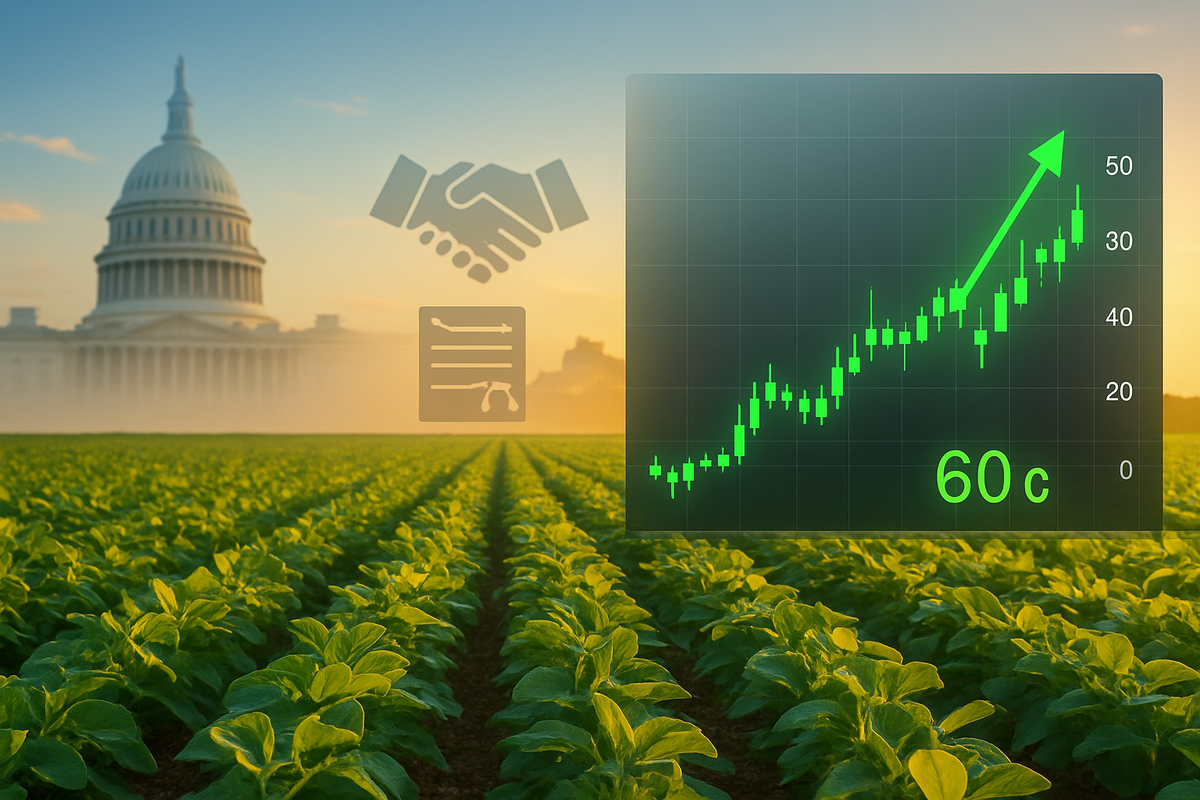
Soybean futures have experienced a dramatic 60-cent rally over the past two weeks, as market optimism builds around a potential breakthrough in US-China trade relations. Reports circulating in Washington and Beijing suggest that President Trump and President Xi Jinping are finalizing plans for a high-stakes summit in April 2026. The goal of this meeting is to extend the current trade truce by another year, providing a much-needed reprieve for an agricultural sector that has been caught in the crossfire of shifting geopolitical alliances.
The surge, which saw March 2026 contracts climb from January lows near $10.50 per bushel to approximately $11.15, marks a significant reversal for the commodity. For American farmers, the prospect of a truce extension is not merely an economic relief but a political lifeline. As the market digests the possibility of reduced tariffs and massive new purchase commitments from Beijing, the focus has shifted to whether this momentum can be sustained through the spring planting season.
The rally began in earnest on February 4, 2026, triggered by a series of communications from the White House indicating a "very productive" dialogue between the two world leaders. This sparked a rapid short-covering rally in the Chicago Board of Trade (CBOT) pits, as traders who had bet on continued downward pressure from a record-breaking Brazilian harvest were forced to reconsider. The timeline for the proposed summit is now coming into focus, with President Trump expected to arrive in Beijing on March 31, 2026, for a three-day visit that will overlap with the critical window before China’s Qingming Festival.
Central to these negotiations is a proposal to slash the 10-13% retaliatory tariffs that China currently imposes on US soybeans. While state-owned enterprises like Sinograin have continued to make strategic purchases, these tariffs have effectively locked out private Chinese crushers, who represent the bulk of the country's demand. If these duties are rolled back, it would reopen the door for the private sector to resume large-scale imports of American beans.
Furthermore, President Trump has reportedly encouraged President Xi to commit to an additional 8 million metric tons (MMT) of "old crop" soybean purchases before the end of the current marketing year. This would bring China's total commitment for the season to 20 MMT, a figure that analysts describe as a "political buy" designed to stabilize the US farm economy. The stakes are high for both sides; the US is looking to clear out surplus stocks, while China seeks to de-escalate tensions and secure its own food supply chain amidst global volatility.
The potential for a trade truce extension has sent ripples through the corporate landscape, with major agribusiness and industrial players positioned as the primary beneficiaries. Archer-Daniels-Midland (NYSE: ADM) and Bunge Global SA (NYSE: BG) have seen renewed investor interest, as a more predictable trade environment allows these global giants to better manage their supply chains and processing margins. Bunge, in particular, saw its shares rise by 2.3% following the news, reflecting the market's belief that "forward visibility" is returning to the oilseed sector.
On the industrial side, agricultural machinery manufacturers are breathing a sigh of relief. John Deere (NYSE: DE), which had previously warned investors of a $1.2 billion pre-tax hit from various tariffs in 2026, could see a significant reversal in its fortunes if the truce is formalized. A stabilized farm economy typically translates into increased capital expenditure by farmers, who have been hesitant to upgrade equipment during periods of extreme price uncertainty.
Similarly, Caterpillar Inc. (NYSE: CAT) stands to gain from any broader de-escalation that boosts construction and infrastructure activity in the Asia-Pacific region. Analysts have already begun adjusting price targets for these industrial bellwethers, anticipating that the "truce dividend" will trickle down through the entire agricultural value chain. Conversely, those who benefited from the shift toward South American supply—such as specialized logistics firms focused exclusively on the Brazil-China corridor—may find their competitive advantage temporarily diminished as US exports regain their footing.
The "Soybean Surge" of 2026 fits into a broader trend of "managed trade" that has come to define the current administration's economic policy. Rather than a total return to free-market principles, the focus has shifted toward bilateral agreements characterized by specific purchase quotas and tiered tariff structures. This event marks a continuation of the "Busan Truce" framework established in late 2025, which aimed to prevent a catastrophic return to the 30% to 145% tariff levels seen during the height of the 2025 trade disputes.
The political significance for the American farmer cannot be overstated. With the 2026 Midterm Elections on the horizon, the administration is acutely aware of the economic pain felt in battleground states like Iowa, Illinois, and Ohio. After a year where net farm income plummeted by nearly $35 billion, the 60-cent price bump acts as a "bridge" for growers currently negotiating operating loans for the upcoming season. It serves as a powerful signal that the rural base remains a top priority for the executive branch.
Historically, this situation echoes the "Phase One" trade deal of the previous decade, though the current landscape is far more complex due to the massive scale of Brazil’s production capacity. Unlike previous cycles, the US is no longer the sole dominant supplier; the 180 MMT Brazilian harvest means that any US-China deal is as much about geopolitical positioning as it is about supply and demand. The regulatory implications are also significant, as any tariff reductions on soybeans are likely to be tied to reciprocal concessions on technology and pharmaceutical exports.
Looking ahead, the market remains in a cautious "wait-and-see" mode. While the 60-cent surge provided a much-needed floor for prices, the actual signing of the extension remains the critical hurdle. In the short term, traders will be hyper-focused on any headlines emerging from the preliminary meetings in March. If the 8 MMT purchase commitment is formalized, it could provide the momentum needed to push soybean futures toward the $12.00 mark, a level not seen in months.
However, long-term challenges remain. The heavy reliance on "political buys" rather than organic demand creates a fragile market structure that is susceptible to sudden diplomatic shifts. American farmers may need to adapt by continuing to diversify their export markets beyond China, even as they welcome the current relief. For investors, the next few months will require a strategic pivot toward companies with the flexibility to navigate both a "truce" scenario and the potential for a sudden breakdown in negotiations.
Market participants should also watch for the impact of the April summit on other commodities, such as corn and pork, which are often bundled into these trade packages. A successful extension could spark a broader "commodity reflation" trade, while a failure to meet the April deadline would likely lead to a sharp and painful correction as the "truce premium" evaporates from the market.
In summary, the February 2026 soybean rally is a testament to the enduring power of trade diplomacy over commodity markets. The prospect of an April meeting between Presidents Trump and Xi has injected a sense of hope into a sector that was beginning to buckle under the weight of high tariffs and record global supply. The key takeaways for the market are the potential for a 10-13% tariff reduction and the aggressive 8 MMT purchase request, both of which serve to bolster the US agricultural heartland.
Moving forward, the market will likely remain volatile as it reacts to every rumor and official statement leading up to the Beijing summit. Investors should keep a close eye on the shipping data and export inspections for signs that China is following through on its "goodwill" gestures. While the immediate outlook is positive, the lasting impact of this event will depend on whether the truce extension can be transformed into a more permanent and stable trade relationship.
The next two months will be a defining period for the 2026 agricultural economy. As the first tractors prepare to enter the fields this spring, the eyes of the farming world—and the financial markets—will be fixed firmly on Beijing, waiting to see if the promised truce extension becomes a reality.
This content is intended for informational purposes only and is not financial advice