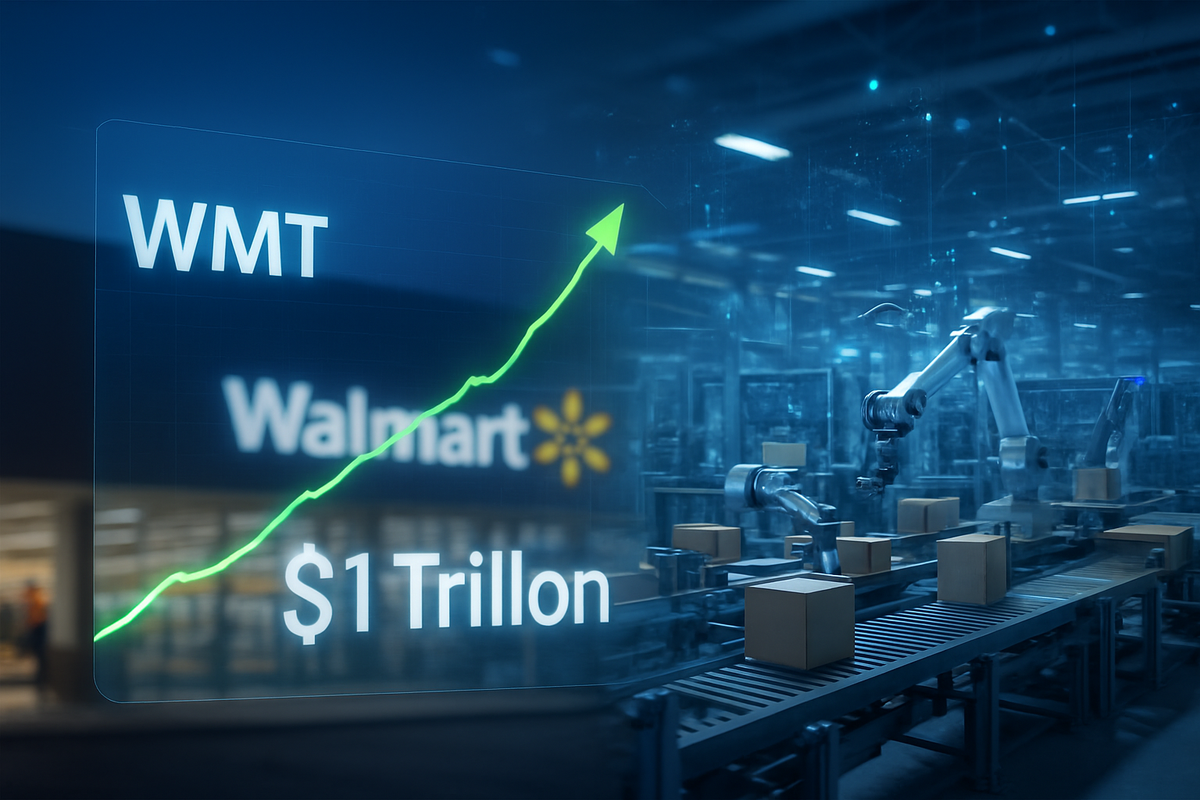
In a historic shift for the global equity markets, Walmart Inc. (Nasdaq:WMT) officially crossed the $1 trillion market capitalization threshold on February 3, 2026. The milestone marks the first time a traditional "brick-and-mortar" retailer has ascended to the valuation heights previously dominated by Silicon Valley’s technology elite. This achievement follows a relentless 26% surge in share price over the past twelve months, a rally fueled by the company’s aggressive pivot toward artificial intelligence and a sweeping leadership transition that has redefined the 64-year-old company as a high-margin logistics powerhouse.
The surge to $1 trillion was finalized when Walmart shares climbed nearly 3% to close at a record $127.71, comfortably clearing the $125.47 mark required to hit the thirteen-figure valuation. For investors, the event is more than just a psychological victory; it represents a fundamental re-rating of the retail sector. As of February 16, 2026, Walmart is no longer being valued merely on its ability to sell groceries at a discount, but on its capacity to leverage a proprietary AI-driven supply chain that rivals the efficiency of pure-play digital giants.
The Path to the Trillion-Dollar Mark
The road to this milestone was paved by a series of strategic maneuvers that culminated in early 2026. A pivotal moment occurred on January 20, 2026, when Walmart moved its listing from the New York Stock Exchange to the Nasdaq-100, replacing AstraZeneca. This move was a clear signal to the market that the company viewed itself as a technology entity. The transition triggered massive inflows from index-tracking funds and set the stage for a four-session winning streak that preceded the $1 trillion breakthrough.
At the center of this transformation is the official commencement of John Furner’s tenure as President and CEO of Walmart Inc., which began on February 1, 2026. Furner, a veteran who started as an hourly associate in 1993, succeeded Doug McMillon with a mandate to move from digital experimentation to large-scale execution. Under his "store-first" philosophy, Furner has overseen the integration of "Wallaby"—a suite of retail-specific large language models (LLMs)—into every facet of the business. From automating merchant decisions to optimizing inventory in real-time at perishable distribution centers, the "Furner Era" is being characterized by what analysts call "continuity with acceleration."
Market analysts point to the rapid rollout of automated distribution centers as the primary catalyst for the stock’s 26% climb. By the time the $1 trillion mark was hit, Walmart had achieved its goal of servicing 65% of its 4,700 U.S. stores through automated facilities. This re-engineering of the supply chain improved unit-delivery cost averages by approximately 20%, allowing the company to defend its "Everyday Low Price" (EDLP) moat while simultaneously expanding operating margins toward a long-term goal of 6%, a figure previously thought unattainable for a high-volume grocer.
Winners and Losers in the Wake of the Milestone
The primary winner in this valuation shift has been Walmart’s ecosystem of technology partners. Symbotic (Nasdaq:SYM), the automation technology firm that partnered with Walmart to overhaul its distribution centers, saw its own shares rally as investors realized the sheer scale of the efficiency gains being realized. Similarly, tech veterans like Shishir Mehrotra, CEO of Superhuman, who recently joined Walmart’s board, have seen their influence grow as the company attracts a new class of "halo-stock" investors seeking stability and tech-driven growth.
Conversely, traditional competitors like Target (NYSE: TGT) and Costco (Nasdaq:COST) are facing increased pressure. While both remain profitable, the "valuation gap" between Walmart and its peers has widened significantly. With Walmart trading at a forward Price-to-Earnings (P/E) ratio of 42x—higher than even Alphabet (Nasdaq:GOOGL) and Meta Platforms (Nasdaq:META) as of mid-February 2026—competitors are being forced to accelerate their own capital expenditures into AI just to maintain their current market share.
The broader logistics industry is also feeling the ripple effects. Third-party delivery services and regional grocers are finding it increasingly difficult to compete with Walmart’s automated fulfillment costs. As Walmart’s "Wally" merchant assistant automates inventory and pricing with pinpoint accuracy, smaller retailers without the capital to invest in proprietary LLMs risk being left behind in a "data-rich vs. data-poor" retail landscape.
A New Benchmark for the "Magnificent" Club
Walmart’s entry into the $1 trillion club is culturally and economically significant because it breaks the monopoly of "Big Tech" over mega-cap status. For years, the club was reserved for the likes of Nvidia (Nasdaq:NVDA), Apple (Nasdaq:AAPL), and Microsoft (Nasdaq:MSFT). Walmart’s inclusion suggests that the "AI Revolution" is entering its second phase: a period where established industrial and retail giants use generative AI to optimize physical assets rather than just digital ones.
Historically, this moment draws comparisons to the early 2000s when GE was the standard-bearer for market cap, or the 2010s when Amazon (Nasdaq:AMZN) disrupted the retail landscape. Today, the tables have turned. Walmart has successfully leveraged its massive physical footprint—4,700 U.S. stores—as strategic "fulfillment nodes" that offer a last-mile efficiency that even Amazon struggles to match in certain categories. This has resulted in a "scarcity premium" for WMT stock, as it is viewed as a "safe haven" during periods of tech-sector volatility.
However, the milestone has not come without scrutiny. Regulatory bodies are increasingly looking at the impact of Walmart’s automation on the labor market. While the company has highlighted the creation of higher-paying technical roles, the displacement of traditional fulfillment roles has led to calls for new workforce transition policies. Furthermore, the sheer scale of Walmart's data collection through its AI "Super Agents" may soon invite the same level of antitrust and privacy oversight currently directed at the traditional tech giants.
The Execution Era: What Lies Ahead
As John Furner settles into the CEO role, the focus shifts from reaching the $1 trillion mark to sustaining it. The market is now pricing in a level of margin expansion that Walmart has not seen in over a decade. To maintain its current 40x+ P/E ratio, the company must prove that its AI investments can consistently deliver 5-6% operating margins even in a fluctuating inflationary environment.
In the short term, investors will be watching for the full integration of the "Wallaby" LLMs across international markets, particularly in India through Flipkart and in Mexico. The strategic pivot will likely involve a heavier focus on "Retail-as-a-Service," where Walmart could potentially license its proprietary automation and AI logistics software to other global retailers, creating a high-margin recurring revenue stream that mirrors the cloud-computing pivots of Microsoft or Amazon.
Challenges remain, particularly in the form of consumer spending fatigue and the high cost of maintaining a massive physical and digital hybrid infrastructure. If the promised efficiency gains from automation do not hit the bottom line by the end of fiscal 2026, the stock could face a sharp correction as the "AI hype" meets the reality of retail math.
Conclusion and Investor Outlook
Walmart’s $1 trillion milestone is a definitive statement that the digital and physical worlds of commerce have fully merged. By combining the logistical "brute force" of its store network with the "intellectual force" of proprietary AI, the company has secured its place as the 10th U.S. company to join the trillion-dollar ranks. The leadership of John Furner marks the beginning of an "Execution Era" where the primary goal is turning technological potential into consistent shareholder value.
For investors, the key takeaways are clear: Walmart is no longer a defensive play for a recessionary environment; it is a growth-oriented technology stock with a retail backbone. Moving forward, the market will be hyper-focused on margin expansion and the scalability of its AI systems. While the valuation is currently at a historic premium, the "Halo Effect" surrounding Walmart suggests that as long as it continues to outpace the S&P 500 in efficiency gains, its residency in the trillion-dollar club will be a long one.
This content is intended for informational purposes only and is not financial advice.