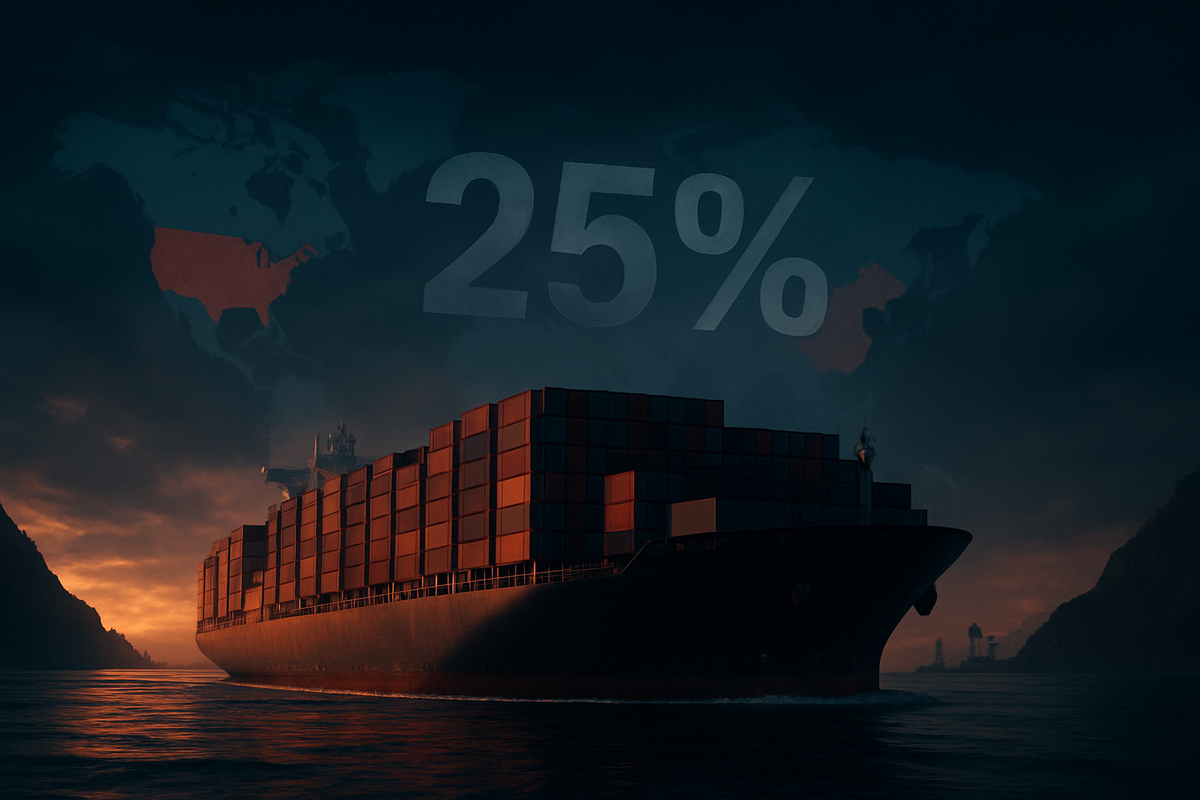
In a move that has sent shockwaves through global capitals and commodity markets, the Trump administration has officially implemented a sweeping 25% tariff on any nation that continues to maintain trade relations with the Islamic Republic of Iran. Announced in early February 2026, this "Secondary Tariff" policy marks a fundamental departure from traditional financial sanctions, effectively weaponizing the vast American consumer market to force a binary choice upon the world’s largest economies: abandon Tehran or face a devastating tax on all exports to the United States.
The immediate implications of the policy were felt within minutes of the formal Executive Order being signed. Brent crude prices surged as traders priced in a "geopolitical risk premium," while currencies of major Iranian trade partners, particularly the Japanese yen and the Indian rupee, faced significant downward pressure. As the February 17, 2026, deadline for initial compliance reviews approaches, global supply chains are already fracturing as multinational corporations scramble to audit their exposure to Iranian energy and petrochemicals to avoid being caught in the crossfire of this new economic "machete."
The "Machete" Doctrine: A Timeline of Escalation
The transition from rhetoric to reality began on January 12, 2026, when President Donald Trump used social media to issue a stark ultimatum, declaring that any country "doing business" with the Iranian regime would be met with a 25% across-the-board tariff. While initially dismissed by some analysts as a negotiating tactic, the administration moved with unexpected speed. By late January, the Treasury Department, led by Secretary Scott Bessent, had already expanded its "shadow fleet" sanctions list, targeting tankers used to move Iranian crude under the radar. On February 6, 2026, the President signed the formal Executive Order, "Addressing Threats to the United States by the Government of Iran," which went into effect at midnight the following day.
The strategy behind this move is distinct from the 2018 "Maximum Pressure" campaign. Where the previous administration utilized "sushi knife" precision—targeting specific banks and energy sectors—the 2026 policy is a broad-spectrum "machete." By applying tariffs to all goods from a non-compliant country, the U.S. is no longer just targeting oil; it is targeting the entire economic output of nations like China, India, and Turkey. This aggressive stance coincided with high-stakes, indirect nuclear negotiations in Muscat, Oman, suggesting the administration is using the threat of global trade disruption as its primary leverage to secure a new, more restrictive deal with Tehran.
Key players in this rollout include Secretary of State Marco Rubio, who has been empowered to determine which nations qualify for "national interest" waivers, and the Department of Commerce, which is spearheading the investigations into "indirect" Iranian trade. The dual-track approach—applying extreme economic pressure while keeping diplomatic channels open in Oman—has left international observers divided on whether this will lead to a breakthrough or a full-scale global trade war.
Market Winners and Losers: The Corporate Fallout
The "Trump Tariff" has created a stark divide in the equity markets, with U.S. energy and defense sectors emerging as the primary beneficiaries. ExxonMobil (NYSE: XOM) and Chevron (NYSE: CVX) have seen their stock prices climb as global crude benchmarks rise and the prospect of reduced Iranian supply tightens the market. These domestic giants, less reliant on foreign "grey market" crude, are positioned to capture higher margins. Similarly, Occidental Petroleum (NYSE: OXY) has seen sympathetic gains, though it remains wary of potential cost inflation in drilling equipment if trade tensions affect global manufacturing.
Conversely, the global shipping and refining industries are bracing for impact. Sinopec (HKG: 0386), the world’s largest refiner, faces a dual threat: the loss of discounted Iranian feedstock and the potential for a 25% tariff on its massive petrochemical exports to the U.S. In India, Reliance Industries (NSE: RELIANCE) has already begun a strategic pivot, reportedly opening talks with U.S. authorities to increase imports of Venezuelan or American crude to replace Iranian barrels and protect its U.S. market access. The logistics sector is equally strained, with A.P. Møller - Mærsk A/S (CPH: MAERSK-B) and COSCO Shipping Holdings (HKG: 1919) navigating both the physical risks of the Red Sea and the administrative burden of new U.S. compliance standards.
Defense contractors have seen a "war premium" boost as regional tensions escalate. Lockheed Martin (NYSE: LMT) and RTX Corporation (NYSE: RTX) have reported a surge in orders for missile defense systems, such as the Patriot and PAC-3, as Middle Eastern allies and global partners move to fortify their positions. Analysts suggest that even if the tariffs are eventually used as a bargaining chip, the heightened state of alert will keep the order books of these aerospace giants full for the foreseeable future.
A Paradigm Shift in Global Trade Relations
This event fits into a broader trend of "economic statecraft" where trade policy is indistinguishable from national security policy. By bypassing the traditional SWIFT-based financial sanctions that defined the last decade, the U.S. is signaling that it is willing to disrupt the entire global trade order to achieve specific geopolitical goals. This has profound implications for the U.S. dollar's role as the global reserve currency; while it currently strengthens the dollar as a safe haven, it also incentivizes rivals to accelerate the development of alternative payment systems that circumvent U.S. jurisdiction entirely.
Historically, this move is being compared to the 1970s oil shocks, but with a modern protectionist twist. Unlike the 2018 sanctions, which many European allies attempted to bypass through the INSTEX mechanism, the 25% tariff is nearly impossible to ignore. A European car manufacturer or a Chinese electronics firm cannot easily absorb a 25% tax on their U.S. sales, making the "cost of doing business with Iran" prohibitively high. This represents a "maximum-maximum pressure" that effectively outlaws neutral trade for any country that values its relationship with the American consumer.
The ripple effects are extending to the World Trade Organization (WTO) and various bilateral trade agreements. Critics argue that using tariffs as a secondary sanction violates international trade laws, yet the Trump administration has remained steadfast, citing national security exceptions. This stance could lead to retaliatory tariffs from the European Union or China, potentially igniting a multi-front trade war that goes far beyond the original intent of curbing Iran’s regional influence.
The Road Ahead: Strategic Pivots and Scenarios
In the short term, the market should expect continued volatility in oil prices and shipping rates. The most immediate concern for investors is whether Iran will respond to this economic "siege" by attempting to block the Strait of Hormuz, a move that would send crude prices well into triple digits. Corporations will likely require a "strategic pivot," involving the rapid decoupling of their supply chains from any entities with even tangential links to the Iranian Revolutionary Guard Corps (IRGC).
Long-term, two primary scenarios emerge. The first is a "Grand Bargain" where the extreme pressure forces Tehran back to the negotiating table for a comprehensive deal, leading to a gradual rollback of the tariffs and a stabilization of the markets. The second, more volatile scenario is one of "Entrenched Fragmentation," where a bloc of nations led by China and Russia decides to ignore the U.S. mandates, creating a bifurcated global economy with two separate trade and financial systems. This would lead to a permanent "geopolitical discount" on Iranian oil and a permanent "tariff wall" between the U.S. and its adversaries.
Summary and Investor Outlook
The 2026 "Trump Tariffs" on Iran’s trade partners represent one of the most significant escalations in economic warfare in modern history. The shift from financial exclusion to broad-based trade taxation has forced global powers into a corner, with the U.S. market serving as the ultimate leverage. The key takeaways for the market moving forward are the undeniable strength of the U.S. energy and defense sectors, the extreme vulnerability of global logistics, and the rising cost of geopolitical risk in every corner of the supply chain.
As we move through the first quarter of 2026, investors should keep a close eye on the ongoing negotiations in Oman and the "compliance audits" being conducted by the Department of Commerce. The ability of major refiners in India and China to source alternative crude will be a primary indicator of how successful the U.S. policy will be in isolating Tehran. Ultimately, the lasting impact of this event may not be the change in Iran's behavior, but the permanent restructuring of how global trade is conducted in an era where the "machete" of tariffs is the preferred tool of diplomacy.
This content is intended for informational purposes only and is not financial advice.