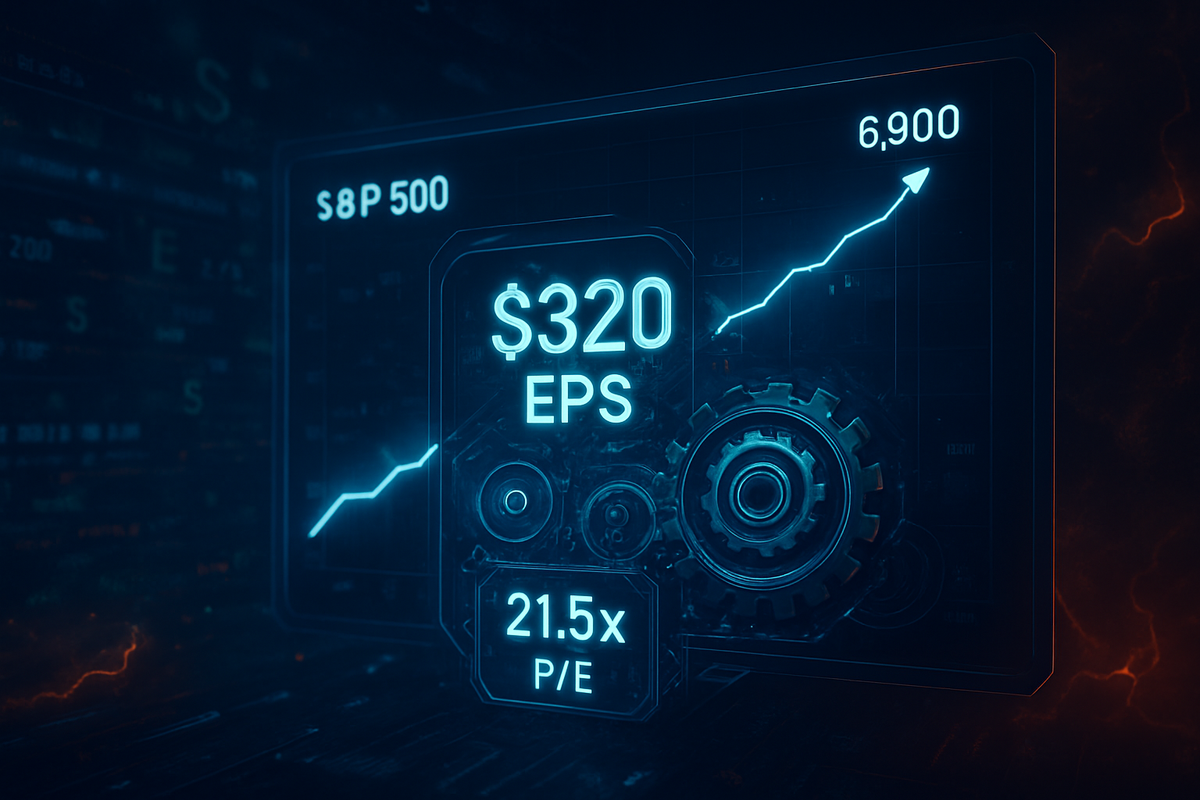
The S&P 500 (INDEXSP: .INX) is currently locked in a high-stakes tug-of-war, hovering near the psychologically significant 6,900 level as of February 24, 2026. Despite a backdrop of intensifying trade policy shifts and a "valuation reset" in the technology sector, the broader market remains anchored by a remarkably durable corporate earnings engine. Investors are navigating a complex landscape where the 2026 S&P 500 earnings per share (EPS) forecast has solidified at $320, supporting a forward price-to-earnings (P/E) multiple of 21.5x.
This resilience is being tested by immediate headwinds, including a recent spike in the CBOE Volatility Index (INDEXCBOE: VIX) to 21.01 and a rotation away from previous mega-cap leaders. However, the fundamental story of 2026 remains one of productivity. As AI-driven efficiencies begin to manifest in bottom-line results across non-tech sectors, the market’s ability to maintain its elevation—even as policy volatility ripples through global supply chains—suggests a transition from a liquidity-driven rally to one fueled by structural earnings growth.
The Road to 6,900: Tariffs, Transitions, and Tech Turbulence
The current market environment is the culmination of a volatile start to 2026. The primary catalyst for the recent intraday swings was the White House’s announcement earlier this week to elevate global tariffs to 15%, up from the previous 10% baseline. This move sparked an immediate "risk-off" reaction in global markets, causing the S&P 500 to retreat slightly from its recent all-time highs to settle near the 6,837 mark. Simultaneously, the nomination of Kevin Warsh as the next Federal Reserve Chair has introduced a new variable into the monetary policy equation, with investors betting on a "Warsh-led" Fed that may prioritize flexibility and growth-oriented rate cuts later this year.
Leading up to this moment, the market has undergone what analysts at Goldman Sachs (NYSE: GS) describe as a "Great Rotation." Throughout January and February 2026, the dominance of the "Magnificent Seven" has waned, replaced by a broader participation from cyclical and defensive sectors. This shift was accelerated by a "software shock" in mid-February, triggered by new autonomous AI coding tools that threatened the legacy business models of established tech giants. While the index is essentially flat year-to-date, the underlying churn has been significant, as institutional players distribute tech holdings in favor of "Old Economy" beneficiaries.
The timeline of the last 90 days shows a market grappling with record-high valuations—the CAPE ratio recently touched 40, a level reminiscent of the 1990s tech bubble—yet sustained by a "non-recessionary" economic outlook. Stakeholders, from institutional asset managers at UBS (NYSE: UBS) to retail investors buoyed by the "One Big Beautiful Bill Act" tax stimulus, are weighing the benefits of a robust U.S. consumer against the rising costs of imported goods. This tension has defined the 6,900 level as a crucial battleground for market sentiment.
Sector Divergence: Winners of the Rotation and the Tech Retrenchment
The narrative of early 2026 is a tale of two markets. On the winning side, the Energy and Materials sectors have emerged as the premier hedges against inflation and tariff-related supply shocks. Companies involved in domestic resource extraction and infrastructure have seen substantial inflows, as the market prices in a "Fortress America" economic strategy. Consumer Staples have also outperformed, rising over 12% year-to-date, as investors seek shelter in the reliable cash flows of companies like Procter & Gamble (NYSE: PG) and PepsiCo (NASDAQ: PEP).
Industrials have also found favor, benefiting from a massive, federally-subsidized buildout of AI-ready power grids and domestic manufacturing facilities. This "bricks and mortar" backbone of the AI revolution is proving to be a more stable investment than the software layer itself. Conversely, the Information Technology sector has been the primary laggard. Microsoft (NASDAQ: MSFT) and other software leaders have faced selling pressure as the market re-evaluates their multi-year growth trajectories in the face of AI-driven displacement.
The cybersecurity sub-sector has been particularly hard-hit. CrowdStrike (NASDAQ: CRWD), once a market darling, has seen its valuation multiple compressed as new, highly efficient AI agents begin to automate many of the functions previously performed by human-managed software suites. Additionally, the Healthcare sector is navigating its own set of challenges, with Managed Care organizations under pressure from "Medicare rate shocks" and proposed flat increases for Medicare Advantage, which have dampened the outlook for insurers like UnitedHealth Group (NYSE: UNH).
Productivity vs. Policy: The Wider Significance of the 2026 Outlook
The broader significance of the S&P 500's current stance lies in the disconnect between policy uncertainty and corporate productivity. While tariffs and geopolitical tensions dominate the headlines, the "earnings engine" is being quietly supercharged by a surge in nonfarm productivity, which rose nearly 5% in late 2025. This productivity boom, largely attributed to the successful integration of generative AI into corporate workflows, is what allows analysts at Morgan Stanley (NYSE: MS) and Ameriprise Financial (NYSE: AMP) to maintain a $320 EPS forecast for 2026 despite the macro-economic noise.
This event fits into a historical pattern where markets initially overreact to policy shifts (like tariffs) before refocusing on the underlying strength of the U.S. consumer and corporate margins. The 21.5x forward P/E ratio, while high by historical standards, reflects a market that is pricing in a "soft landing" followed by an AI-accelerated growth phase. However, the ripple effects of the current policy volatility are being felt globally; as the U.S. leans into protectionism, traditional partners are being forced to recalibrate their trade dependencies, potentially leading to more fragmented global markets.
Comparisons are being drawn to the market of late 1999, but with a critical difference: today’s valuations are backed by record-breaking corporate cash piles and tangible productivity gains rather than pure speculation. The "software shock" of 2026 serves as a reminder that technological progress can be a "creative destroyer," eliminating old moats while building new ones. The regulatory landscape is also shifting, with ongoing Supreme Court cases regarding Federal Reserve independence adding a layer of constitutional risk that investors have not had to account for in decades.
Navigating the Future: Potential Scenarios and Strategic Pivots
As the market looks toward the second half of 2026, several scenarios are emerging. In the short term, the S&P 500 may continue to consolidate around the 6,800–6,900 range as it digests the 15% tariff implementation and the transition at the Federal Reserve. A strategic pivot is already underway among institutional investors who are shifting their focus toward "AI-enabled" companies—those that use AI to cut costs—rather than "AI-providers" whose margins are being squeezed by competition and high R&D spend.
The long-term outlook remains cautiously optimistic, with some major firms targeting a move toward 7,600 or even 7,700 by year-end 2026 if the Fed successfully manages the "Warsh transition" and delivers on anticipated rate cuts. However, the threat of a "software-led" deflationary period in the service sector remains a wildcard. If AI displacement leads to significant white-collar job losses, the consumer spending floor—currently bolstered by the "One Big Beautiful Bill Act"—could begin to crack.
Market opportunities are likely to emerge in mid-cap companies that have been overlooked during the mega-cap era. These firms, which often have more domestic focus and less exposure to global software disruption, may represent the next leg of the bull market. Conversely, the challenge for established tech giants will be to prove they can monetize AI at a scale that justifies their still-lofty valuations. Investors should prepare for a period of "active management" where sector selection becomes more critical than overall index exposure.
Summary: A Market Defined by Fundamental Strength and Political Risk
The S&P 500’s current position near 6,900 is a testament to the enduring power of American corporate earnings. With a $320 EPS forecast and a 21.5x forward multiple, the market is betting that productivity gains will outpace policy-induced costs. The key takeaways from early 2026 are clear: the "Great Rotation" is real, tech is no longer the sole engine of growth, and policy volatility is the new normal.
Moving forward, the market is likely to remain in a state of "dynamic equilibrium," where strong earnings provide a floor while high valuations and geopolitical risks act as a ceiling. The transition to a new Federal Reserve leadership and the impact of the 15% global tariffs will be the primary drivers of volatility in the coming months.
Investors should watch for signs of "earnings fatigue" in the tech sector and monitor the 10-year Treasury yield, which is currently stabilizing around 4.00%. While the path to 7,000 and beyond is clear, it will likely be paved with higher-than-average volatility as the market continues to price in the most significant technological and political shifts of the decade.
This content is intended for informational purposes only and is not financial advice