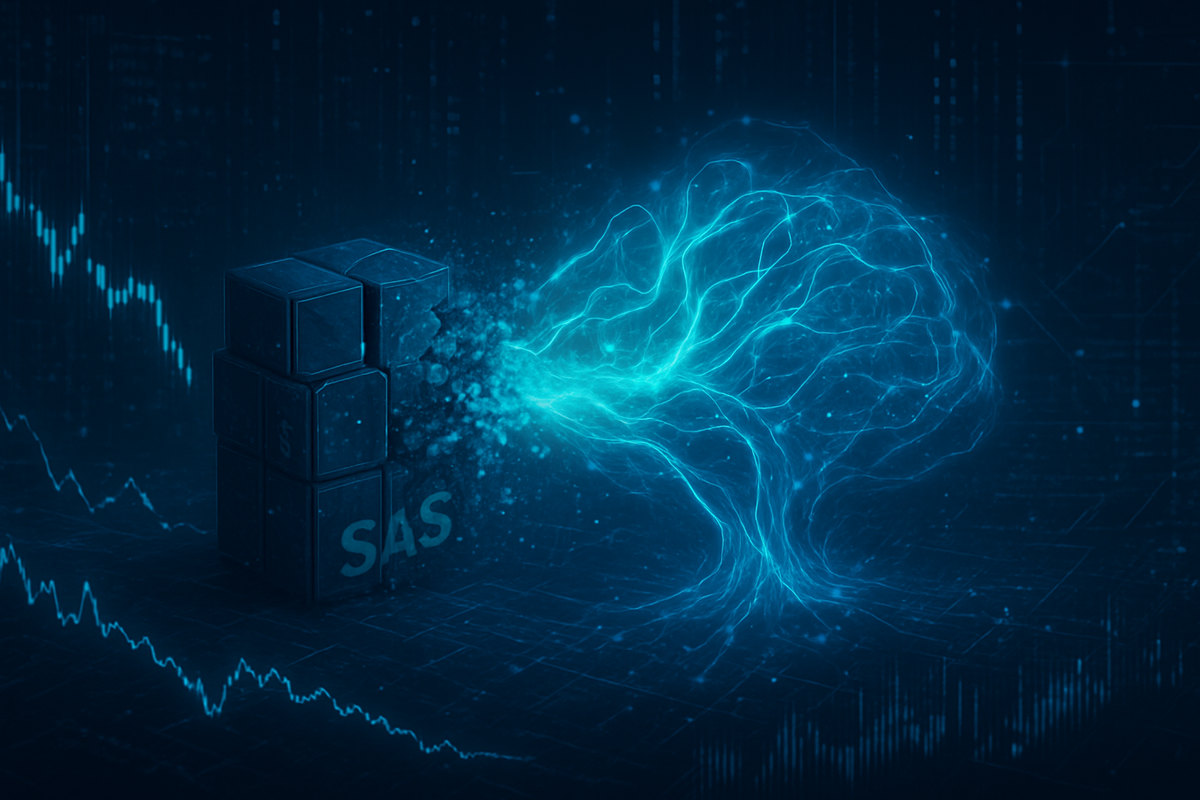
The final week of February 2026 has sent a tremor through the technology sector, as a sudden wave of volatility wiped billions in market capitalization from premier software-as-a-service (SaaS) companies. Investors, once enamored by the steady growth and high margins of cloud monitoring and cybersecurity, are now grappling with a sobering question: Is the very artificial intelligence that fueled the recent bull market now poised to cannibalize its pioneers? The selloff, which intensified following a series of technological breakthroughs and dire economic forecasts, has placed a spotlight on the fragility of high-valuation stocks in an era of rapid AI evolution.
The immediate implications are stark. The "software-is-eating-the-world" mantra of the last decade is being replaced by fears that "AI is eating software." As companies like Datadog (NASDAQ: DDOG) and CrowdStrike (NASDAQ: CRWD) see their stocks fluctuate wildly, the market is signaling a fundamental re-evaluation of what constitutes a "moat" in the enterprise tech space. The volatility suggests that the days of assuming linear growth for incumbent SaaS leaders may be over, replaced by a climate where disruptive AI agents could render traditional monitoring and security platforms obsolete overnight.
The 'February Panic': A Week of Digital Devaluation
The current turbulence reached a fever pitch during the week of February 23, 2026, in what traders are now calling the "February Panic." The catalyst was a "perfect storm" of news that broke over the preceding weekend. On February 20, 2026, Anthropic launched "Claude Code Security," a sophisticated AI agent capable of autonomously scanning enterprise codebases, identifying vulnerabilities, and—most crucially—writing and deploying patches without human intervention. This launch sent a shockwave through the cybersecurity sector, as investors feared that proactive AI patching could diminish the need for "runtime" protection services.
By the opening bell on Monday, February 23, the reaction was swift and brutal. CrowdStrike (NASDAQ: CRWD) plummeted 10.6% in a single session, its steepest one-day decline since mid-2024. This was followed closely by Datadog (NASDAQ: DDOG), which fell 11.3% despite having reported record bookings just weeks prior. The panic was further fueled by a viral report from Citrini Research titled "The 2028 Global Intelligence Crisis," which predicted that AI-driven automation would lead to a significant contraction in white-collar employment. For a software industry built on "per-seat" pricing models, the prospect of fewer human employees felt like an existential threat.
Throughout the week, the contagion spread to other high-multiple names. Zscaler (NASDAQ: ZS) and Okta (NASDAQ: OKTA) saw double-digit percentage drops as the market struggled to differentiate between "AI-enhanced" and "AI-disrupted" business models. Even legacy titans were not immune; IBM (NYSE: IBM) suffered a 13% decline, its worst performance in over two decades, as investors questioned whether its massive consulting arm could survive in a world where AI agents handle complex system integrations. The week has been a masterclass in market psychology, where narrative-driven fears have temporarily overshadowed strong quarterly earnings.
Winners and Losers in the Agentic Era
In this shifting landscape, the traditional winners of the cloud era are finding themselves on the defensive. Companies like Datadog (NASDAQ: DDOG) face a complex challenge: their platform is designed to help human engineers observe and manage complex systems. However, if "agentic AI" becomes the primary operator of these systems—self-healing and self-optimizing code in real-time—the value of a "single pane of glass" for human oversight begins to erode. Similarly, CrowdStrike (NASDAQ: CRWD) must prove that its "Falcon" sensor is still necessary when AI-native security tools are integrated directly into the development environment (IDE) and the cloud fabric itself.
Conversely, the clear winners in the current environment appear to be the "Foundational Model" providers and those who can pivot to an "Outcome-Based" pricing model. Anthropic and OpenAI are moving aggressively into the application layer, potentially absorbing the niche functions once held by dozens of individual SaaS vendors. Analysts suggest that companies like Salesforce (NYSE: CRM) might weather the storm better if they successfully transition from charging for "seats" to charging for "outcomes"—such as a closed sales deal or a resolved customer service ticket—effectively decoupling their revenue from the headcount of their clients.
Smaller, agile "AI-native" startups are also emerging as potential victors, unencumbered by legacy technical debt or outdated pricing structures. These firms are building "agentless" security and monitoring tools that leverage cloud APIs rather than requiring heavy software installations. As investors rotate out of the high-flying SaaS darlings of 2024 and 2025, they are increasingly looking for companies that view AI not as a feature to be added, but as the core architecture of the service itself.
The Death of the 'Seat' and the Rise of the Agent
The current volatility is more than just a market correction; it represents a structural shift in the software industry. For twenty years, the "per-user" or "seat-based" subscription model has been the gold standard for predictable revenue. However, as AI agents become capable of doing the work of multiple human employees, this model is fundamentally breaking. Gartner reports that by early 2026, 40% of enterprise applications have integrated task-specific agents, leading to a "seat count collapse" that is forcing a radical rethinking of software valuation.
Furthermore, this event mirrors historical precedents such as the transition from on-premise software to SaaS in the early 2000s. Just as incumbents like Oracle (NYSE: ORCL) had to reinvent themselves for the cloud, today’s cloud giants must reinvent themselves for the AI age. The "Observability" market, which Datadog (NASDAQ: DDOG) helped define, is being pushed toward "Actionability." It is no longer enough for a software tool to tell a human what is wrong; the tool must now fix the problem autonomously. This transition requires a level of deep AI integration that may favor different players than the previous generation of "cloud-first" companies.
The ripple effects are also being felt in the regulatory and policy spheres. As AI agents begin to take over critical infrastructure monitoring and security patching, questions of liability and "algorithmic transparency" are becoming paramount. Regulators are closely watching the "February Panic" as an indicator of how dependent the global economy has become on a handful of AI providers. If a single update to a model like Claude can disrupt the entire cybersecurity market, the systemic risk posed by centralized AI models may lead to new antitrust or safety mandates.
What Lies Ahead: Strategic Pivots and Market Realities
In the short term, the market is likely to remain highly sensitive to any news regarding AI "feature creep" into the domains of traditional SaaS providers. Investors should expect continued volatility as companies report their first-ever "AI-impacted" guidance numbers in the coming quarters. A key metric to watch will be the "Net Expansion Rate"—if this begins to falter because customers are hiring fewer humans and relying more on AI agents, the downward pressure on valuations will likely persist.
However, a long-term opportunity may be emerging from the chaos. Some analysts, including Dan Ives of Wedbush, argue that the current selloff is an "AI Ghost Trade." They point out that as AI generates more code, the volume of digital infrastructure is actually exploding. More code means more vulnerabilities to secure and more systems to monitor, which could ultimately lead to a "second act" for companies like CrowdStrike (NASDAQ: CRWD) and Datadog (NASDAQ: DDOG). To succeed, these companies must execute a flawless strategic pivot, moving away from monitoring humans and toward securing and observing the vast, complex networks of AI agents that will define the next decade.
A New Frontier for Enterprise Software
The events of February 2026 serve as a stark reminder that in the technology sector, no moat is permanent. The sudden volatility in Datadog (NASDAQ: DDOG) and CrowdStrike (NASDAQ: CRWD) highlights a market in the throes of a deep identity crisis. While the underlying businesses remain profitable and essential to the current digital economy, the "future-proof" aura they once held has been tarnished by the rapid advancement of agentic AI.
Moving forward, the market will likely reward companies that can prove their indispensability in an AI-run world. This means moving beyond "per-seat" metrics and demonstrating value through autonomous problem-solving and outcome-driven results. For investors, the coming months will require a discerning eye; the ability to distinguish between a company whose business model is being "disrupted" versus one that is being "augmented" by AI will be the difference between significant losses and generational gains. The era of "easy" SaaS growth is over; the era of AI-driven competition has truly begun.
This content is intended for informational purposes only and is not financial advice.