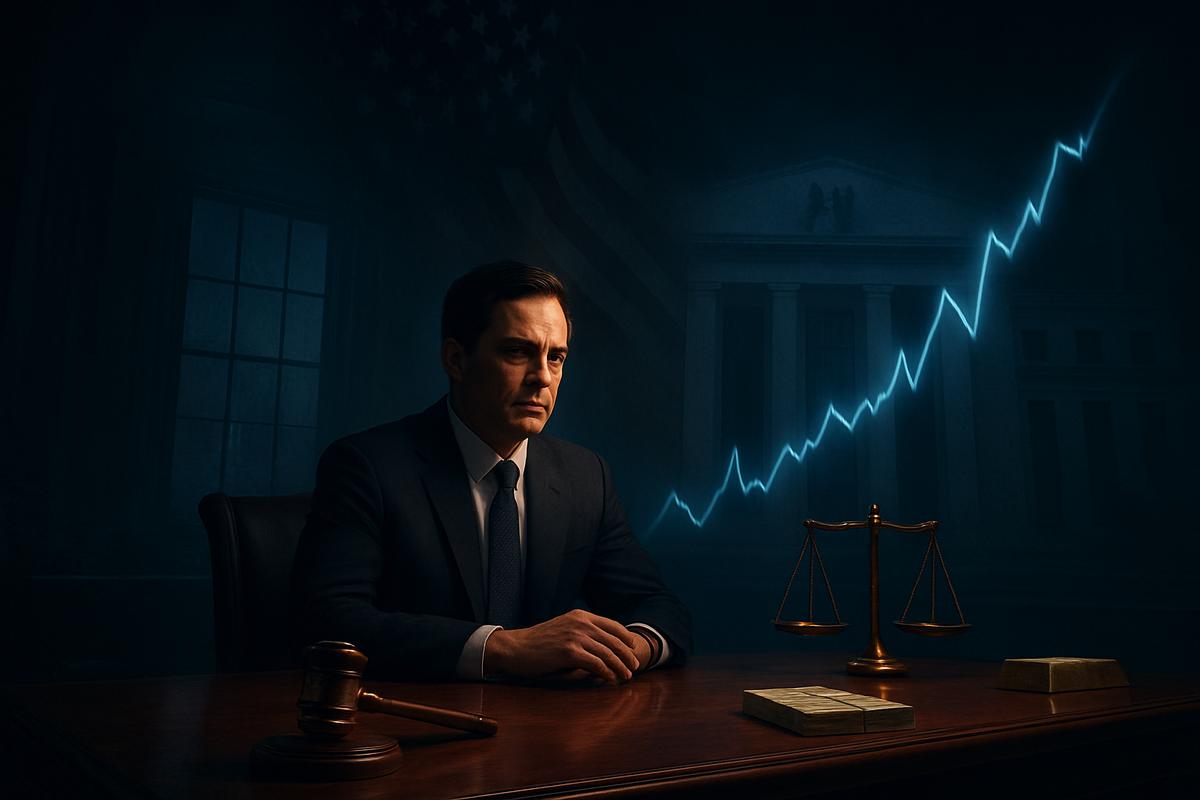
WASHINGTON, D.C. — In a week that has sent tremors through the global financial architecture, Treasury Secretary Scott Bessent appeared before the Senate Banking Committee on February 5, 2026, delivering testimony that many economists believe signals a fundamental shift in the relationship between the White House and the Federal Reserve. By pivoting from the long-standing tradition of central bank independence to a new model of “independence with accountability,” Bessent has effectively opened the door for direct executive influence over monetary policy, a move that critics argue could permanently damage the credibility of the U.S. dollar.
The immediate implications are stark: bond markets are already pricing in a "Fed independence premium," reflecting fears that future interest rate decisions will be driven by political cycles rather than economic data. As the Treasury Department pulls back its traditional role as a buffer between the President and the Fed, investors are grappling with a new reality where the central bank’s autonomy is no longer a given, but a point of negotiation.
A Week of Institutional Warfare
The controversy reached a fever pitch during Bessent’s two-day stint on Capitol Hill, following a series of escalations that began in late January. On January 11, 2026, the Department of Justice, led by Attorney General Pam Bondi, issued a subpoena to Fed Chair Jerome Powell regarding a $2.5 billion headquarters renovation project. Powell publicly characterized the investigation as a "pretext" for political intimidation, a sentiment echoed by several members of the Senate. This was followed on January 30 by the formal nomination of Kevin Warsh to succeed Powell when his term ends in May.
During his testimony, Bessent refused to distance the administration from the legal pressure on Powell. When asked by Senator Elizabeth Warren if the administration could guarantee that a future Fed Chair would not be subjected to investigations for failing to cut rates, Bessent’s response—"That is up to the President"—sent shockwaves through the chamber. He further defended the President’s right to "jawbone" the Fed, arguing that the central bank had "lost the trust of the American people" by allowing inflation to persist, thereby justifying a more hands-on approach from the executive branch.
Market reaction was swift and unforgiving. By Friday, February 6, 2026, the U.S. dollar reached a two-week high, not out of strength in the economy, but as a "safe-haven" flow driven by institutional instability. Meanwhile, gold surged toward $4,600 an ounce as investors sought a hedge against potential currency debasement. The bond market saw a significant spike in long-dated Treasury yields, as lenders demanded higher returns to compensate for the risk of a politicized Fed that might prioritize short-term growth over long-term price stability.
Winners and Losers in the New Regime
The financial sector has found itself at the epicenter of this volatility. Major institutions like JPMorgan Chase & Co. (NYSE: JPM) and The Goldman Sachs Group, Inc. (NYSE: GS) have already issued warnings to clients. JPMorgan's trading desk noted that the erosion of central bank credibility has created a "fragile foundation" for U.S. equities, leading to a de-risking trend across their portfolios. Bank of America Corp. (NYSE: BAC) and Citigroup Inc. (NYSE: C) have also seen their shares pressured by the rising "institutional risk premium" that now hangs over American finance.
The most immediate "losers" from this policy shift are consumer credit firms. Shares of Capital One Financial Corp. (NYSE: COF) plummeted 6.4%, while Synchrony Financial (NYSE: SYF) fell 8.4% this week. This decline was triggered by Bessent’s defense of a populist proposal to cap credit card interest rates at 10%. Without a strong, independent Federal Reserve to provide a check on such mandates, investors fear that banks will be forced to absorb significant losses or exit the consumer lending market entirely. Similarly, payment giants Visa Inc. (NYSE: V) and Mastercard Inc. (NYSE: MA) saw their stock prices drop nearly 5% on fears that a weakened Fed would be unable to stop the Credit Card Competition Act from gutting swipe fee revenues.
On the other side of the ledger, traditional "hard asset" plays and certain defensive sectors have seen speculative interest. While the overall market has been volatile, commodities and inflation-sensitive assets are being viewed as the primary "winners" in a world where the Fed might be forced to keep rates lower than necessary to appease the White House. Conversely, mega-cap technology firms such as Microsoft Corp. (NASDAQ: MSFT), Alphabet Inc. (NASDAQ: GOOGL), and Amazon.com, Inc. (NASDAQ: AMZN) have faced valuation compression. These high-growth companies are highly sensitive to "terminal" interest rates; if the market believes the Fed will lose its grip on inflation, the resulting higher long-term yields will continue to devalue their future cash flows.
The Ghost of 1972: Historical Precedents and Global Risks
The current tension is drawing frequent comparisons to the 1970s, specifically the relationship between President Richard Nixon and then-Fed Chair Arthur Burns. Nixon famously pressured Burns to keep interest rates low to boost the economy ahead of the 1972 election, a move that many economists believe laid the groundwork for the "Great Inflation" that followed. By adopting the "Accountability Doctrine," Bessent is essentially reviving a ghost that the U.S. financial system has spent fifty years trying to exorcise.
This event fits into a broader global trend of "populist economics," where executive branches around the world are increasingly challenging the independence of their central banks to pursue immediate political goals. If the U.S.—the guardian of the world's reserve currency—formally abandons central bank autonomy, it could trigger a "race to the bottom" among other nations, leading to global currency instability. Regulatory implications are already emerging; if the Fed is viewed as an arm of the Treasury, its role as a neutral arbiter of the banking system (via the FSOC) is compromised, potentially leading to more fragmented and political financial regulation.
The "ripple effects" are also being felt in the labor market. On February 6, United Parcel Service, Inc. (NYSE: UPS) announced significant job cuts, citing a "stalling labor market" exacerbated by the uncertainty of the Fed's future path. For manufacturing and logistics companies, the combination of potential tariffs—which Bessent also defended—and interest rate volatility creates a "pincer effect" that makes long-term capital expenditure nearly impossible to plan.
The Road to May: What Comes Next?
In the short term, all eyes are on the Senate confirmation hearings for Kevin Warsh. The battle is expected to be one of the most contentious in decades, with Senator Thom Tillis (R-NC) already vowing to block the nomination until the Department of Justice drops its investigation into Jerome Powell. This creates a potential "governance vacuum" at the Fed precisely when the market is most desperate for stability. If Powell is forced out or chooses to resign before his term ends in May, the resulting leadership gap could trigger a major sell-off in Treasury bonds.
Long-term, the market must adapt to a "politicized Fed" scenario. This will likely require strategic pivots from institutional investors, who may move away from traditional 60/40 portfolios in favor of more robust inflation protection and international diversification. We may see the emergence of a "dual-mandate" that is increasingly influenced by fiscal needs—essentially, the Fed being used to keep government borrowing costs low, regardless of the inflationary consequences.
A Final Assessment for Investors
The testimony of Secretary Bessent marks a "Rubicon" moment for the American economy. The move to redefine Fed independence as "accountability" to the executive branch suggests that the era of the technocratic, data-driven Federal Reserve may be coming to a close. For investors, the key takeaway is that institutional risk is no longer a theoretical concern for emerging markets—it has arrived on Wall Street.
Moving forward, the market is likely to remain in a state of heightened volatility until the leadership transition at the Fed is resolved. Investors should watch the "term premium" on 10-year and 30-year Treasuries; if these yields continue to climb despite cooling economic data, it will be a clear sign that the market has lost faith in the Fed’s ability to remain independent. In this new landscape, the ability of a company to maintain margins in a high-inflation, high-volatility environment will be the primary differentiator between winners and losers.
This content is intended for informational purposes only and is not financial advice.