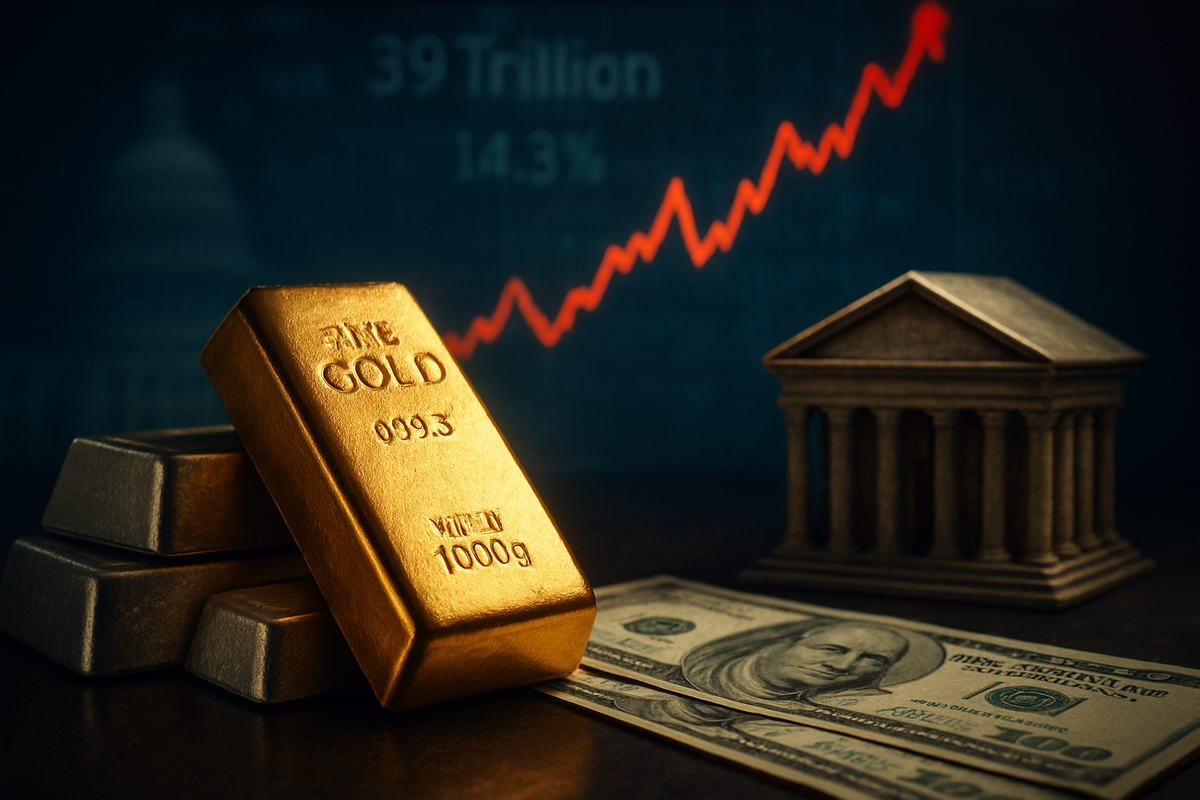
As of February 6, 2026, the global financial landscape is grappling with a profound paradigm shift: the erosion of trust in the "full faith and credit" of the U.S. government. In the opening weeks of 2026, gold and silver have transitioned from traditional hedges to primary stores of value, as investors flee a dollar burdened by a $39 trillion national debt and a Federal Reserve increasingly caught in the crosshairs of executive power. The rapid ascent of precious metals—with gold hitting a record peak of nearly $5,600 per ounce in January—serves as a stark warning that the market is beginning to price in "fiscal dominance," a scenario where monetary policy is no longer independent but is instead a tool to manage the government's ballooning interest obligations.
The immediate implications are far-reaching. While the U.S. dollar has historically benefited from its status as the world’s reserve currency, the sheer scale of the 2025-2026 deficit projections has created a "trust gap." With the passage of the "One Big Beautiful Bill Act" (OBBBA) in late 2025, which extended sweeping tax cuts while maintaining high spending levels, the Congressional Budget Office now warns of a permanent structural deficit exceeding 6% of GDP. This fiscal reality has forced the Federal Reserve into a precarious corner, just as a leadership transition looms, leaving investors to wonder if the central bank can—or will—remain the ultimate guardian of price stability.
A Perfect Storm: Deficits, Interest, and the Warsh Nomination
The current crisis traces its roots to the second half of 2025, when the federal deficit began to accelerate far beyond traditional recessionary expectations. By the end of last year, the net interest expense on the U.S. national debt surpassed $1 trillion for the first time in history, making it the second-largest line item in the federal budget after Social Security. This symbolic milestone sent shockwaves through the Treasury market, as interest payments now consume approximately 14.3% of all federal outlays, effectively eclipsing the entire national defense budget. This "interest trap" has led many to believe that the Federal Reserve will be forced to keep interest rates lower than inflation—a policy known as financial repression—to prevent a sovereign debt crisis.
The political temperature reached a boiling point on January 30, 2026, when the White House announced the nomination of Kevin Warsh to succeed Jerome Powell as Chair of the Federal Reserve (NYSE: FED) when Powell’s term expires this coming May. While Warsh is a known entity on Wall Street, the nomination followed months of public criticism from the administration regarding the Fed’s "restrictive" stance. The market's initial reaction was a "capitulation event" in precious metals, with silver (NYSEARCA:SLV) plunging 28% in a single day as traders weighed whether a new Fed leadership would prioritize political growth targets over inflation control. However, the subsequent rebound in early February suggests that investors remain skeptical that any single individual can solve the underlying fiscal mathematics.
Throughout this period, the demand for physical bullion and digital gold equivalents has reached levels not seen since the 1970s. Central banks, particularly in the Global South, have accelerated their de-dollarization efforts, diversifying their reserves into gold to avoid the "sanctions risk" and "debasement risk" associated with U.S. Treasuries. This has created a floor for precious metals prices, as any significant dip is immediately met with institutional and sovereign buying. The volatility of the past month is not merely a trading anomaly; it is the market attempting to find the "real" price of money in an era of fiscal excess.
Winners and Losers in the Hard Asset Revolution
The primary beneficiaries of this flight to quality have been the major precious metals producers and the exchange-traded funds that track them. Newmont (NYSE: NEM), the world's largest gold producer, saw its stock price surge over 6% in early February as it recovered from the January volatility. With gold trading consistently above $5,000, Newmont's margins have expanded to unprecedented levels, allowing the company to return massive amounts of capital to shareholders through "inflation-linked" dividends. Similarly, Barrick Gold (NYSE: GOLD) has seen its valuation nearly triple since the start of 2025, as its tier-one assets in Nevada and Africa become increasingly valuable in a high-inflation environment.
Investors seeking leveraged exposure to this bull run have also poured record amounts of capital into the VanEck Gold Miners ETF (NYSEARCA:GDX). This vehicle has decoupled from the broader S&P 500, serving as an "alpha generator" for portfolios that are otherwise bogged down by traditional tech and consumer stocks. On the silver side, the iShares Silver Trust (NYSEARCA:SLV) continues to see massive inflows, despite the "flash crash" on January 30. The industrial demand for silver in the burgeoning green energy sector, combined with its historical role as "poor man's gold," has made it a favorite for retail investors looking to hedge against a devalued dollar.
Conversely, the clear losers in this environment are holders of long-term U.S. Treasuries, such as those in the iShares 20+ Year Treasury Bond ETF (NASDAQ: TLT). As the "term premium" returns to the bond market, investors are demanding higher yields to compensate for the risk of holding long-term debt in a fiscally unstable nation. This has led to a steepening yield curve that threatens to raise borrowing costs for corporations and mortgage holders, potentially stifling economic growth. Furthermore, traditional "cash-rich" companies that have failed to diversify their balance sheets into hard assets are finding their purchasing power significantly eroded, leading to a scramble among CFOs to re-allocate capital into "trust-based" hard assets.
The End of the "Fed Put" and the Rise of Fiscal Dominance
The current movement into gold and silver is more than a simple trade; it represents a fundamental challenge to the post-Bretton Woods monetary order. For decades, the "Fed Put"—the belief that the Federal Reserve would always step in to support markets with lower rates—provided a safety net for investors. However, with interest expenses now exceeding $1 trillion annually, the Fed’s ability to act is being curtailed by the government's need for cheap financing. This "Fiscal Dominance" means the Fed may no longer be able to fight inflation effectively if doing so would bankrupt the Treasury.
This dynamic echoes the inflationary decade of the 1970s, but with a critical difference: the debt-to-GDP ratio today is nearly three times higher than it was during the Volcker era. Historical precedents suggest that when a nation's interest payments exceed its defense spending, a period of monetary instability usually follows. The market is currently testing whether the U.S. can "grow its way out" of this debt or if it will be forced into a "soft default" through the gradual debasement of the currency. The recent surge in precious metals is a clear signal that a significant portion of the market has already made its choice.
Furthermore, the policy implications are daunting. If the new Fed leadership under Kevin Warsh attempts to re-establish credibility by raising rates, they risk triggering a deep recession and a fiscal crisis. If they succumb to political pressure and print money to cover the deficit, inflation could spiral into the double digits. This "no-win" scenario is precisely what makes gold and silver so attractive; as "hard assets" with no counterparty risk, they exist outside of the traditional banking system and the whims of central planners.
Looking Ahead: The Warsh Transition and the May Milestone
As we look toward the transition in May 2026, the short-term outlook for the markets remains highly uncertain. The "Warsh Shock" of late January showed how sensitive investors are to any change in the Fed's perceived independence. In the coming months, we expect to see a series of "stress tests" for the incoming Chair, as the Treasury Department attempts to auction off record amounts of new debt. If these auctions fail to attract sufficient buyers, the Fed may be forced to step in as the "buyer of last resort," a move that would likely send gold back toward its $5,600 peak and silver toward the $120 mark.
Strategically, investors are likely to continue diversifying away from "paper assets" and into "tangible assets." We may see a shift in corporate treasury management, where companies begin holding small percentages of their cash reserves in gold or even Bitcoin to protect against dollar volatility. The "Hard Asset Revolution" is no longer a fringe movement; it is becoming a core component of institutional risk management. The challenge for the new Fed leadership will be to convince the world that the dollar is still a reliable store of value, a task that becomes more difficult with every billion dollars added to the national debt.
Final Thoughts: The New Monetary Reality
The events of early 2026 have laid bare the fragility of a global monetary system built on "trust" in a time of fiscal profligacy. The explosion of the U.S. deficit and the record-breaking interest expenses are no longer theoretical problems for the future—they are current realities that are reshaping the investment landscape. Gold and silver have reclaimed their roles as the ultimate barometers of systemic risk, reflecting a deep-seated anxiety about the independence of the Federal Reserve and the long-term viability of the dollar.
For investors, the key takeaway is that the "Gold Standard of Skepticism" has arrived. While precious metals will remain volatile, their upward trajectory is supported by the cold, hard math of the U.S. budget. Moving forward, the market will be watching the May leadership transition at the Fed with bated breath. Any sign that the central bank is losing its battle with fiscal dominance will likely trigger the next leg of the gold bull market. In this new era, the most valuable asset may not be the dollar in your pocket, but the "trust-based" hard assets that sit outside the reach of the printing press.
This content is intended for informational purposes only and is not financial advice