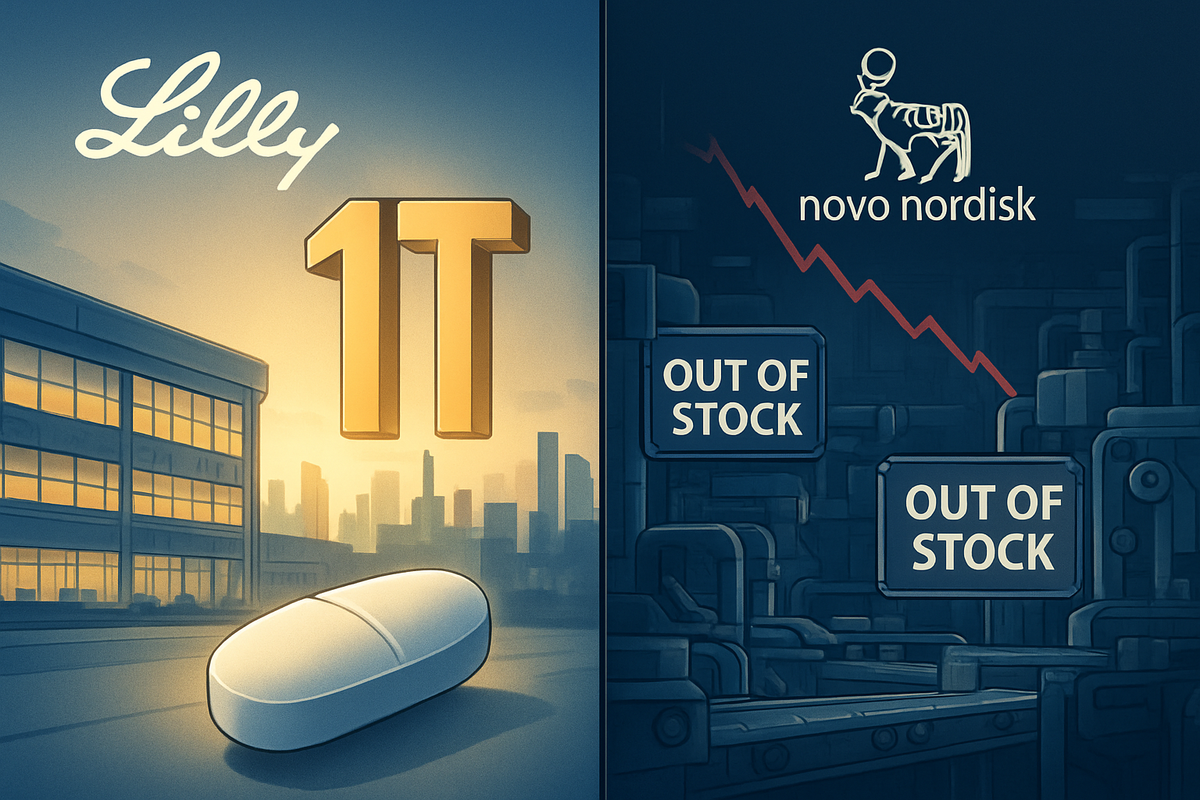
The global race for obesity market dominance reached a historic turning point this week as Eli Lilly and Company (NYSE: LLY) officially crossed the $1 trillion market capitalization threshold, cementing its status as the world’s most valuable healthcare entity. The milestone follows a stellar 2026 guidance report that projected a 25% surge in annual revenue, fueled by the accelerating rollout of its next-generation obesity treatments. In sharp contrast, its primary rival, Novo Nordisk A/S (NYSE: NVO), saw its shares crater nearly 20% after issuing a shock warning that its 2026 sales could decline by as much as 13%, marking a dramatic reversal for the Danish pharmaceutical giant.
This divergence signals a fundamental decoupling of the two market leaders, driven by Lilly's superior manufacturing scale and the looming arrival of its highly anticipated oral obesity therapy, Orforglipron. While both companies have spent years as the "duopoly" of the weight-loss sector, the market is now aggressively favoring Lilly's aggressive capital expenditure strategy and its ability to navigate a new era of U.S. pricing pressures that have left Novo Nordisk vulnerable to margin compression.
A Tale of Two Guidance Reports: Volume vs. Price
The catalyst for the market's violent reaction was the release of the companies' early 2026 financial outlooks. Eli Lilly stunned analysts by projecting 2026 revenues between $80 billion and $83 billion. This growth is underpinned by what analysts call a "volume defense" strategy. Despite new federal pricing regulations under the "Most Favored Nation" (MFN) clauses, which have significantly lowered the net price of GLP-1 medications in the United States, Lilly has successfully offset these lower prices by drastically increasing the number of doses delivered to patients. The company's direct-to-consumer platform, LillyDirect, has played a pivotal role in this, allowing the firm to capture a larger share of the patient journey while maintaining brand loyalty.
Novo Nordisk, however, appears to have hit a ceiling. Its February 2026 guidance warning was its first projected sales drop in over a decade. The company cited "unprecedented" pricing pressures in the U.S. and acknowledged that it has been unable to scale its volume quickly enough to compensate for the lower revenue per patient. While Novo's Wegovy remains a household name, the firm has faced a string of drug shortage notifications in Europe and Asia throughout late 2025, suggesting that its internal supply chain is still struggling to meet global demand even as competitors ramp up.
The Manufacturing Moat: $55 Billion in Leverage
The most significant differentiator between the two titans has become their respective manufacturing capacities. Since 2020, Eli Lilly has committed over $55 billion to expanding its global production footprint—more than double the capital expenditure of Novo Nordisk over the same period. By the start of 2026, Lilly reached a milestone of producing 1.8 times more incretin doses than it did just two years prior. This "manufacturing muscle" has allowed Lilly to keep its blockbuster tirzepatide—marketed as Zepbound—on pharmacy shelves while Novo Nordisk continues to grapple with "capacity limitations" at several of its primary production sites.
Furthermore, Lilly’s strategic focus on "small molecule" chemistry is beginning to pay dividends over Novo’s biological "peptide" approach. Lilly's experimental oral drug, Orforglipron, is a non-peptide small molecule, which means it can be synthesized through traditional chemical processes that are far cheaper and easier to scale than the complex fermentation and purification required for Novo’s oral semaglutide (Rybelsus). As global demand for weight-loss drugs shifts from injectable "boutique" medicine to mass-market oral pills, Lilly’s ability to manufacture billions of doses at a fraction of the cost is being viewed as an insurmountable long-term advantage.
The Oral Revolution: Convenience and Efficacy
As of February 2026, the battleground has moved from the syringe to the pill bottle. The release of Phase 3 ATTAIN-1 trial results for Orforglipron showed that patients lost an average of 12.4% of their body weight over 72 weeks. While this is lower than the ~22% loss seen with injectable Zepbound, the convenience factor is transformative. Unlike Novo Nordisk’s oral semaglutide, which requires patients to take the pill on an empty stomach with a specific, small amount of water and wait 30 minutes before eating, Lilly’s Orforglipron has no such restrictions.
Novo Nordisk attempted to counter this by launching high-dose oral Wegovy (50mg) in January 2026 at a competitive price of $149 per month for eligible patients. However, the market has remained skeptical of its "peptide-in-a-pill" technology, which remains difficult to manufacture and provides lower bioavailability than small molecules. In the REIMAGINE 2 study results released this month, Novo’s next-generation combination drug, CagriSema, showed impressive efficacy but still failed to surpass the numerical weight-loss benchmarks set by Lilly’s existing portfolio. This has led to concerns that Novo is perpetually "playing catch-up" in a market it once pioneered.
What Lies Ahead: The April FDA Deadline
The immediate focus for investors is now the U.S. Food and Drug Administration (FDA) decision on Orforglipron, expected in early April 2026. If approved, Lilly will be the first to market with a high-efficacy, easy-to-manufacture oral GLP-1, potentially capturing the vast "primary care" segment of the obesity market that has been hesitant to adopt injectables. This could trigger another leg up for Lilly’s stock, while further isolating Novo Nordisk in the injectable niche.
Novo Nordisk, for its part, is attempting a strategic pivot toward its "REDEFINE" clinical program, which seeks to prove the superior cardiovascular and metabolic benefits of its combination therapies. The Danish firm is also awaiting final FDA approval for new domestic manufacturing sites in the U.S., which it hopes will alleviate the supply bottlenecks that have plagued its 2025 performance. However, with Lilly already sitting on a $1 trillion valuation and a war chest of manufacturing assets, the window for Novo to reclaim the lead appears to be narrowing.
Summary and Market Outlook
The current divergence between Eli Lilly and Novo Nordisk is more than just a fluctuation in stock price; it is a reflection of a maturing industry where manufacturing scale and patient convenience are replacing pure clinical discovery as the primary drivers of value. Lilly’s $1 trillion milestone is a testament to its foresight in investing heavily in domestic production and small-molecule chemistry.
For investors, the coming months will be defined by Lilly’s ability to execute the Orforglipron launch and Novo’s ability to defend its margins against federal pricing mandates. While the obesity market is still projected to grow toward $150 billion by the end of the decade, the "winner-take-most" dynamics are currently favoring the American giant. Investors should keep a close eye on the FDA’s April calendar and any updates regarding Novo Nordisk’s U.S. manufacturing expansion, as these will be the key indicators of whether this divergence is a temporary reset or a permanent shift in the pharmaceutical hierarchy.
This content is intended for informational purposes only and is not financial advice