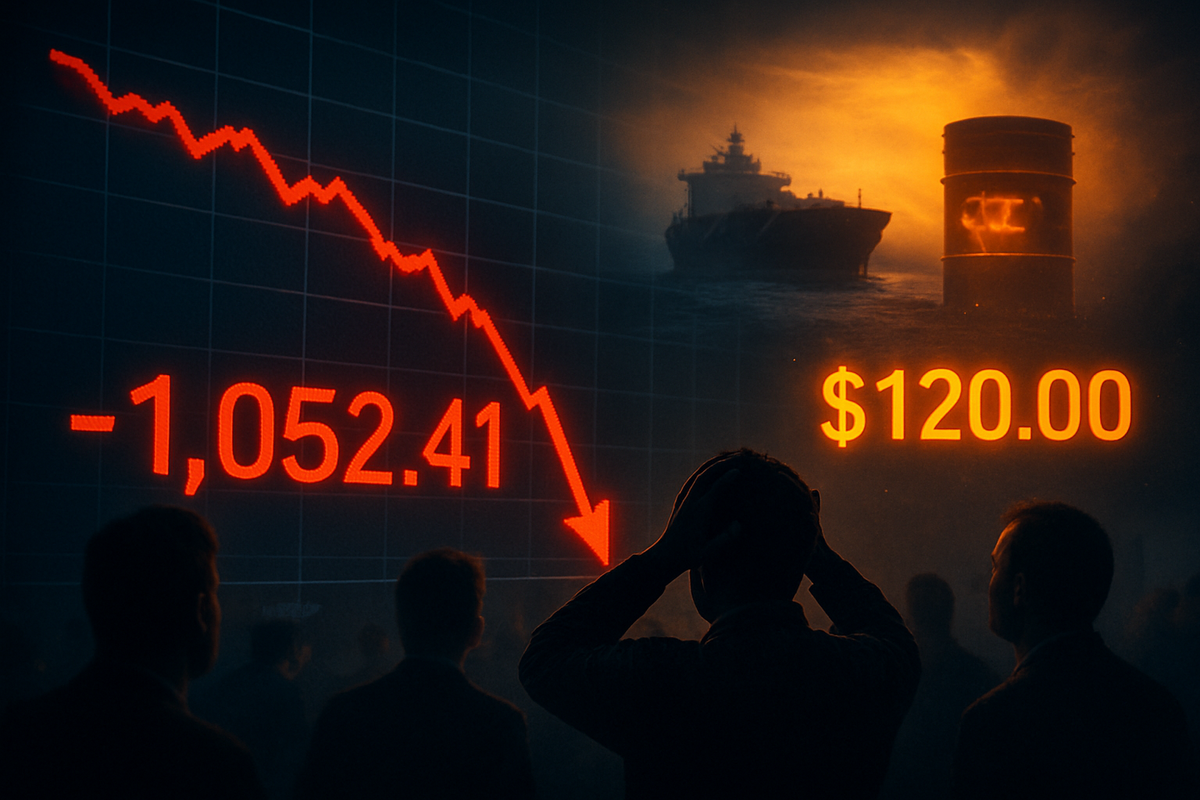
NEW YORK — Wall Street was engulfed in a wave of panic selling on Tuesday, March 3, 2026, as escalating military hostilities between the United States and Iran sent shockwaves through the global financial system. The Dow Jones Industrial Average (DJI) plummeted 1,052 points, a 2.1% decline, marking its most volatile session in over two years. The sell-off was fueled by a dramatic spike in crude oil prices following reports that the Strait of Hormuz—the world’s most vital energy artery—has been effectively closed to commercial traffic.
The carnage was not limited to blue-chip stocks. The S&P 500 (SPX) and the Nasdaq Composite (IXIC) both sank more than 2.4%, as investors scrambled to price in a "war premium" that many fear could derail the global economic recovery. Market breadth was overwhelmingly negative, with approximately 86% of all U.S. equities finishing the day in the red. As safe-haven assets like gold and the U.S. dollar surged, the "fear gauge," or CBOE Volatility Index (VIX), spiked to its highest level since the regional banking crisis of 2023, closing the day at 27.30.
The market's collapse followed a rapid-fire series of geopolitical escalations that began over the weekend. Following the launch of Operation Epic Fury—a joint U.S.-Israeli precision strike campaign aimed at Iranian nuclear and missile infrastructure—Tehran responded with what it termed "existential defense" measures. By early Tuesday morning, reports surfaced that the Islamic Revolutionary Guard Corps (IRGC) had deployed naval mines and anti-ship missiles along the Strait of Hormuz, causing global shipping insurers to immediately withdraw coverage for the region.
The physical impact on energy supplies was instantaneous. Brent Crude futures leaped 13% in a single session, briefly touching $120 per barrel before settling near $118. Analysts at major institutions like JPMorgan and Goldman Sachs warned that a prolonged closure of the Strait could see oil prices hit $150 or higher by the end of the month. The suddenness of the move caught many traders off guard, triggering a cascade of automated sell orders and margin calls that accelerated the Dow’s 1,000-point slide during the final hour of trading.
The timeline of the crash was marked by a chilling "flight to safety" that briefly overwhelmed the bond market. Early in the session, the 10-year Treasury yield plummeted as investors sought the security of government debt. However, as the scale of the oil spike became clear, yields reversed course and spiked to 4.10%. The market realized that $120 oil would almost certainly reignite the "inflation monster" the Federal Reserve has been battling for years, potentially forcing the central bank to keep interest rates "higher for longer" despite the equity market turmoil.
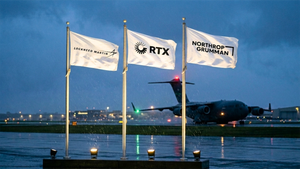
In a day dominated by red screens, a handful of sectors managed to defy the gravity of the crash. Defense contractors saw massive inflows as investors bet on a sustained period of high military procurement. Lockheed Martin (NYSE: LMT) surged 6.2%, while Northrop Grumman (NYSE: NOC) climbed 4.8% following news that their advanced missile defense systems and stealth platforms were central to the ongoing operations in the Middle East. Energy giants also saw strategic buying; ExxonMobil (NYSE: XOM) and Chevron (NYSE: CVX) rose 3.4% and 2.9% respectively, as the prospect of $100+ oil promised a windfall for domestic producers with limited Middle Eastern exposure.
The "losers" column, however, was far more crowded. The airline industry was decimated by the dual threat of soaring fuel costs and regional instability. American Airlines (NASDAQ: AAL) plunged 8.5%, while Delta Air Lines (NYSE: DAL) and United Airlines (NASDAQ: UAL) each lost over 6%. Industry analysts warn that jet fuel price spikes could wipe out entire quarters of profitability if the conflict persists. Consumer discretionary stocks also took a hit, as investors feared that $5.00-per-gallon gasoline would soon bleed into retail spending.
Technology stocks, the primary engine of the market’s 2025 rally, were not spared. Apple (NASDAQ: AAPL) and Microsoft (NASDAQ: MSFT) fell 3.1% and 3.5%, respectively, as the rising 10-year Treasury yield forced a repricing of their growth-oriented valuations. Even the AI darling Nvidia (NASDAQ: NVDA) faced heavy selling pressure early in the day, though it managed a partial recovery to close down just 1.2% after announcing a new multi-billion dollar infrastructure deal.
Today’s crash fits into a broader, more ominous trend of "deglobalization" and the weaponization of energy supplies. Unlike the 2020 COVID-19 crash, which was a demand-side shock, the March 3 sell-off is a supply-side crisis that complicates the Federal Reserve’s mandate. If the Fed cuts rates to support the falling stock market, it risks pouring gasoline on the fire of oil-induced inflation. If it stays the course, it risks a deep recession.
Historically, 1,000-point drops in the Dow have occurred during moments of extreme systemic stress, such as the 2008 financial crisis or the 2020 pandemic. However, on a percentage basis, today's 2.1% drop is less severe than the 22.6% "Black Monday" of 1987. Modern circuit breakers and more robust capital requirements for banks have, so far, prevented a total liquidity freeze. Nonetheless, the ripple effects are expected to reach far beyond Wall Street. Competitors in the European and Asian markets are already bracing for a similar "Red Wednesday," as high energy costs are expected to hit the manufacturing-heavy German and Japanese economies even harder than the U.S.
In the short term, all eyes are on the White House and the United Nations. Any sign of a diplomatic de-escalation or a successful "freedom of navigation" operation to reopen the Strait of Hormuz would likely trigger a massive relief rally. Conversely, if Iran targets further energy infrastructure in Saudi Arabia or the UAE, the 1,000-point drop seen today may only be the beginning of a larger correction. Strategic pivots are already underway; many hedge funds have shifted to "neutral" or "short" positions, awaiting clarity on the Fed’s next move at the March 17-18 meeting.
Investors should prepare for continued volatility. Market opportunities may emerge in domestic energy production and cybersecurity firms as the conflict potentially expands into the digital realm. However, the primary challenge remains the Federal Reserve's reaction function. The "Fed Put"—the idea that the central bank will always step in to save the market—is being tested by $120 oil. If the Fed remains hawkish in the face of this crash, the era of easy gains for U.S. equities may be coming to a definitive end.
The events of March 3, 2026, serve as a stark reminder that geopolitical risk can never be fully discounted. After a year of record highs fueled by the AI boom, the market has been reminded of the fragile nature of global supply chains and the enduring power of "Old World" commodities like oil. The 1,052-point drop in the Dow is more than just a number; it is a signal that the cost of capital and the cost of energy are moving in a direction that investors have not had to navigate in decades.
Moving forward, market participants should watch the "fear premium" in oil prices and the 10-year Treasury yield as the primary indicators of stability. While the U.S. economy remains more resilient than many of its peers, the "higher for longer" interest rate environment combined with an energy shock is a toxic brew for equities. In the coming months, the ability of companies to pass on higher costs to consumers will be the ultimate differentiator between the winners and the losers of this new geopolitical epoch.
This content is intended for informational purposes only and is not financial advice