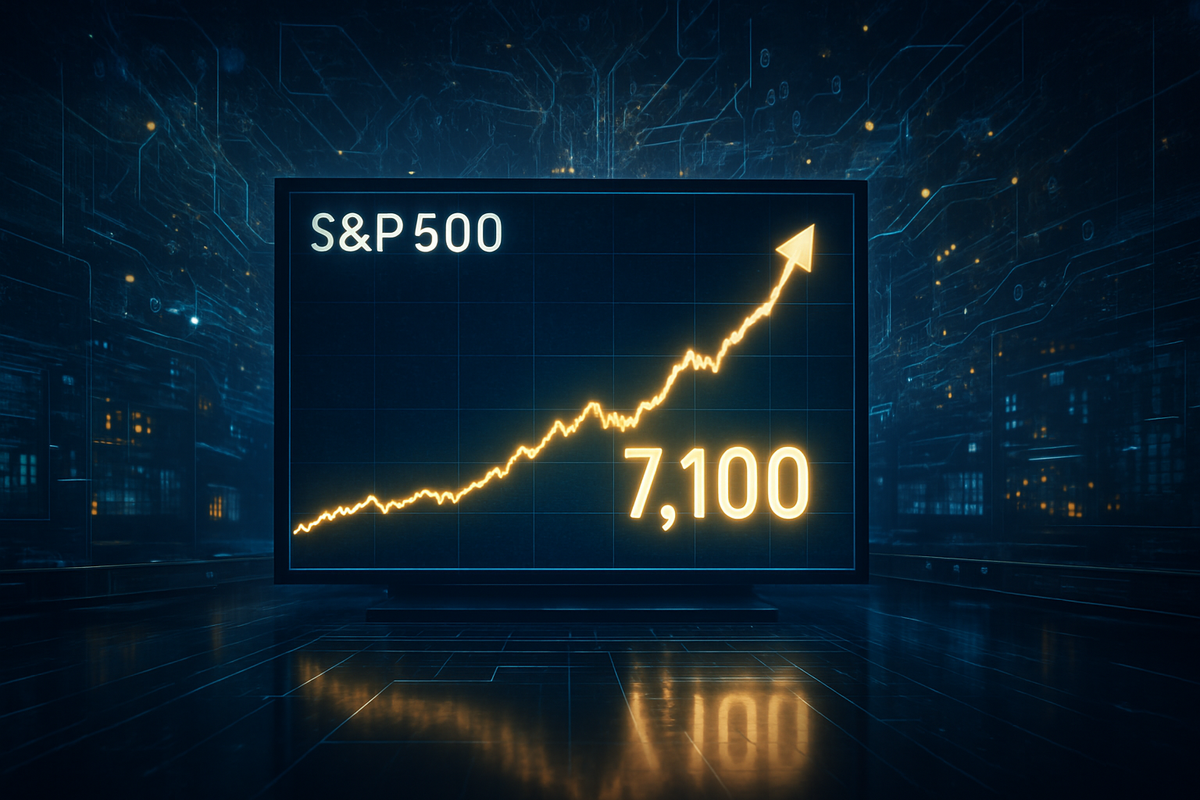
The S&P 500 has once again rewritten the history books, crossing the monumental 7,100 mark in early March 2026. This milestone, a primary year-end target set by conservative analysts at Bank of America (NYSE: BAC), signals a market that has transitioned from the speculative "hype" phase of 2024 to a robust, earnings-driven expansion. Despite lingering concerns over high valuations and an aggressive capital expenditure cycle, the index’s ascent to 7,100 underscores the deep-seated impact of artificial intelligence integration across the American corporate landscape.
The rally, which saw the index first breach the psychological 7,000 barrier on January 28, 2026, has been fueled by a "Goldilocks" economic backdrop: stable interest rates, resilient consumer spending, and a surge in corporate productivity. However, as the market hits these record highs, investors are increasingly wary of a technical pullback. With the index now trading at a significant premium to historical averages, the conversation on Wall Street has shifted from "how high can we go?" to "how long can we stay here?"
The Path to 7,100: A Technical and Fundamental Triumph
The journey to 7,100 began in late 2025, as the S&P 500 steadily climbed from the 6,800 level amid a blockbuster Q4 earnings season. The defining moment of this rally occurred on January 28, 2026, when the index touched 7,002.28 intraday, sparked by a blowout earnings report and record bookings from semiconductor equipment giant ASML (NASDAQ: ASML). This "ASML spark" reignited the tech sector, providing the final push needed to break through the 7,000 ceiling. Since then, the market has spent the last five weeks in a "choppy" consolidation phase, ultimately grinding higher to hit the 7,100 target today, March 3, 2026.
Key stakeholders, most notably the strategy team at Bank of America led by Savita Subramanian, had accurately forecasted this trajectory. BofA’s year-end 2026 target of 7,100 was initially viewed as one of the more cautious outlooks on the Street—with peers like Oppenheimer and Deutsche Bank setting targets as high as 8,100. The current milestone validates BofA’s thesis that 2026 would be a year of "growth without expansion," where double-digit earnings growth of 14% to 15% would be offset by "multiple compression" as price-to-earnings ratios begin to normalize from their 2025 peaks.
Initial market reactions to the 7,100 level have been a mix of celebration and caution. While retail investors have flooded back into index funds, institutional desks have noted a 20% decline in corporate share buybacks as companies like Microsoft (NASDAQ: MSFT) and Alphabet (NASDAQ: GOOGL) divert record amounts of cash—upwards of $37 billion per quarter—into AI infrastructure. This pivot from returning capital to shareholders to investing in long-term AI capabilities is the defining corporate strategy of the 2026 market.
Winners and Losers in the Agentic AI Era
The winners of this 7,100 rally are no longer just the chipmakers, but the "implementation leaders" who are successfully monetizing AI. ServiceNow (NYSE: NOW) has emerged as a standout, with its AI assistant "Now Assist" crossing a $600 million annual contract value, while Salesforce (NYSE: CRM) saw a 330% year-over-year increase in recurring revenue from its "Agentforce" autonomous platform. Oracle (NYSE: ORCL) has also surged, reporting 34% growth in cloud revenue as it provides the backbone for the massive data center clusters required by the "Magnificent Seven."
Conversely, the financial sector has seen a mixed bag of results. While Bank of America (NYSE: BAC) has benefited from a stable interest rate environment and rising wealth management fees, its peer JPMorgan Chase & Co. (NYSE: JPM) saw its stock dip recently after announcing that 2026 expenses would balloon to $105 billion due to massive technology investments. The market is increasingly penalizing companies that cannot prove a direct line from their high AI spending to bottom-line efficiency, a trend that could lead to a widening gap between the tech elite and the rest of the index.
Apple (NASDAQ: AAPL) remains a pillar of stability, with its services and iPhone revenue hitting record highs in early 2026. However, even the most successful companies are facing the "AI Air Pocket"—a temporary margin squeeze where the massive capital expenditures of 2025 have yet to fully translate into the productivity gains expected in 2027. This lag in ROI is the primary risk factor for companies currently trading at "priced for perfection" valuations.
Broader Significance and Historical Precedents
The S&P 500 hitting 7,100 is not just a numerical achievement; it represents a fundamental shift in the global economy. For the first time, "Agentic AI"—autonomous systems that execute complex workflows—is becoming a standard feature of enterprise software. This shift is being compared to the mid-1990s internet boom, but with a critical difference: today’s leaders are generating massive cash flows to fund their expansion, unlike the speculative "dot-com" era.
Regulatory and policy implications are also looming large. The Federal Reserve, currently maintaining interest rates between 3.5% and 3.75%, has managed to pilot the economy toward a soft landing. However, the sheer concentration of the market—with the top seven stocks now accounting for 37% of the S&P 500's total market cap—has raised concerns about systemic risk. If any one of these giants falters, the entire index is vulnerable. Historically, such high levels of concentration have often preceded periods of heightened volatility or "mean reversion."
Ripple effects are also being felt in the labor market. As companies like Palantir (NASDAQ: PLTR) and Accenture (NYSE: ACN) help Fortune 500 firms deploy AI agents, the focus has shifted from "AI replacing jobs" to "AI enhancing productivity." This narrative has kept consumer confidence high, which in turn has supported the earnings growth necessary to sustain the 7,100 level. However, the threat of "sluggish" rate cuts from the Fed remains a shadow over the market’s continued upward trajectory.
The Road Ahead: 8,500 Bull Case vs. 5,500 Bear Case
Looking forward, the market faces two distinct paths. The bull case, supported by several top-tier investment banks, suggests that if AI implementation leads to a faster-than-expected productivity boom, the S&P 500 could reach as high as 8,500 by the end of 2027. This scenario assumes that corporate margins will expand as the "Air Pocket" of high CapEx closes and the Fed begins a more aggressive easing cycle.
The bear case, however, cannot be ignored. Bank of America’s "air pocket" warning suggests that if the anticipated AI gains fail to materialize in 2026, or if a geopolitical event triggers a recessionary "air pocket," the index could retreat toward the 5,500 level. Investors must also contend with "multiple compression," where the market refuses to pay the same high multiples for earnings as it did during the 2024-2025 hype cycle. Strategic pivots will be required, with a potential rotation into value sectors like Healthcare and Real Estate as investors seek safety.
Conclusion: A Market at a Crossroads
The S&P 500 reaching 7,100 is a testament to the enduring power of American innovation and the transformative potential of artificial intelligence. It marks the successful transition from a valuation-led rally to an earnings-driven bull market. However, the milestone also serves as a warning. With valuations stretched and the "Magnificent Seven" carrying an unprecedented share of the market’s weight, the margin for error has never been thinner.
For investors, the key takeaway is that 2026 will likely be a year of consolidation and "stock-picking" rather than broad-based index gains. While hitting 7,100 is a cause for celebration, the real test lies in the upcoming Q1 2026 earnings reports, where companies will need to prove that their AI investments are starting to pay off. Moving forward, the market's focus will remain squarely on the Federal Reserve’s next move and the ability of corporate America to bridge the gap between AI promise and AI profit.
This content is intended for informational purposes only and is not financial advice.