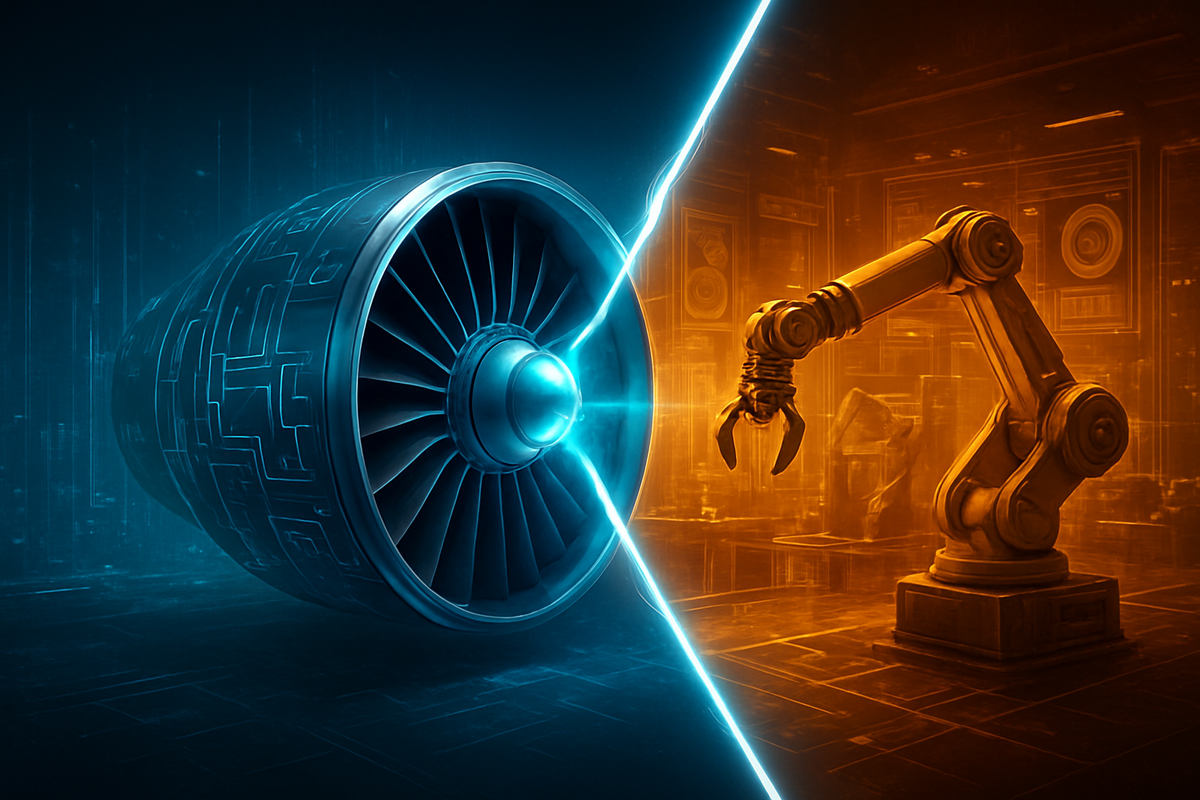
CHARLOTTE, N.C. – March 5, 2026 – In a definitive move to dismantle its century-old conglomerate structure, Honeywell International Inc. (Nasdaq: HON) has reached a critical milestone in its multi-year transformation. On March 3, 2026, the industrial giant filed its Form 10 registration statement with the U.S. Securities and Exchange Commission, officially setting the stage for the spin-off of its Aerospace division into a standalone, publicly traded entity.
The new company, to be named Honeywell Aerospace (Nasdaq: HONA), is expected to debut in the third quarter of 2026. This structural overhaul, the largest in the company's history, is being hailed by Wall Street as a primary catalyst to unlock billions in shareholder value by eliminating the "conglomerate discount" that has long weighed on Honeywell’s valuation. Following the successful model of General Electric’s (NYSE: GE) recent breakup, Honeywell's leadership is betting that a leaner, focused automation business and a pure-play aerospace leader will command higher market multiples.
A Decisive Break: From Conglomerate to Pure-Play
The filing of the Form 10 is the culmination of a high-stakes strategy first signaled by CEO Vimal Kapur in early 2025. The roadmap for this separation was accelerated following intense pressure from activist investor Elliott Investment Management, led by Paul Singer, which disclosed a $5 billion stake in Honeywell in November 2024. Elliott argued that the conglomerate's complexity was stifling growth and suggested that a split could boost the share price by as much as 75% within two years.
Honeywell's transition has been methodical. On January 1, 2026, the company officially transitioned to a new reporting structure, organizing its core into four high-growth segments: Aerospace Technologies, Building Automation, Industrial Automation, and Process Automation & Technology. This followed the successful October 2025 spin-off of its advanced materials business, now trading as Solstice Advanced Materials (Nasdaq: SOLS), which served as a operational pilot for the much larger Aerospace separation. The upcoming spin-off of HONA will finalize the "three-way split," leaving the "RemainCo"—Honeywell Automation—to focus on the industrial transition toward autonomy and software-integrated systems.
Identifying the Winners: Shareholders and Pure-Play Peers
The primary winners of this structural shift are expected to be long-term shareholders and activist investors like Elliott Management. Analysts at Wolfe Research have projected a "sum-of-the-parts" valuation for the post-split entities of approximately $293 per share, a significant premium over Honeywell's historical trading range. By creating Honeywell Aerospace (Nasdaq: HONA), management is delivering a massive pure-play aerospace and defense supplier with projected 2025 net sales of $17.4 billion and $1.5 billion in net income.
Industry peers such as GE Aerospace (NYSE: GE) and RTX Corporation (NYSE: RTX) are also key beneficiaries of this trend, as the emergence of another high-quality pure-play competitor clarifies sector benchmarks. GE Aerospace, in particular, has seen its stock price soar by over 140% since its own split in 2024, providing a "gold standard" for Honeywell to follow. On the other side, the "RemainCo," focused on automation, will now compete directly with companies like Emerson Electric Co. (NYSE: EMR) and Rockwell Automation (NYSE: ROK) without the distraction of a capital-intensive aerospace wing, allowing for more aggressive M&A and R&D in the software space.
The De-Conglomeration Trend and Wider Industry Significance
Honeywell’s split is not an isolated event but a landmark in the broader "de-conglomeration" trend sweeping the industrial sector. For decades, the conglomerate model—pioneered by leaders like Jack Welch—was the industry standard. However, the market has increasingly penalized diversified firms, favoring "pure-play" transparency where capital can be allocated more efficiently to specific industry cycles. The recent success of GE Vernova (NYSE: GEV), which has seen its stock price quadruple since its April 2024 spin-off, has validated this strategy for boards and activists alike.
The move also carries significant regulatory and policy implications. As two separate entities, Honeywell Aerospace and Honeywell Automation will have distinct balance sheets, making them more agile targets—or acquirers—in a consolidating defense and tech landscape. For the broader market, this spin-off signifies a shift in how industrial giants view "megatrends." While the old Honeywell attempted to capture growth across every sector, the new entities will focus exclusively on the Future of Aviation (HONA) and Industrial Autonomy (HON), reflecting a more surgical approach to global economic shifts.
The Horizon: Investor Day and Final Execution
Looking ahead, the next major milestone is the Honeywell Aerospace "Investor Day," scheduled for June 3, 2026, in Phoenix, Arizona. During this event, CEO-elect of HONA, Jim Currier, is expected to detail the standalone company’s capital allocation strategy, dividend policy, and long-term growth targets. Investors will be watching closely for signs of how aggressively the new aerospace entity will pursue acquisitions in the space and electronic solutions markets.
In the short term, the "RemainCo" (Honeywell Automation) faces its own set of challenges and opportunities. The company has already indicated plans to divest lower-margin units like Productivity Solutions & Services in the first half of 2026 to further sharpen its focus. The goal is to reach a high single-digit organic growth rate and expand segment margins to over 23%. Should these targets be met, the automation business could see a re-rating similar to that of high-growth software firms.
Investor Wrap-Up: What to Watch for in 2026
The filing of the Form 10 marks the "point of no return" for Honeywell’s transformation. For investors, the takeaway is clear: the industrial conglomerate era is largely over, replaced by a focus on strategic purity and operating agility. The 2026 fiscal year will be one of transition, with projected sales for the combined entity targeting nearly $40 billion, but the real story lies in the post-spin potential of the individual parts.
As we move toward the Q3 2026 separation, market participants should keep a sharp eye on the Phoenix Investor Day and any final SEC approvals. The successful execution of this split could finalize Honeywell’s journey from a diversified industrial giant into two dominant, specialized leaders. In a market that has handsomely rewarded the GE breakup, all eyes are now on Honeywell to see if it can capture the same lightning in a bottle.
This content is intended for informational purposes only and is not financial advice.