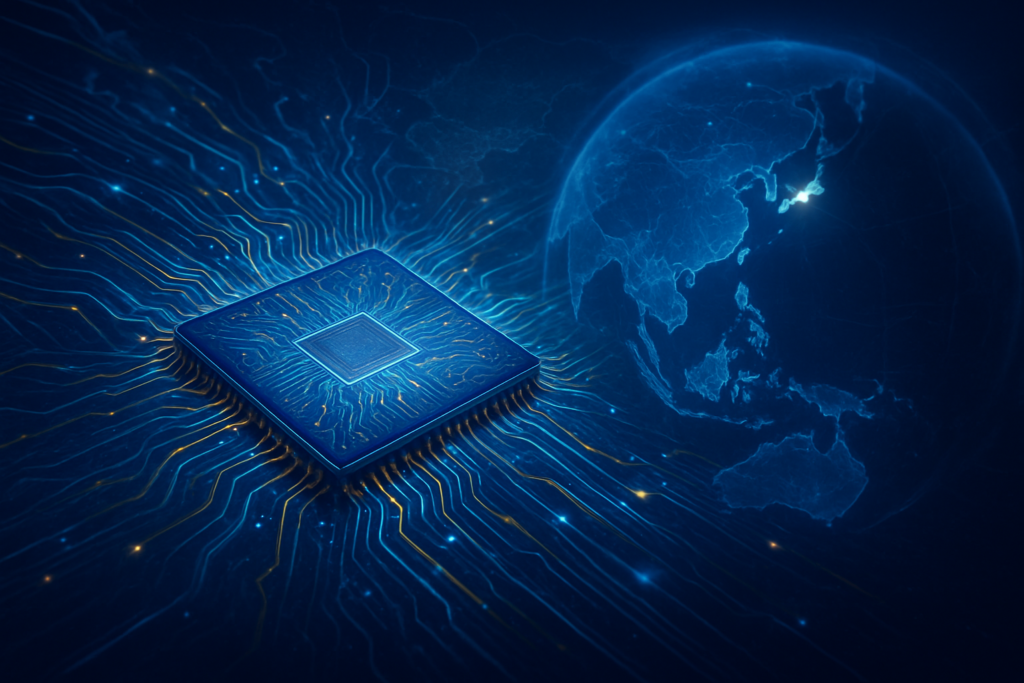
Taiwan stands as the undisputed heart of the global semiconductor industry, a tiny island nation whose technological prowess underpins virtually every advanced electronic device and, crucially, the entire burgeoning field of Artificial Intelligence. Producing over 60% of the world's semiconductors and a staggering 90% of the most advanced chips, Taiwan's role is not merely significant; it is indispensable. This unparalleled dominance, primarily spearheaded by the Taiwan Semiconductor Manufacturing Company (TSMC) (NYSE: TSM), has made the nation an irreplaceable partner for tech giants and AI innovators worldwide, dictating the pace and potential of technological progress.
The immediate significance of Taiwan's semiconductor supremacy cannot be overstated. As AI models grow exponentially in complexity and demand for computational power, the need for cutting-edge, energy-efficient processors becomes paramount. Taiwan's foundries are the exclusive manufacturers of the specialized GPUs and AI accelerators that train and deploy these sophisticated AI systems, making the island the silent architect behind breakthroughs in generative AI, autonomous vehicles, high-performance computing, and smart technologies. Any disruption to this delicate ecosystem would send catastrophic ripples across the global economy and halt the AI revolution in its tracks.
Geopolitical Currents Shaping a Technological Triumph
Taiwan's ascendancy to its current technological zenith is a story deeply interwoven with shrewd industrial policy, strategic international partnerships, and a demanding geopolitical landscape. In the 1980s, the Taiwanese government, recognizing the strategic imperative of semiconductors, made substantial investments in R&D and fostered institutions like the Industrial Technology Research Institute (ITRI). This state-led initiative, including providing nearly half of TSMC's initial capital in 1987, laid the groundwork for acquiring critical technology and cultivating a highly skilled engineering workforce.
A pivotal moment was the pioneering of the "pure-play" foundry model by Morris Chang, TSMC's founder. By exclusively focusing on manufacturing chips designed by other companies, TSMC avoided direct competition with its clients, creating a low-barrier-to-entry platform for countless fabless chip design companies globally. This strategic neutrality and reliability attracted major international clients, including American tech giants like Apple (NASDAQ: AAPL), NVIDIA (NASDAQ: NVDA), and AMD (NASDAQ: AMD), who became heavily reliant on Taiwan's manufacturing capabilities. Today, TSMC commands over 64% of the global dedicated contract chipmaking market.
This technological triumph has given rise to the concept of the "silicon shield," a geopolitical theory asserting that Taiwan's indispensable role in the global semiconductor supply chain acts as a deterrent against potential aggression, particularly from mainland China. The premise is twofold: China's own economy and military are heavily dependent on Taiwanese chips, making a conflict economically devastating for Beijing, and the global reliance on these chips, especially by major economic and military powers, would likely compel international intervention in the event of a cross-strait conflict. While debated, the "silicon shield" remains a significant factor in Taiwan's security calculus, compelling the government to keep its most advanced AI chip production within the country.
However, Taiwan's semiconductor industry operates under intense geopolitical pressures. The ongoing US-China tech war, with its export controls and calls for decoupling, places Taiwanese firms in a precarious position. China's aggressive pursuit of semiconductor self-sufficiency poses a long-term strategic threat, while escalating cross-strait tensions raise the specter of a conflict that could incur a $10 trillion loss to the global economy. Furthermore, global diversification efforts, such as the U.S. CHIPS and Science Act and the European Chips Act, seek to reduce reliance on Taiwan, though replicating its sophisticated, 60-year-old ecosystem proves challenging and costly.
The Indispensable Enabler for the AI Ecosystem
Taiwan's semiconductor industry is the critical enabler of the AI revolution, directly impacting AI companies, tech giants, and startups across the globe. TSMC's unparalleled expertise in advanced process nodes—such as 3nm, 2nm, and the upcoming A16 nodes—along with sophisticated packaging technologies like CoWoS (Chip-on-Wafer-on-Substrate), are fundamental for manufacturing the high-performance, energy-efficient chips required by AI. These innovations enable the massive parallel processing necessary for training complex machine learning algorithms, allowing for unprecedented speed and efficiency in data processing.
Leading AI hardware designers like NVIDIA (NASDAQ: NVDA) rely exclusively on TSMC for manufacturing their cutting-edge GPUs, which are the workhorses of AI training and inference. Similarly, Apple (NASDAQ: AAPL) depends on TSMC for its custom silicon, influencing its entire product roadmap. Other tech giants such as AMD (NASDAQ: AMD), Qualcomm (NASDAQ: QCOM), Google (NASDAQ: GOOGL), and Broadcom (NASDAQ: AVGO) also leverage TSMC's foundry services for their processors and AI-focused chips. Even innovative AI startups, including those developing specialized AI accelerators, collaborate with TSMC to bring their designs to fruition, benefiting from its deep experience in cutting-edge AI chip production.
This concentration of advanced manufacturing in Taiwan creates significant competitive implications. Companies with strong relationships and guaranteed access to TSMC's advanced nodes gain a substantial strategic advantage, leading to superior product performance, power efficiency, and faster time-to-market. This dynamic can widen the gap between industry leaders and those with less access to the latest silicon. TSMC's pure-play foundry model fosters deep expertise and significant economies of scale, making it incredibly difficult for integrated device manufacturers (IDMs) to catch up in advanced node technology. Furthermore, Taiwan's unique position allows it to build an "AI shield," transforming its technological dominance into diplomatic capital by making itself even more indispensable to global AI infrastructure.
Despite these strategic advantages, potential disruptions loom large. Geopolitical tensions with China remain the most significant threat, with a conflict potentially leading to catastrophic global economic consequences. The concentration of advanced chip manufacturing in Taiwan also presents a single point of failure for the global tech supply chain, exacerbated by the island's susceptibility to natural disasters like earthquakes and typhoons. While countries are investing heavily in diversifying their semiconductor production, replicating Taiwan's sophisticated ecosystem and talent pool remains a monumental challenge. Taiwan's strategic advantages, however, are multifaceted: unparalleled technological prowess, a complete semiconductor ecosystem, mass production capabilities, and a dominant share in the AI/HPC market, further bolstered by government support and synergy.
The Broader AI Landscape: A Foundational Pillar
Taiwan's semiconductor industry is not merely a participant in the AI revolution; it is its foundational pillar, inextricably linked to the broader AI landscape and global technology trends. The island's near-monopoly on advanced chip production means that the very "power and complexity" of AI models are dictated by Taiwan's manufacturing capabilities. Without the continuous advancements from TSMC and its ecosystem partners, the current explosion in AI capabilities, from generative AI to autonomous systems, would simply not be possible.
This foundational role extends beyond AI to virtually every sector reliant on advanced computing. Taiwan's ability to produce smaller, faster, and more efficient chips dictates the pace of innovation in smartphones, cloud infrastructure, medical technology, and even advanced military systems. Furthermore, Taiwan's leadership in advanced packaging technologies like CoWoS is as crucial as transistor design in enhancing chip interconnect efficiency and lowering power consumption for AI and HPC applications.
However, this centrality creates significant vulnerabilities. The geopolitical risks associated with cross-strait tensions are immense, with the potential for a conflict to trigger a global economic shock far exceeding any recent crisis. The extreme concentration of advanced manufacturing in Taiwan also represents a critical single point of failure for the global technology ecosystem, making it susceptible to natural disasters or cyberattacks. Taiwan's heavy economic reliance on semiconductors, while providing leverage, also exposes it to external shocks. Moreover, the immense power and water demands of advanced fabrication plants strain Taiwan's limited natural resources, posing energy security challenges.
Compared to previous AI milestones, Taiwan's current role is arguably more critical and concentrated. Earlier AI breakthroughs relied on general-purpose computing, but today's deep learning and large language models demand unprecedented computational power and specialized hardware. Taiwan's advanced chips are not just incremental improvements; they are the "enablers of the next generation of AI capabilities." This level of foundational dependence on a single geographical location for such a transformative technology is unique to the current AI era, transforming semiconductors into a geopolitical tool and making the "silicon shield" and the emerging "AI shield" central to Taiwan's defense and international relations.
The Horizon: Sustained Dominance and Evolving Challenges
In the near-term, Taiwan's semiconductor industry is poised to further solidify its indispensable role in AI. TSMC is set to begin mass production of 2-nanometer (2nm) chips in the second half of 2025, promising substantial improvements in performance and energy efficiency crucial for next-generation AI applications. The company also expects to double its 2.5D advanced packaging capacity, such as CoWoS, by 2026, directly addressing the growing demand for high-performance AI and cloud computing solutions. Taiwan is projected to control up to 90% of global AI server manufacturing capacity by 2025, cementing its pivotal role in the AI infrastructure supply chain.
Long-term, Taiwan aims to transcend its role as solely a hardware provider, diversifying into an AI power in its own right. Beyond nanometer-scale advancements, sustained innovation in strategic technologies like quantum computing, silicon photonics, and robotics is expected. The Taiwanese government continues to fuel this growth through initiatives like the "AI Taiwan Action Plan" and the "Semiconductor Development Programme," aiming to rank among the world's top five countries in computing power by 2040. Potential applications for these advanced chips are vast, ranging from even more powerful high-performance AI and computing in data centers to ubiquitous edge AI in IoT devices, autonomous vehicles, advanced healthcare diagnostics, and next-generation consumer electronics.
However, significant challenges persist. The escalating energy demands of advanced data centers and fabrication plants are straining Taiwan's energy grid, which relies heavily on imported energy. Geopolitical risks, particularly the US-China tech war and cross-strait tensions, continue to pose strategic threats, necessitating careful navigation of export controls and supply chain diversification efforts. Talent shortages and the immense capital investment required to maintain cutting-edge R&D and manufacturing capabilities remain ongoing concerns. While global efforts to diversify semiconductor production are underway, experts largely predict Taiwan's continued dominance due to TSMC's enduring technological lead, its comprehensive ecosystem advantage, and the evolving "AI shield" concept.
A Legacy Forged in Silicon and Strategy
Taiwan's pivotal role in the global semiconductor industry is a testament to decades of strategic foresight, relentless innovation, and a unique business model. Its dominance is not merely a matter of economic success; it is a critical component of global technological advancement and geopolitical stability. As the AI revolution accelerates, Taiwan's advanced chips will remain the indispensable "lifeblood" powering the next generation of intelligent systems, from the most complex large language models to the most sophisticated autonomous technologies.
The significance of this development in AI history is profound. Taiwan's semiconductor prowess has transformed hardware from a mere component into the very enabler and accelerator of AI, fundamentally shaping its trajectory. This has also intertwined cutting-edge technology with high-stakes geopolitics, making the "silicon shield" and the emerging "AI shield" central to Taiwan's defense and international relations.
In the coming weeks and months, the world will watch closely as TSMC continues its aggressive push into 2nm production and advanced packaging, further solidifying Taiwan's lead. The ongoing geopolitical maneuvering between the US and China, along with global efforts to diversify supply chains, will also shape the industry's future. Yet, one thing remains clear: Taiwan's tiny island continues to cast an immense shadow over the future of AI and global technology, making its stability and continued innovation paramount for us all.
This content is intended for informational purposes only and represents analysis of current AI developments.
TokenRing AI delivers enterprise-grade solutions for multi-agent AI workflow orchestration, AI-powered development tools, and seamless remote collaboration platforms.
For more information, visit https://www.tokenring.ai/.