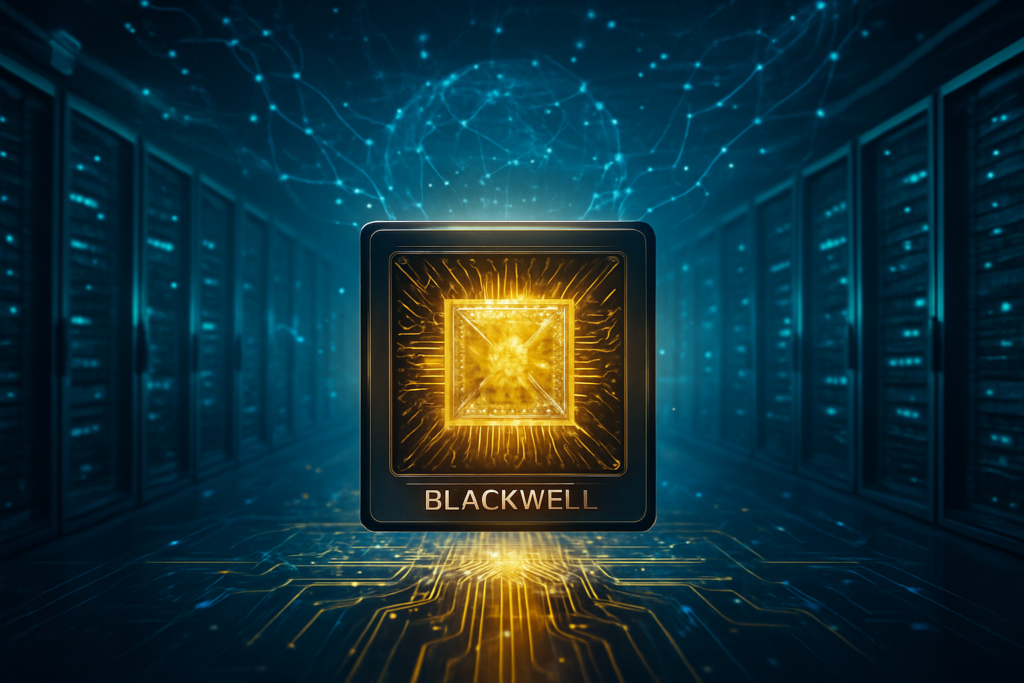
As of December 19, 2025, the landscape of artificial intelligence has been fundamentally reshaped by the full-scale deployment of Nvidia’s (Nasdaq: NVDA) Blackwell architecture. What began as a highly anticipated announcement in early 2024 has evolved into the dominant backbone of the world’s most advanced data centers. With the recent rollout of the Blackwell Ultra (B300-series) refresh, Nvidia has not only met the soaring demand for generative AI but has also established a new, formidable benchmark for large-scale training and inference that its competitors are still struggling to match.
The immediate significance of the Blackwell rollout lies in its transition from a discrete component to a "rack-scale" system. By integrating the GB200 Grace Blackwell Superchip into massive, liquid-cooled NVL72 clusters, Nvidia has moved the industry beyond the limitations of individual GPU nodes. This development has effectively unlocked the ability for AI labs to train and deploy "reasoning-class" models—systems that can think, iterate, and solve complex problems in real-time—at a scale that was computationally impossible just 18 months ago.
Technical Superiority: The 208-Billion Transistor Milestone
At the heart of the Blackwell architecture is a dual-die design connected by a high-bandwidth link, packing a staggering 208 billion transistors into a single package. This is a massive leap from the 80 billion found in the previous Hopper H100 generation. The most significant technical advancement, however, is the introduction of the Second-Generation Transformer Engine, which supports FP4 (4-bit floating point) precision. This allows Blackwell to double the compute capacity for the same memory footprint, providing the throughput necessary for the trillion-parameter models that have become the industry standard in late 2025.
The architecture is best exemplified by the GB200 NVL72, a liquid-cooled rack that functions as a single, unified GPU. By utilizing NVLink 5, the system provides 1.8 TB/s of bidirectional throughput per GPU, allowing 72 Blackwell GPUs to communicate with almost zero latency. This creates a massive pool of 13.5 TB of unified HBM3e memory. In practical terms, this means that a single rack can now handle inference for a 27-trillion parameter model, a feat that previously required dozens of separate server racks and massive networking overhead.
Initial reactions from the AI research community have been overwhelmingly positive, particularly regarding Blackwell’s performance in "test-time scaling." Researchers have noted that for new reasoning models like Llama 4 and GPT-5.2, Blackwell offers up to a 30x increase in inference throughput compared to the H100. This efficiency is driven by the architecture's ability to handle the intensive "thinking" phases of these models without the catastrophic energy costs or latency bottlenecks that plagued earlier hardware generations.
A New Hierarchy: How Blackwell Reshaped the Tech Giants
The rollout of Blackwell has solidified a new hierarchy among tech giants, with Microsoft (Nasdaq: MSFT) and Meta Platforms (Nasdaq: META) emerging as the primary beneficiaries of early, massive-scale adoption. Microsoft Azure was the first to deploy the GB200 NVL72 at scale, using the infrastructure to power the latest iterations of OpenAI’s frontier models. This strategic move has allowed Microsoft to offer "Azure NDv6" instances, which have become the preferred platform for enterprise-grade agentic AI development, giving them a significant lead in the cloud services market.
Meta, meanwhile, has utilized its massive Blackwell clusters to transition from general-purpose LLMs to specialized "world models" and reasoning agents. While Meta’s own MTIA silicon handles routine inference, the Blackwell B200 and B300 chips are reserved for the heavy lifting of frontier research. This dual-track strategy—using custom silicon for efficiency and Nvidia hardware for performance—has allowed Meta to remain competitive with closed-source labs while maintaining an open-source lead with its Llama 4 "Maverick" series.
For Google (Nasdaq: GOOGL) and Amazon (Nasdaq: AMZN), the Blackwell rollout has forced a pivot toward "AI Hypercomputers." Google Cloud now offers Blackwell instances alongside its seventh-generation TPU v7 (Ironwood), creating a hybrid environment where customers can choose the best silicon for their specific workloads. However, the sheer versatility and software ecosystem of Nvidia’s CUDA platform, combined with Blackwell’s FP4 performance, has made it difficult for even the most advanced custom ASICs to displace Nvidia in the high-end training market.
The Broader Significance: From Chatbots to Autonomous Reasoners
The significance of Blackwell extends far beyond raw benchmarks; it represents a shift in the AI landscape from "stochastic parrots" to "autonomous reasoners." Before Blackwell, the bottleneck for AI was often the sheer volume of data and the time required to process it. Today, the bottleneck has shifted to global power availability. Blackwell’s 2x improvement in performance-per-dollar (TCO) has made it possible to continue scaling AI capabilities even as energy constraints become a primary concern for data center operators worldwide.
Furthermore, Blackwell has enabled the "Real-time Multimodal" revolution. The architecture’s ability to process text, image, and high-resolution video simultaneously within a single GPU domain has reduced latency for multimodal AI by over 40%. This has paved the way for industrial "world models" used in robotics and autonomous systems, where split-second decision-making is a requirement rather than a luxury. In many ways, Blackwell is the milestone that has finally made the "AI Agent" a practical reality for the average consumer.
However, this leap in capability has also heightened concerns regarding the concentration of power. With the cost of a single GB200 NVL72 rack reaching several million dollars, the barrier to entry for training frontier models has never been higher. Critics argue that Blackwell has effectively "moated" the AI industry, ensuring that only the most well-capitalized firms can compete at the cutting edge. This has led to a growing divide between the "compute-rich" elite and the rest of the tech ecosystem.
The Horizon: Vera Rubin and the 12-Month Cadence
Looking ahead, the Blackwell era is only the beginning of an accelerated roadmap. At the most recent GTC conference, Nvidia confirmed its shift to a 12-month product cadence, with the successor architecture, "Vera Rubin," already slated for a 2026 release. The near-term focus will likely be on the further refinement of the Blackwell Ultra line, pushing HBM3e capacities even higher to accommodate the ever-growing memory requirements of agentic workflows and long-context reasoning.
In the coming months, we expect to see the first "sovereign AI" clouds built entirely on Blackwell architecture, as nations seek to build their own localized AI infrastructure. The challenge for Nvidia and its partners will be the physical deployment: liquid cooling is no longer optional for these high-density racks, and the retrofitting of older data centers to support 140 kW-per-rack power draws will be a significant logistical hurdle. Experts predict that the next phase of growth will be defined not just by the chips themselves, but by the innovation in data center engineering required to house them.
Conclusion: A Definitive Chapter in AI History
The rollout of the Blackwell architecture marks a definitive chapter in the history of computing. It is the moment when AI infrastructure moved from being a collection of accelerators to a holistic, rack-scale supercomputer. By delivering a 30x increase in inference performance and a 4x leap in training speed over the H100, Nvidia has provided the necessary "oxygen" for the next generation of AI breakthroughs.
As we move into 2026, the industry will be watching closely to see how the competition responds and how the global energy grid adapts to the insatiable appetite of these silicon giants. For now, Nvidia remains the undisputed architect of the AI age, with Blackwell standing as a testament to the power of vertical integration and relentless innovation. The era of the trillion-parameter reasoner has arrived, and it is powered by Blackwell.
This content is intended for informational purposes only and represents analysis of current AI developments.
TokenRing AI delivers enterprise-grade solutions for multi-agent AI workflow orchestration, AI-powered development tools, and seamless remote collaboration platforms.
For more information, visit https://www.tokenring.ai/.