As of February 5, 2026, the global semiconductor landscape has undergone its most radical transformation in decades. Following the enactment of Presidential Proclamation 11002 in mid-January, the United States has officially implemented a dual-track economic strategy targeting advanced logic semiconductors: a 25% import tariff on top-tier AI hardware and a controversial, first-of-its-kind revenue-sharing arrangement with China. This policy, colloquially known as the "Washington Tax," marks a departure from total export bans, opting instead to monetize the flow of "controlled but accessible" compute power to the Chinese market.
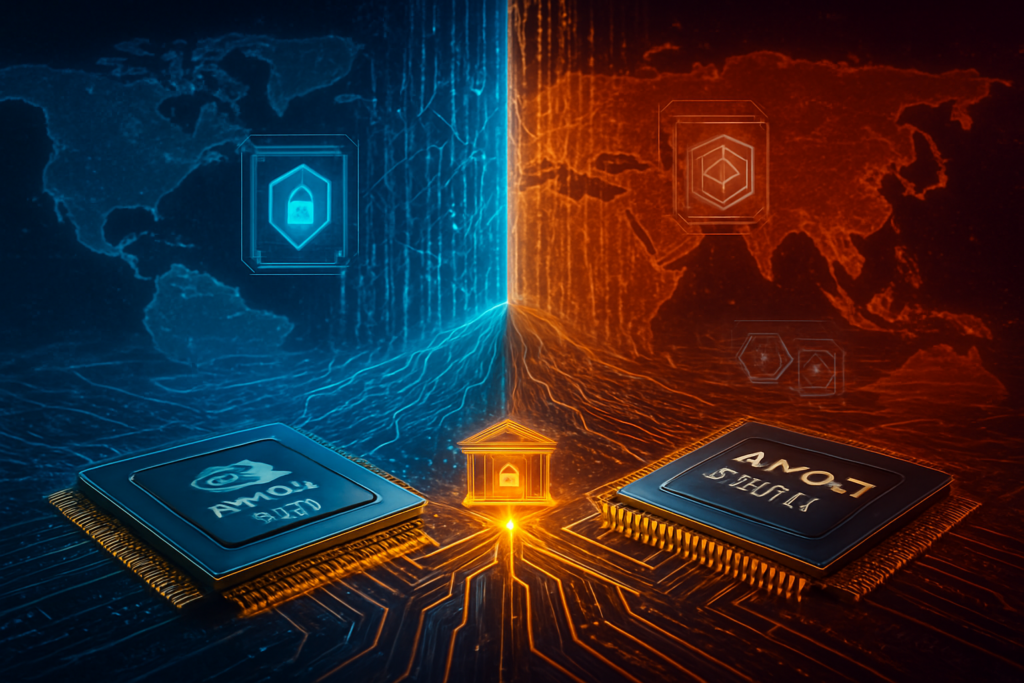
The move comes in the wake of the late-2025 "Busan Truce," a diplomatic breakthrough where the U.S. and China agreed to a fragile cessation of escalating trade hostilities. Under this new framework, the U.S. government now permits the sale of specific high-performance chips, such as the NVIDIA (NASDAQ: NVDA) H200 and AMD (NASDAQ: AMD) MI325X, to "approved customers" in China. However, this access comes at a steep price: 25% of all revenue from these transactions is redirected into the U.S. Treasury to fund domestic research and the "Project Vault" strategic semiconductor reserve.
Technical Auditing and the Hardware Gatekeepers
The technical implementation of this policy is as complex as its geopolitical goals. The baseline for the new "case-by-case" export category is defined by the processing power of the NVIDIA H200 and the AMD Instinct MI325X. The H200, built on the TSMC (NYSE: TSM) 4N architecture, boasts 141 GB of HBM3e memory and nearly 4 PFLOPS of FP8 performance. Its counterpart, the AMD MI325X, offers a massive 256 GB of HBM3E memory with 6.0 TB/s of bandwidth, making it a powerhouse for large-scale AI training. While these chips are elite by 2024 standards, they are now considered the "permissible ceiling" for export, as newer architectures like NVIDIA’s Blackwell and the rumored "Rubin" series remain strictly prohibited for Chinese entities.
To ensure compliance, the U.S. Department of Commerce has mandated a "Third-Party Lab Interception" protocol. All chips destined for China must first pass through independent, government-approved laboratories for firmware auditing. These labs install specialized, tamper-resistant firmware developed in collaboration with U.S. national laboratories. This "Proof-of-Work" firmware enables real-time auditing of compute workloads to ensure the hardware is not being utilized for unauthorized military applications or state-run weapons research.
The industry's reaction to these technical hurdles has been mixed. While researchers at major AI labs appreciate the clarity of the "case-by-case" review system—moving away from the "presumption of denial" that characterized 2024 and 2025—engineers have expressed concerns over the performance overhead introduced by the mandatory auditing firmware. Hardware enthusiasts have noted that the 1,000W TDP of the MI325X already pushes data center infrastructure to its limits, and the added layer of software monitoring only complicates the thermal management of these massive clusters.
Market Dynamics: A Windfall for the Treasury, a Challenge for the Giants
For industry leaders like NVIDIA (NASDAQ: NVDA) and AMD (NASDAQ: AMD), the 25% revenue-sharing fee represents a unique operational challenge. While it allows them to regain access to the lucrative Chinese market, the "Washington Tax" effectively narrows their profit margins on international sales or forces them to pass the cost onto Chinese buyers, who are already facing a domestic 50% equipment mandate. This mandate, enacted by Beijing in response to the U.S. tariffs, requires Chinese firms to source half of their hardware from domestic champions like Huawei and Biren.
Strategic advantages are shifting toward companies that can navigate this bifurcated supply chain. NVIDIA, which has already established a robust ecosystem through its CUDA platform, remains the preferred choice for Chinese developers, even with the added tax. Meanwhile, AMD (NASDAQ: AMD) is leveraging the MI325X’s superior memory capacity to win over large-scale training projects that require massive datasets. The revenue collected by the U.S. Treasury—estimated to reach billions by the end of 2026—is already being funneled into "Project Vault," a strategic initiative to subsidize the construction of 2nm-capable fabs on U.S. soil.
However, the 25% import tariff on these same logic chips when brought into the U.S. has created a "Buy American" incentive for domestic hyperscalers. Companies like Microsoft (NASDAQ: MSFT) and Alphabet (NASDAQ: GOOGL) are being nudged to favor chips that contribute to the "buildout of the U.S. technology supply chain." This has led to a surge in demand for domestic assembly and test facilities, providing a boost to firms involved in the reshoring movement.
Geopolitical Friction and the Silicon Sovereignty
The wider significance of the "Silicon Curtain" cannot be overstated. It represents the formalization of a "pay-to-play" era in global AI development. By allowing China to purchase older-generation silicon while taxing the revenue to fund American 2nm leadership, the U.S. is attempting to maintain a "two-generation lead" indefinitely. This strategy, however, has birthed the concept of "Silicon Sovereignty" in Beijing. China's response—a combination of massive state subsidies for domestic lithography and the 50% domestic mandate—suggests that the world is moving toward two entirely separate technology stacks.
The "Busan Truce" of late 2025 was the catalyst for this arrangement, but many analysts view it as a temporary ceasefire rather than a permanent peace. The 25% fee is currently facing legal challenges in the U.S. Court of International Trade. Critics argue that the fee violates the Export Clause of the U.S. Constitution, which prohibits taxes on exports, and exceeds the authority granted under the Export Control Reform Act (ECRA). If these legal challenges succeed, the entire revenue-sharing model could collapse, potentially leading back to the total bans seen in previous years.
Comparisons are already being made to the 1980s semiconductor friction between the U.S. and Japan, but the stakes today are significantly higher. AI compute is now viewed as a foundational resource, akin to oil or electricity. The ability of the U.S. to "tax" China’s AI progress to fund its own domestic infrastructure is a bold experiment in economic statecraft that has no historical precedent.
Future Outlook: The Road to 2nm and Beyond
Looking ahead, the next 18 to 24 months will be defined by the success of "Project Vault" and the U.S.-Taiwan landmark deal signed on January 15, 2026. This $250 billion investment aims to bring 2nm-capable production to U.S. soil by 2028. In the near term, we can expect NVIDIA and AMD to release "limited edition" versions of their next-gen chips that are specifically designed to meet the audit requirements of the "Washington Tax" framework, provided they remain below the prohibited performance thresholds.
The most significant hurdle remains the legal battle over the "Washington Tax." If the U.S. Supreme Court is eventually forced to weigh in on the constitutionality of export fees, it could redefine the executive branch’s power over international trade. Furthermore, as Chinese domestic firms like Huawei close the performance gap, the value of being an "approved customer" for U.S. silicon may diminish, leading to a potential drop-off in the revenue that currently funds U.S. reshoring efforts.
Experts predict that the "volume caps"—which limit shipments to China to 50% of U.S. domestic volume—will become the next flashpoint. As U.S. demand for AI clusters continues to skyrocket, the "ceiling" for Chinese access will rise, potentially leading to renewed concerns about the speed of China's military AI modernization.
Summary of the New Status Quo
The events of early 2026 have established a new reality for the AI industry. The "Silicon Curtain" is not just a barrier, but a complex economic filter designed to extract value from the global trade of intelligence. Key takeaways include:
- The NVIDIA H200 and AMD MI325X are the current standard-bearers for sanctioned-but-taxed exports.
- The 25% revenue-sharing fee is being used to directly fund the U.S. semiconductor reshoring movement.
- Hardware-level auditing via firmware has become a mandatory component of international AI trade.
As we move deeper into 2026, the industry must watch for the outcome of pending legal challenges and the progress of U.S. 2nm fab construction. The "Silicon Curtain" may have brought a temporary truce, but the race for computational supremacy remains as intense as ever.
This content is intended for informational purposes only and represents analysis of current AI developments.
TokenRing AI delivers enterprise-grade solutions for multi-agent AI workflow orchestration, AI-powered development tools, and seamless remote collaboration platforms.
For more information, visit https://www.tokenring.ai/.