In a move set to redefine the global AI supply chain, Taiwan Semiconductor Manufacturing Company (NYSE: TSM) has finalized plans to aggressively expand its advanced packaging capacity. By late 2026, the company aims to produce 130,000 Chip-on-Wafer-on-Substrate (CoWoS) wafers per month, nearly quadrupling its output from late 2024 levels. This massive industrial pivot is designed to shatter the persistent hardware bottlenecks that have constrained the growth of generative AI and large-scale data center deployments over the past two years.
The significance of this expansion cannot be overstated. As AI models grow in complexity, the industry has hit a wall where traditional chip manufacturing is no longer the primary constraint; instead, the sophisticated "packaging" required to connect high-speed memory with powerful processing units has become the critical missing link. By committing to this 130,000-wafer-per-month target, TSMC is signaling its intent to remain the undisputed kingmaker of the AI era, providing the necessary throughput for the next generation of silicon from industry leaders like NVIDIA and AMD.
The Engine of AI: Understanding the CoWoS Breakthrough
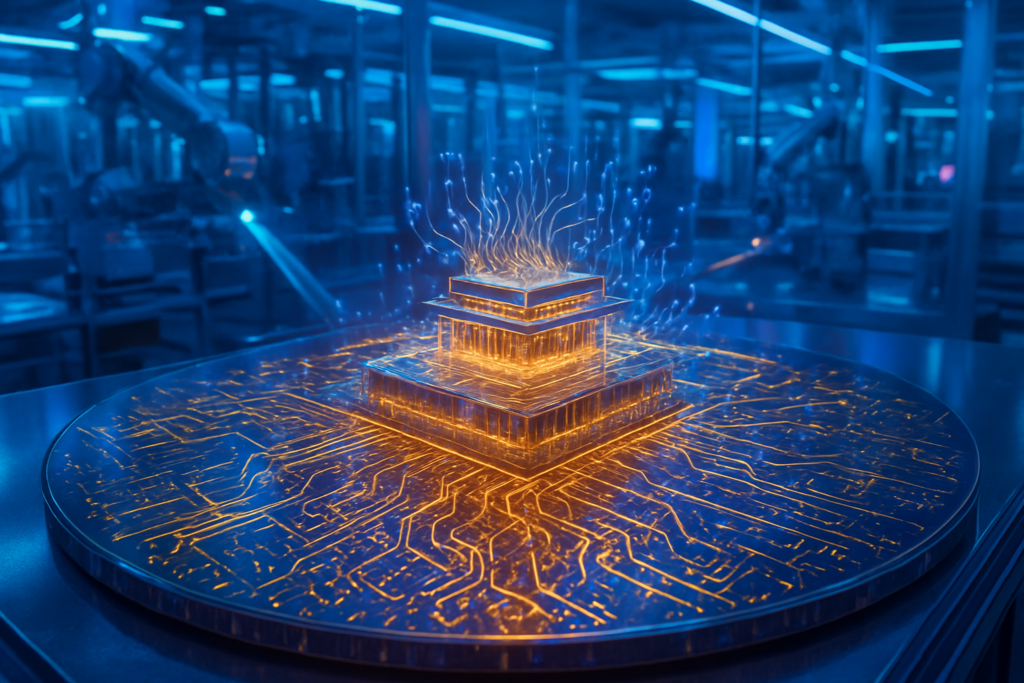
At the heart of TSMC’s expansion is CoWoS (Chip-on-Wafer-on-Substrate), a 2.5D and 3D packaging technology that allows multiple silicon dies—such as a GPU and several stacks of High Bandwidth Memory (HBM)—to be integrated onto a single interposer. This proximity allows for massive data transfer speeds that are impossible with traditional PCB-based connections. Specifically, TSMC is ramping up production of CoWoS-L (Local Silicon Interconnect), which uses tiny silicon "bridges" to link massive dies that exceed the physical limits of a single lithography exposure, known as the reticle limit.
This technical shift is essential for the latest generation of AI hardware. For example, the Blackwell architecture from NVIDIA (NASDAQ: NVDA) utilizes two massive GPU dies linked via CoWoS-L to act as a single, unified processor. Early production of these chips faced challenges due to a "Coefficient of Thermal Expansion" (CTE) mismatch, where the different materials in the chip warped at high temperatures. TSMC has since refined the manufacturing process at its Advanced Backend (AP) facilities, particularly at the AP6 site in Zhunan and the newly acquired AP8 facility in Tainan, to improve yields and ensure the structural integrity of these complex multi-die systems.
The 130,000-wafer target will be supported by a sprawling network of new factories. The Chiayi (AP7) complex is poised to become the world’s largest advanced packaging hub, with multiple phases slated to come online between now and 2027. Unlike previous approaches that focused primarily on shrinking transistors (Moore’s Law), TSMC’s strategy for 2026 focuses on "System-on-Integrated-Chips" (SoIC). This approach treats the entire package as a single system, integrating logic, memory, and even power delivery into a three-dimensional stack that offers unprecedented compute density.
The Competitive Arena: Who Wins in the Capacity Grab?
The primary beneficiary of this capacity surge is undoubtedly NVIDIA, which is estimated to have secured roughly 60% of TSMC’s total CoWoS allocation for 2026. This guaranteed supply is the backbone of NVIDIA’s roadmap, supporting the full-scale deployment of Blackwell and the early-stage ramp of its successor architecture, Rubin. By securing the lion's share of TSMC's capacity, NVIDIA maintains a strategic "moat" that makes it difficult for competitors to match its volume, even if they have competitive designs.
However, NVIDIA is not the only player in the queue. Broadcom Inc. (NASDAQ: AVGO) has secured approximately 15% of the capacity to support custom AI ASICs for giants like Google and Meta. Meanwhile, Advanced Micro Devices (NASDAQ: AMD) is using its ~11% allocation to power the Instinct MI350 and MI400 series, which are gaining ground in the enterprise and supercomputing markets. Other major firms, including Marvell Technology, Inc. (NASDAQ: MRVL) and Amazon (NASDAQ: AMZN) through its AWS custom chips, are also vying for space in the 2026 production schedule.
This expansion also intensifies the rivalry between foundries. While TSMC leads, Intel Corporation (NASDAQ: INTC) is positioning its "Systems Foundry" as a viable alternative, touting its upcoming glass core substrates as a solution to the warping issues seen in organic interposers. Samsung Electronics Co., Ltd. (KRX: 005930) is also pushing its "Turnkey" solution, offering to handle everything from HBM production to advanced packaging under one roof. Nevertheless, TSMC's deep integration with the existing supply chain—including partnerships with Outsourced Semiconductor Assembly and Test (OSAT) leader ASE Technology Holding Co., Ltd. (NYSE: ASX)—gives it a formidable head start.
The Paradigm Shift: From Silicon Shrinking to System Integration
TSMC’s massive investment marks a fundamental shift in the broader AI landscape. For decades, the tech industry measured progress by how small a transistor could be made. Today, the "packaging" of those transistors has become just as, if not more, important. This transition suggests that we are entering an era of "More than Moore," where performance gains come from architectural ingenuity and high-density integration rather than just raw process node shrinks.
The impact of this shift extends to the geopolitical stage. By centralizing the world’s most advanced packaging in Taiwan, TSMC reinforces the island’s strategic importance to the global economy. While efforts are underway to build packaging capacity in the United States—specifically through TSMC's Arizona facilities and Amkor Technology, Inc. (NASDAQ: AMKR)—the vast majority of high-volume, high-yield CoWoS production will remain in Taiwan for the foreseeable future. This concentration of capability creates a "silicon shield" but also remains a point of concern for supply chain resilience experts who fear a single point of failure.
Furthermore, the environmental and power costs of these ultra-dense chips are becoming a central theme in industry discussions. As TSMC enables chips that consume upwards of 1,000 watts, the focus is shifting toward liquid cooling and more efficient power delivery. The 130,000-wafer-per-month capacity will flood the market with high-performance silicon, but it will be up to data center operators and energy providers to figure out how to power and cool this new wave of AI compute.
The Road Ahead: Beyond 130,000 Wafers
Looking toward the late 2020s, the challenges of advanced packaging will only grow. As we move toward HBM4, which features even thinner silicon and higher vertical stacks, the bonding precision required will reach the atomic scale. TSMC is already researching hybrid bonding techniques that eliminate the need for traditional solder bumps entirely, allowing for even tighter integration. The 2026 capacity expansion is just the beginning of a decade-long roadmap toward "wafer-level systems" where a single 300mm wafer could potentially house a whole supercomputer's worth of logic and memory.
Experts predict that the next major hurdle will be the transition to glass substrates, which offer better thermal stability and flatter surfaces than current organic materials. While TSMC is currently focused on maximizing its CoWoS-L and SoIC technologies, the research and development teams in Hsinchu are undoubtedly watching competitors like Intel closely. The race is no longer just about who can make the smallest transistor, but who can build the most robust and scalable "system-in-package."
Near-term developments to watch include the specific ramp-up speed of the Chiayi AP7 plant. If TSMC can bring Phase 1 and Phase 2 online ahead of schedule, we may see the AI chip shortage ease by early 2027. However, if equipment lead times for specialized lithography and bonding tools remain high, the 130,000-wafer target might become a moving goalpost, potentially extending the window of high prices and limited availability for AI accelerators.
A New Era of Compute Density
TSMC’s decision to double down on CoWoS capacity to 130,000 wafers per month by late 2026 is a watershed moment for the semiconductor industry. It confirms that advanced packaging is the new battlefield of high-performance computing. By nearly quadrupling its output in just two years, TSMC is providing the "fuel" for the generative AI revolution, ensuring that the ambitions of software developers are not limited by the physical constraints of hardware manufacturing.
In the history of AI, this expansion may be viewed as the moment the industry moved past the "scarcity phase." As supply finally begins to catch up with the astronomical demand from hyperscalers and enterprises, we can expect a shift in focus from merely acquiring hardware to optimizing how that hardware is used. The "Compute Wars" are entering a new phase of high-volume execution.
For investors and industry watchers, the coming months will be defined by yield rates and construction milestones. Success for TSMC will mean a continued dominance of the foundry market, while any delays could provide an opening for Samsung or Intel to capture disgruntled customers. For now, all eyes are on the construction cranes in Chiayi and Tainan, as they build the foundation for the next generation of artificial intelligence.
This content is intended for informational purposes only and represents analysis of current AI developments.
TokenRing AI delivers enterprise-grade solutions for multi-agent AI workflow orchestration, AI-powered development tools, and seamless remote collaboration platforms.
For more information, visit https://www.tokenring.ai/.