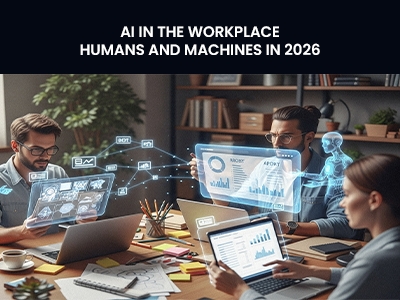
By January 2026, the American office had not been transformed into a sci-fi movie set. You will not find hovering robots making espresso or holographic managers pacing the hallways. Instead, the revolution is a quiet, flickering presence on your laptop screen. Whether you are a graphic designer in Chicago or a marketing lead in Atlanta, your newest colleague is likely an AI agent. It is a digital entity capable of drafting an entire global campaign in less time than it takes you to check your email.
This is the year AI stopped being a novelty and started being a roommate. It sits at the desk with us. It listens to our meetings. For many American workers, the primary feeling is not awe: it is a persistent, low-grade anxiety. If the machine can do the heavy lifting, what exactly is left for the human?
The Job Market: Displacement or Upgrade?
The data from the start of 2026 presents a confusing, mixed bag for the labor force. According to the latest McKinsey Global Survey, nearly 88% of organizations now use AI in at least one business function. While that sounds like a total takeover, the financial reality is more nuanced. Only 6% of these companies are actually seeing major gains. This suggests a massive gap in execution. Everyone has the tools, but very few people know how to build a profitable house with them.
Goldman Sachs Research predicts a complicated road through the rest of the decade. Analysts there estimate that widespread AI adoption could displace 6% to 7% of the U.S. workforce. However, they also argue that this is a "frictional" period. History shows us that technology usually creates more roles than it kills. In fact, Goldman Sachs expects AI to eventually drive a 15% leap in global productivity. You are likely not being replaced by a computer. You are being replaced by a person who knows how to talk to one better than you do.
The Battle for Real Creativity and the "Sea of Sameness"
In the world of art and marketing, we have hit a strange wall. Industry insiders call it the "Sea of Sameness." Because AI is trained on everything that already exists, it is incredibly good at being average. It produces the most likely next word or the most probable next pixel. If every brand uses the same algorithms to design a logo or write a script, the entire internet starts to look like bland, corporate wallpaper.
Gartner recently predicted that by late 2026, the most successful organizations will be those that "flatten" their structures and focus on human-centric content. They are realizing that digital perfection is actually boring. The most valuable creative asset in this new economy is the "human quirk." This is the ability to make a weird, illogical connection or to tell a story that feels raw and imperfect. The machine provides the clay, but the human must provide the soul.
The "Human Premium": Which Skills Actually Matter?
If you want to stay relevant in 2026, you need to stop acting like a calculator. The most in-demand skills in the current job market are no longer technical. They are deeply, stubbornly human. We are seeing the rise of the "Human Premium," where tasks requiring emotional depth are becoming more expensive as they become more rare.
The World Economic Forum (WEF) recently identified "analytical thinking" and "curiosity" as the top priorities for employers through 2030. Their research shows that while 39% of current work skills will be outdated by the end of the decade, human-centric skills like empathy and active listening are almost 30 times less likely to be automated.
Harvard Business Review echoes this sentiment. They suggest that "nuanced judgment" is the new gold standard. AI can give you a thousand data points, but it cannot tell you how a controversial decision will play out in a sensitive cultural moment. That requires a gut feeling that a processor cannot replicate.
The Rise of the AI-Orchestrator Role
We are seeing a new type of worker emerge: the AI Orchestrator. These individuals do not spend their day typing. They spend their day managing a fleet of specialized AI agents. In a modern marketing firm, an orchestrator might oversee one agent for SEO, one for graphic generation, and another for sentiment analysis.
The value of this worker is not their ability to do the work themselves. It is their ability to critique the output. They act as a high-level editor. According to data from LinkedIn’s 2026 Emerging Jobs Report, "AI Orchestrator" has become the fastest-growing job title in the professional services sector. It requires a blend of project management and deep domain expertise. If you don't know what a "good" marketing plan looks like, you cannot tell the AI when it has given you a "bad" one.
The Psychological Toll of the "Always-On" Agent
We cannot talk about 2026 without talking about mental health. The presence of AI has accelerated the pace of work to a degree that is often unsustainable for the human brain. When your digital assistant can produce a report in thirty seconds, the expectation from your boss is that you should be able to review and approve it in sixty seconds.
The American Psychological Association (APA) has noted a 22% increase in reported "digital burnout" since the start of 2025. Workers feel like they are on a treadmill that keeps speeding up. Companies are now being forced to implement "Human-Speed Polices." These are mandatory delays in workflows designed to give human brains time to process information before moving to the next task. In 2026, the most productive workers are often the ones who know when to turn the AI off.
Education and the 2026 Skills Gap
The education system is currently in a state of total upheaval. Universities are moving away from traditional essays, which are now impossible to verify. Instead, we are seeing a return to oral exams and "blue book" handwritten assessments.
The focus of a 2026 college degree is shifting toward "Prompt Engineering" and "Algorithmic Literacy." However, the most progressive schools are also doubling down on the liberal arts. They argue that to stay ahead of AI, you must understand philosophy, history, and the things that make humans tick. If you want to influence a human audience, you have to understand human nature, something an LLM only understands through a mirror of data.
The New Middle Class: The "Freelance Agentic"
A new economic class is forming in 2026: the "Freelance Agentic." These are solo entrepreneurs who use a suite of AI agents to perform the work of a twenty-person agency. We are seeing "Solopreneurs" in the legal, accounting, and architectural fields who can handle hundreds of clients at once.
This shift is putting massive pressure on traditional app development firms. Why pay a huge retainer to a law firm with fifty associates when a single specialist with a highly tuned AI agent can do the same work for a fraction of the price? The "unbundling" of the professional services industry is the biggest economic story of 2026. It is creating a "winner-take-all" market where the most skilled AI-users are capturing the majority of the wealth.
Ethical Liability and the "Human-in-the-Loop"
As AI agents take on more autonomy, the question of "Who is responsible?" has become a legal nightmare. If an AI agent at a FinTech app makes a bad investment, who pays? In 2026, the U.S. legal system has landed on the "Human-in-the-Loop" doctrine.
This means that a human must sign off on any decision that has a significant financial or physical impact. This has created a new category of "Signature Workers." These are licensed professionals whose sole job is to audit and approve the decisions made by machines. It is a high-stakes role. You aren't being paid for your labor: you are being paid for your liability.
Adapting to the New Normal: The Agency Advantage
We are moving toward a future where "information" is no longer a competitive advantage. Anyone can generate a 50-page report with a single prompt. The new advantage is agency. This is the ability to take that information and turn it into a meaningful, real-world result.
Success in 2026 does not require a computer science degree. It requires a high level of AI fluency combined with an even higher level of emotional intelligence. The workers who are thriving are those who use AI to handle the chores, freeing up their own brainpower for the high-stakes, messy, and beautiful work that only a human can do.
In the end, AI is not a replacement for the human spirit. It is a mirror. It shows us what we have been doing that was actually "robotic" all along: the filing, the data entry, the repetitive emails. By automating the boring parts of our jobs, AI is actually forcing us to be more human. It is asking us to find our passion again. The paycheck of the future belongs to those who can answer that call.
Media Contact
Company Name: Inceptives Digital
Contact Person: Mike Davis
Email: Send Email
Phone: +1 737-389-7170
Address:5900 Balcones Drive STE 100
City: Austin
State: TX 78731
Country: United States
Website: https://inceptivesdigital.com/