Google, Microsoft, and Apple claimed the top three slots. The US has the most representation, while China surpasses Japan and firmly holds the third position again.
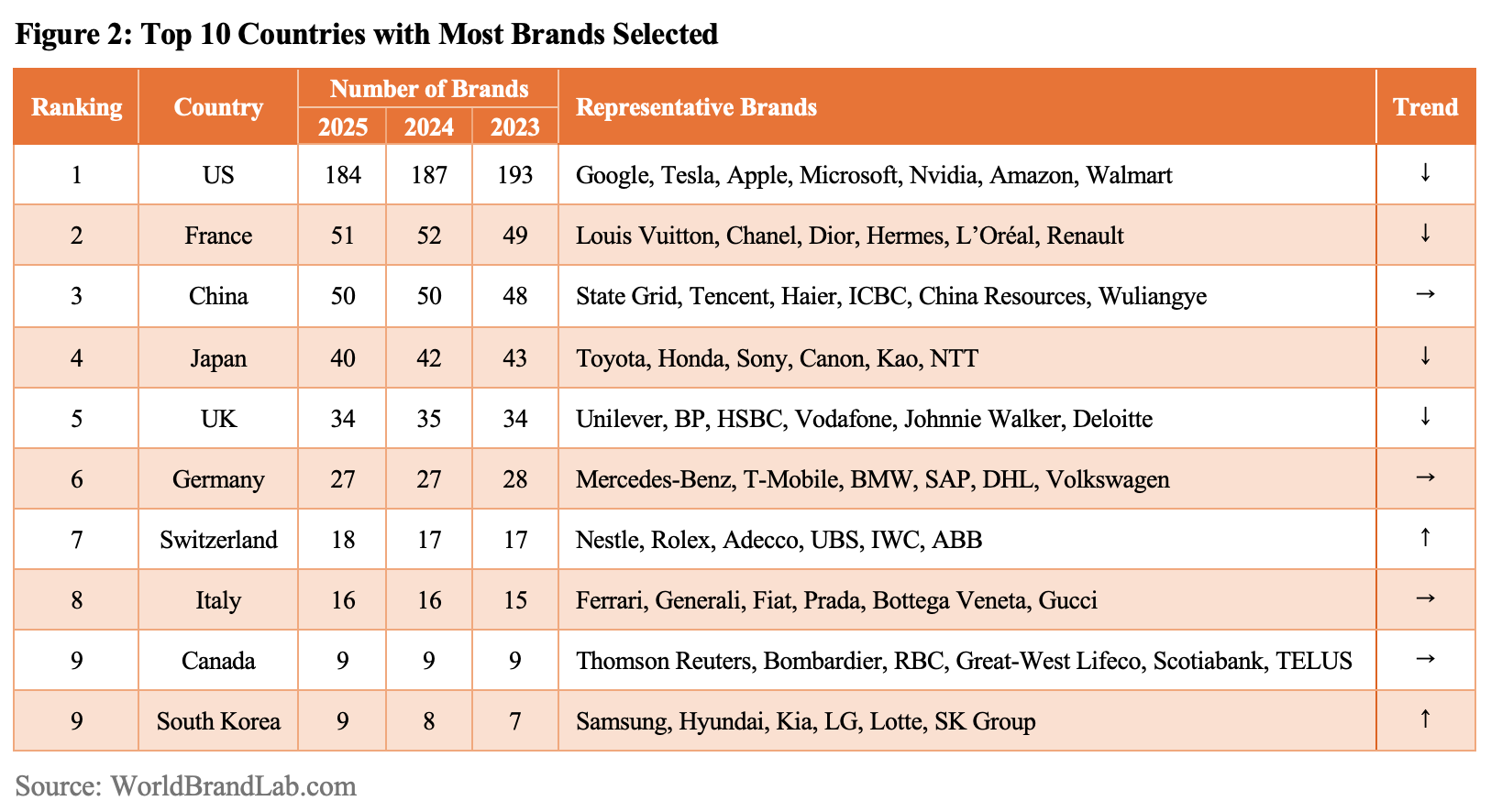
NEW YORK CITY, NEW YORK / ACCESS Newswire / December 16, 2025 / The 22nd edition of the list of the World's 500 Most Influential Brands, exclusively compiled by World Brand Lab, was unveiled on December 17 in New York, US, followed by a launch summit held in Hong Kong. Google surpassed Apple to take the top spot. Microsoft remained in second place, while Apple ranked third. The United States dominated the list with 184 entries, maintaining its position as the leading brand powerhouse. France, China, Japan, and the UK formed the second tier of global brand powerhouses. China, with 50 entries, once again surpassed Japan's 40, firmly securing the third position. Outstanding Chinese brands included State Grid, Tencent, Haier, China Resources, China Minmetals, China Southern Power Grid, Wuliangye, Poly, Air China, Changhong, Tsingtao, Sinochem, China Huadian, Hengli, Shenghong, XCMG, Hengtong, Tongwei, and Bosideng. In the era of artificial intelligence (AI), as brands serve as a core medium for contemporary cultural symbols, their creative expression is facing the double-edged impact of generative AI.
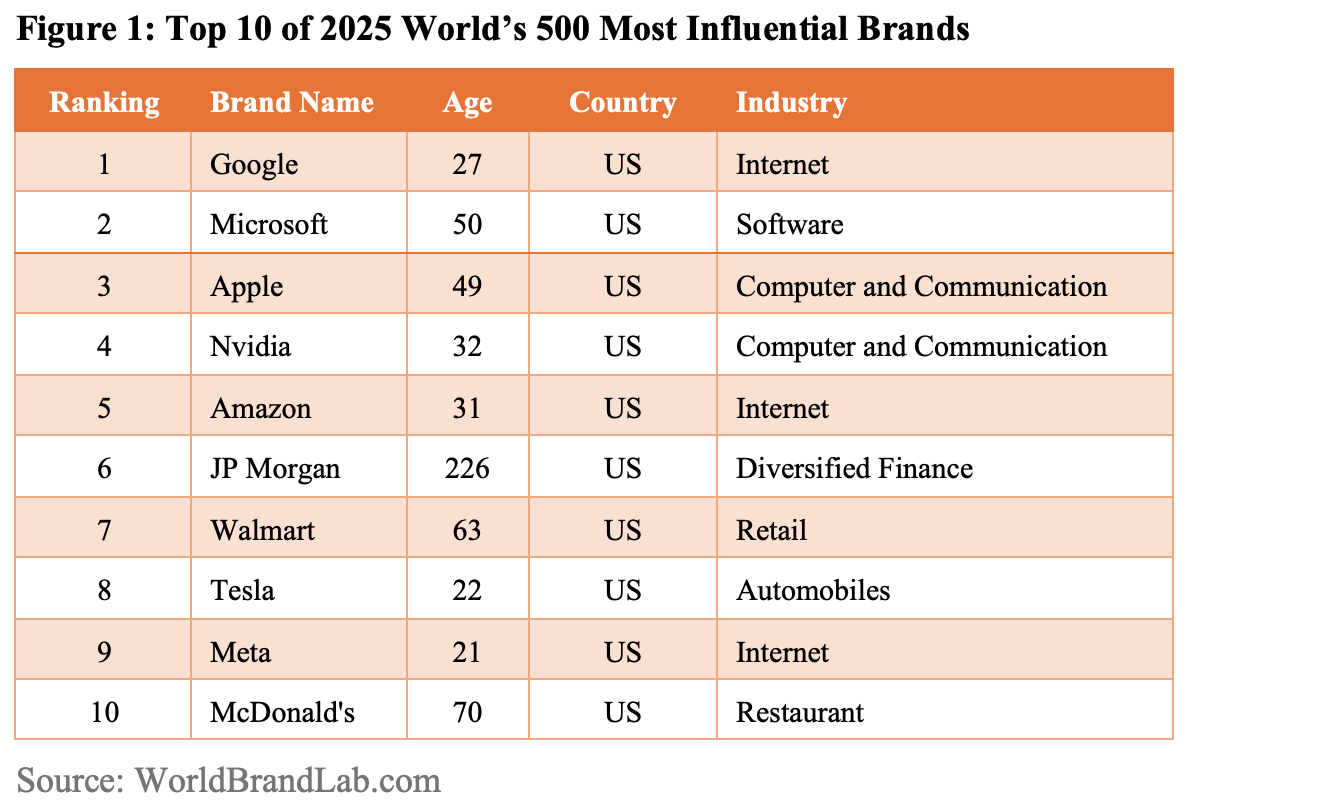
The World's 500 Most Influential Brands is judged on the basis of a brand's global influence. Brand influence refers to a brand's ability to develop and capture markets and make profits. Based on three key indicators of brand influence, namely market share, brand loyalty and global leadership, World Brand Lab tracked more than 8,000 leading brands around the globe to pioneer the World's 500 Most Influential Brands list. For assessing brand loyalty, data from iTrust Rating were referenced, and when gauging brand leadership, particularly ESG performance, SuperFinance's ESG database was consulted.
Dr. Steve WOOLGAR, Chairman of the World Brand Lab academic committee and Emeritus Professor of Marketing at the University of Oxford, noted that the World Brand Lab has been compiling the World Brand Report for 22 years. In 2025, a total of 33 countries are represented on the list. In terms of national distribution, The United States ranked first with 184 brands. France, China, Japan, and the United Kingdom form the second tier of brand powerhouses, with 51, 50, 40, and 34 brands on the list, respectively. Germany, Switzerland, and Italy constituted the third tier. Despite escalating geopolitical conflicts and mounting economic pressures, Europe's super brands have shown strong resilience-these brands are not only economic assets, but also core carriers of contemporary cultural symbols, embodying national identity and social narratives. For instance, the steady performance of UK brands is a testament to the country's deep creative heritage. Against this backdrop, World Brand Lab, through its annual reports, summits, and curatorial initiatives, fosters interdisciplinary dialogue on brands as tools for contemporary cultural storytelling, and advances sustainable, culture-driven innovation.
Research by the joint team of World Brand Lab and BrandAI finds that in an era flooded with AI-generated content, soul, the cultural depth and emotional distinctiveness infused by humans, has become a core driver of brand differentiation. Meanwhile, a study by SuperFinance shows that the correlation between brand value and ESG performance continues to strengthen. This year's World's 500 Most Influential Brands list spans 50 industries. Automobiles and parts led with 33 brands on the list; energy and food & beverage followed with 30 brands each, tying for second. Banking ranked fourth with 29 brands. Retail, computers, and communications each had 27 brands, tying for fifth. Other sectors represented include the internet (24), media (24), insurance (22), and telecommunications (21). With the advent of the AI era, tech brands related to AI have seen explosive growth. Globally, consumer spending growth has generally remained weak, and the rankings of food & beverage, media, and luxury brands have shown an overall decline.
This year's list features a total of 23 new brands. The highest-ranked newcomer is Elevance Health from the United States, positioned at 173rd overall. As a leading player in US managed care, Elevance Health has continued to raise healthcare value and deliver shareholder returns through strong financial performance and innovation in digital health, setting a benchmark for the industry. Brands such as the UK's ARM, Singapore's Shopee, and the UAE's ADNOC also made the list. China added three new entrants-CATL, China Unicom, and TONGDING-highlighting the country's significantly strengthened capabilities in new energy, infrastructure, and information and communications. Among the brands that dropped off the list in 2025 were several long-established companies affected by weakening business performance and declining profitability, such as Campbell's and Goodyear in the United States. In addition, some brands fell off the list due to major strategic missteps or reputational damage caused by external shocks, including Hertz and Japan Post.
The average age of the brands listed is 98.46 years, down from last year, mainly because rapid growth in the technology sector has driven the fast rise of a new cohort of younger brands. This year, there were 221 century-old brands, accounting for over 40% of the list. France's long-established company Saint-Gobain (360 years) is the oldest brand in the corporate world. Aviva and Moutai ranked second and third by brand age, each boasting a history of more than 300 years. Among the 50 Chinese brands on the list, only Moutai, Tsingtao, Wuliangye, Bank of China, and AIA are over 100 years old. By industry, the Food & Beverage sector stands out as the oldest, with 27 out of 30 brands surpassing the 100-year mark.
The topic of this year's World Executive Summit and World's 500 Brands Release Event, held in Hong Kong on December 17, is From Data to Intelligence: Growth Operating Models for Branding and Marketing in the AI Era. A new study by World Brand Lab finds that global brands that use digital twin models to showcase ethical sourcing and sustainable practices across global supply-chain processes can enhance their brand image and attract socially conscious consumers. Prof. Maria SAENZ, the Director of the Digital Supply Chain Transformation Lab at MIT, believes that artificial intelligence is not merely a tool, but a dynamic partner that can sense, interact, adapt, and learn. Human-AI collaboration can significantly strengthen supply-chain resilience and innovation, enabling smarter operational decisions and improving brand performance.
Artificial intelligence is reshaping the entire system, including global brands and creativity. It brings powerful opportunities for transformation, while also presenting unprecedented challenges. Prof. Ziv CARMON, Chaired Professor at INSEAD, examines that AI is rapidly reshaping branding, marketing, and organizational decision-making, yet its contribution to growth and revenue remains uneven - even as AI adoption has exploded across markets. Behavioral science helps explain this gap: leaders and organizations systematically mismanage and misjudge AI. They overestimate the benefits and underestimate the costs of oversight, rare but high-consequence errors, and reputational risk. The reason is that human cognition tends to favor speed, vivid demonstrations, and easily trackable metrics, while overlooking more complex issues such as outcomes, organizational fit, and long-term brand impact.
World Brand Lab's year-end report shows that in 2026, global brands will continue to face many challenges, including economic volatility, geopolitical tensions, digital transformation, and a crisis of sustainable trust. How can brands use AI to transform data into decisions centered on human psychological needs? Prof. Jane WANG, Chaired Professor at the College of Fashions and Textiles at Fu Jen Catholic University (FJU) in Taiwan, argues that we need to move away from a mindset focused solely on hardware specifications and instead place human psychological needs at the core, transforming product design from cold, data-driven tools and addictive algorithms into an empathetic system that reduces cognitive burden and responds to users' anxiety and uncertainty. By focusing on three design dimensions-contextual relevance, cognitive fluency, and emotional resonance-products can more accurately address users' needs in real-world situations, enhance usability and acceptance, and alleviate genuine user anxiety.
Dr. Haisen DING, Founder of the World Brand Lab, Curator of the World Brand Summit and DPhil of the University of Oxford, emphasizes that generative AI brings a double-edged effect to brand creativity: it democratizes the creative process by enabling anyone to generate content, and delivers exponential efficiency gains through data-driven workflows; yet at the same time, AI-generated content often lacks the human soul-namely, the depth of cultural storytelling and emotional authenticity. Dr. Ding emphasized that as brands are a core carrier of contemporary cultural symbols, human judgment is essential to infuse unique value. To this end, World Brand Lab is developing the BrandAI platform in London, adopting a dual-engine model: humans provide soul input and cultural judgment, while AI handles scaled generation of visuals, videos, and design. World Brand Lab was originally chaired by Prof. Robert Mundell, winner of the 1999 Nobel Prize in Economic Sciences, and is now wholly owned by the World Executive Group.
Jason Wang
Communications Manager
info@worldbrandlab.com
212-208-1429
SOURCE: World Brand Lab
View the original press release on ACCESS Newswire