Artificial intelligence (AI) stocks have been some of the market’s most volatile names over the past year, and SoundHound AI (SOUN) is no exception. The voice-AI specialist has become one of the most heavily shorted technology stocks on Wall Street, with 134.9 million shares sold short representing roughly 35.6% of its float. Such an unusually high short interest signals that a large portion of investors are betting the stock will decline. But it also creates the conditions for a potential short squeeze if sentiment suddenly shifts.
Data shows that bearish positioning in SOUN has climbed steadily in recent months, reflecting skepticism about the company’s profitability and the competitive pressures in the voice-AI market. While the voice-AI specialist has posted rapid revenue growth, it remains deeply unprofitable.
Competition is another factor fueling bearish sentiment. SoundHound operates in the highly competitive voice-AI market, where it faces formidable rivals including Amazon.com, (AMZN) and Alphabet (GOOG) (GOOGL) tech giants with vastly larger resources and established ecosystems.
Nevertheless, if a positive catalyst such as a major partnership or accelerating adoption of its conversational AI platform forces short sellers to cover their positions, the resulting buying pressure could trigger a sharp rally. With short interest among the highest in the tech sector, SoundHound could be the next candidate for a dramatic short-squeeze move.
About SoundHound Stock
Headquartered in Santa Clara, California, SoundHound is a voice-and-conversational AI company that develops speech-recognition, natural-language-processing, and voice-commerce platforms for industries such as automotive, restaurants, customer service, and smart devices. Its market cap is around $3.4 billion.
SoundHound’s stock has experienced sharp volatility over the past year, reflecting both strong investor enthusiasm around AI and growing skepticism about the company’s path to profitability. Year-to-date (YTD), the stock has declined 17.1%, indicating a weak start to 2026 as investors rotated away from high-beta AI names.
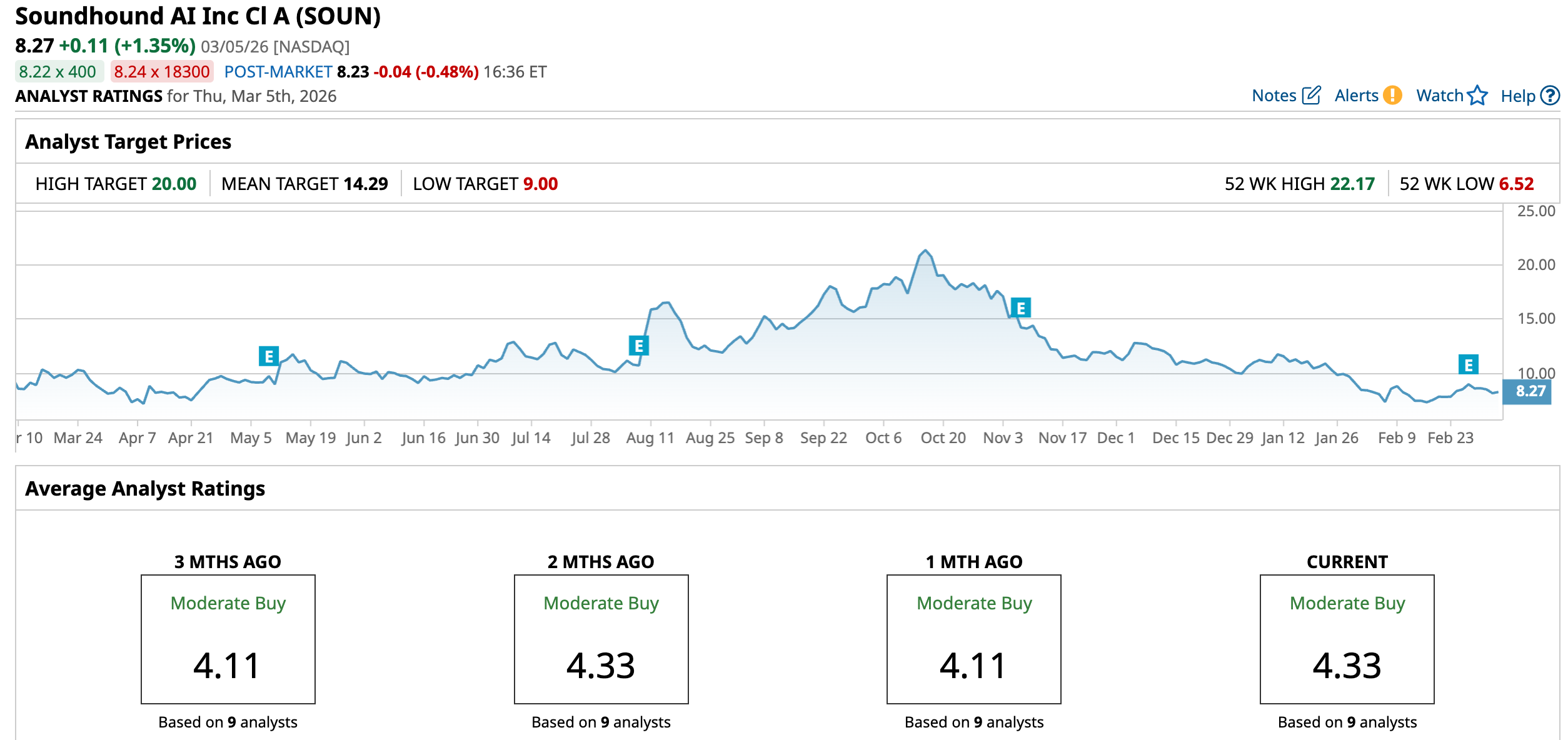
Looking at the broader picture, the stock’s 52-week performance shows an even more dramatic swing. SoundHound shares have traded at a 52-week low of about $6.52 and a 52-week high of around $22.17, reached in October 2025. The stock has pulled back by 62.7% from the October highs and is currently trading much closer to the lower end of the range, closing today's session at $8.27. Overall, the stock is down 18.52% over the past year.
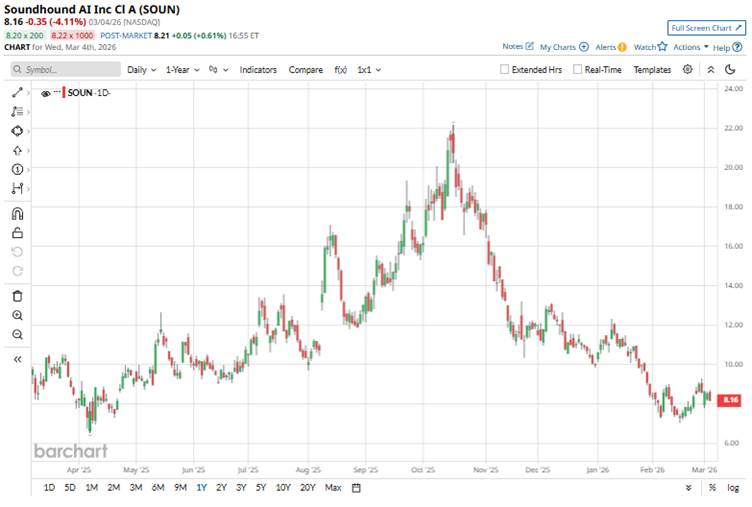
Despite the plunge, the stock trades at a lofty valuation compared to its industry peers at 14.82 times forward sales.
Improving Financials
SoundHound AI released its fourth quarter and full-year 2025 financial results on Feb. 26 that beat expectations. In the quarter ended Dec. 31, 2025, SoundHound recorded $55.1 million in revenue, a 59% year-over-year (YOY) increase, driven by strong enterprise adoption and expanded customer deals. Plus, the company reported net income of $40.1 million, a swing from prior-year losses.
The company remained in the red on an adjusted basis. SoundHound posted a non-GAAP net loss of about $7.3 million, translating to a non-GAAP loss per share of roughly $0.02, compared with a non-GAAP loss of around $0.05 per share in the fourth quarter of 2024, indicating a meaningful improvement in underlying earnings performance.
For the full fiscal year 2025, SoundHound delivered a record $168.9 million in revenue, nearly doubling its top line with a 99% YOY increase. On a GAAP basis, the company posted a net loss of $14 million for the year, a dramatic improvement from the $350.7 million net loss in 2024.
SoundHound posted a non-GAAP loss of $0.13 per share for 2025, improving from a loss of about $0.20 per share in 2024, highlighting steady progress toward narrowing losses even as the company continues to invest heavily in product development and expansion.
Also, management provided forward guidance, projecting 2026 revenue range from $225 million to $260 million, signaling confidence in continued demand for its agentic AI offerings and broader enterprise deployments.
Analysts predict loss per share to deteriorate 10.7% YOY to around $0.31 for fiscal 2026 and improve by 19.4% annually to -$0.25 in fiscal 2027.
What Do Analysts Expect for SoundHound Stock?
Recently, H.C. Wainwright lowered its price target on SoundHound to $20 from $26 while maintaining a “Buy” rating, citing near-term valuation pressure across software stocks.
On the other hand, last month, D.A. Davidson reiterated its “Buy” rating and $14 price target on SoundHound following the company’s strong fourth-quarter results.
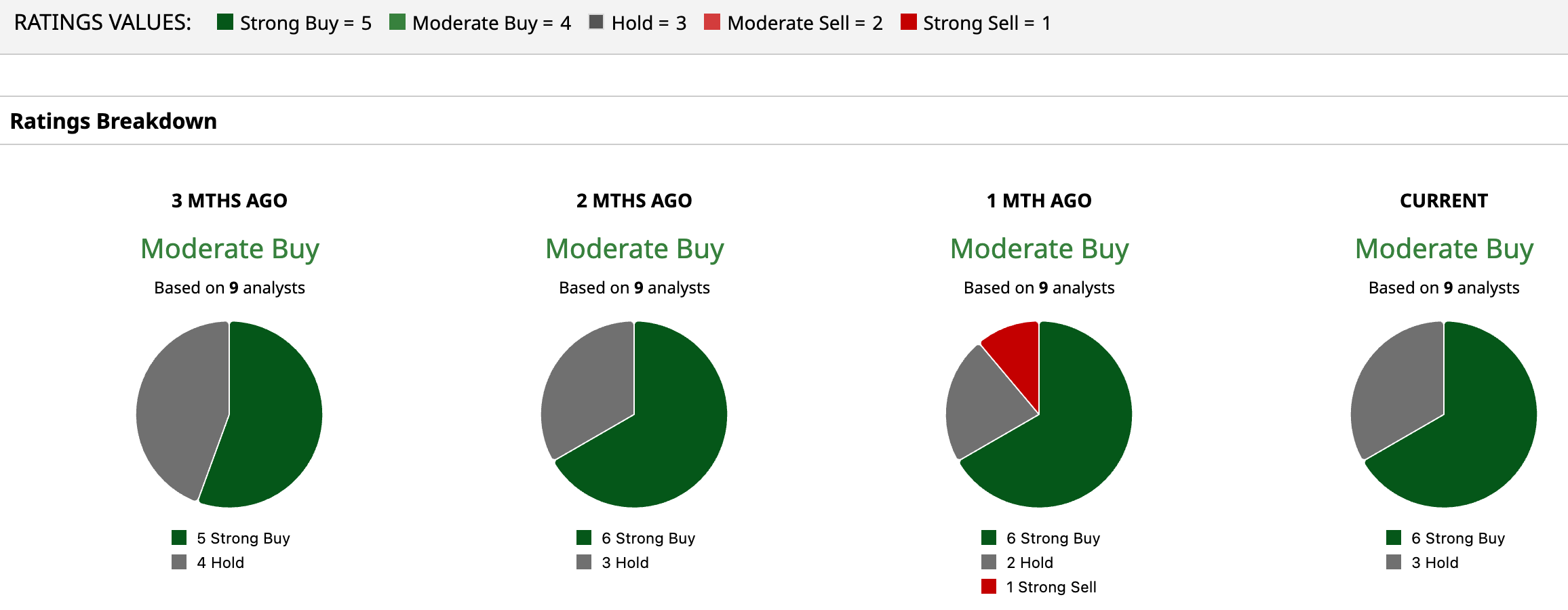
Wall Street is moderately bullish on SOUN. Overall, SOUN has a consensus “Moderate Buy” rating. Of the nine analysts covering the stock, six advise a “Strong Buy,” and the remaining three analysts are on the sidelines, giving it a “Hold” rating.
While the average analyst price target of $14.29 suggests an upside potential of 72.8%, H.C. Wainwright’s Street-high target price of $20 suggests it could still rally as much as 141.8%.
On the date of publication, Subhasree Kar did not have (either directly or indirectly) positions in any of the securities mentioned in this article. All information and data in this article is solely for informational purposes. For more information please view the Barchart Disclosure Policy here.
More news from Barchart
- SoundHound Is One of the Most Short Stocks Right Now. Should You Bet on a SOUN Squeeze?
- Down 15% in 2026, Should You Buy the Dip in Microsoft Stock?
- 1 ‘Strong Buy’ AI Stock That Wedbush Loves Now: ‘No Lost Deals’ Amid ‘Disruption’
- Okta Is Pushing Higher. Should You Chase the Rally in OKTA Stock After Earnings Here?