Date: January 16, 2026
By: Staff Financial Correspondent
Introduction
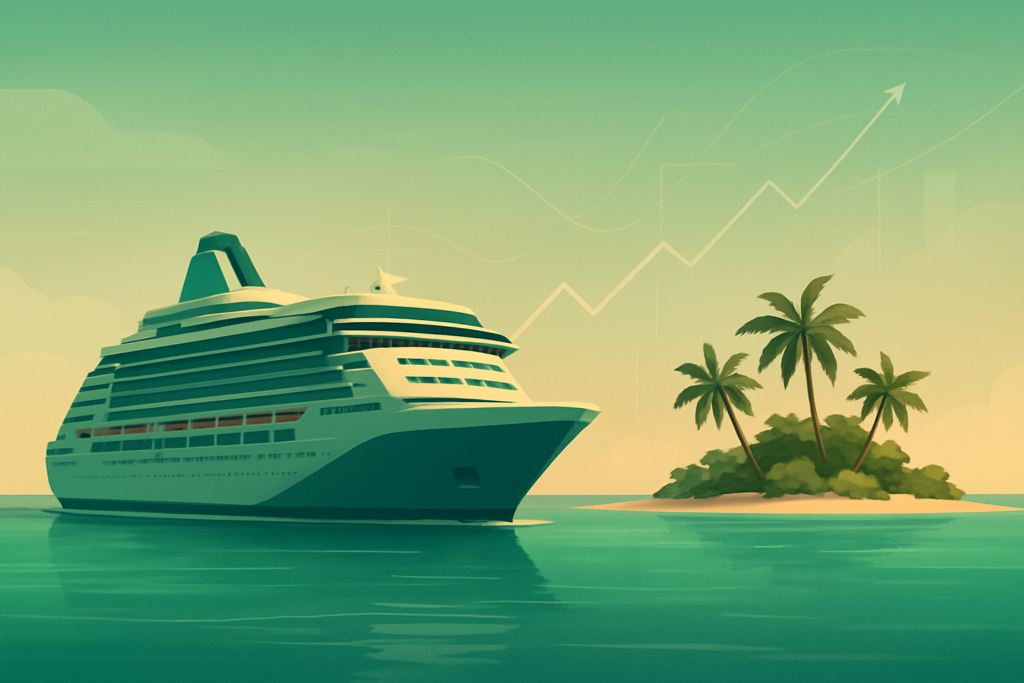
As the sun rises over the Port of Miami on this January morning in 2026, the silhouette of the Star of the Seas—the newest titan in the Royal Caribbean Group (NYSE: RCL) fleet—serves as a towering symbol of a corporate resurrection. Just four years ago, the cruise industry was a pariah of the capital markets, tethered by multibillion-dollar debt and global health restrictions. Today, Royal Caribbean has not only recovered but has fundamentally redefined itself as a high-margin "vacation ecosystem" that rivals land-based giants like Disney and Marriott. With booking demand shattering records into 2027 and the company achieving investment-grade status, RCL stands at the center of the "experience economy" boom, making it a critical focus for institutional and retail investors alike.
Historical Background
Founded in 1968 by three Norwegian shipping companies, Royal Caribbean Cruise Line (as it was then known) began with a single ship, the Song of Norway. For decades, it grew through a combination of audacious engineering—launching the world’s first "megaships"—and strategic acquisitions. The 1997 merger with Celebrity Cruises and the later acquisition of a majority stake in Silversea Cruises transformed the company into the Royal Caribbean Group, a multi-brand powerhouse catering to every segment from budget-conscious families to ultra-luxury travelers.
The company’s defining modern era began under the leadership of Richard Fain, who steered the firm for over 30 years, and has continued under his successor, Jason Liberty. The narrative of the last five years, however, is one of survival and pivot. After the total shutdown of 2020, RCL aggressively restructured its debt and used the downtime to refine its "private destination" strategy, which has since become its most significant competitive advantage.
Business Model
Royal Caribbean operates through a tri-brand architecture:
- Royal Caribbean International: The "vacation for all" brand, focusing on large-scale innovation and family demographics.
- Celebrity Cruises: Positioning itself in the "New Luxury" space, targeting affluent travelers who prefer design-forward, premium experiences.
- Silversea Cruises: An ultra-luxury and expedition brand that offers all-inclusive, smaller-ship intimacy.
The company’s revenue model is split between ticket sales (the "hook") and onboard revenue (the "margin"). By 2026, the "onboard" component has shifted significantly toward pre-cruise purchases of Wi-Fi, beverage packages, and shore excursions, which are booked via a highly integrated mobile app. Furthermore, the company’s ownership of private destinations like "Perfect Day at CocoCay" allows it to capture 100% of the shore excursion and food/beverage spend that would otherwise be lost to local operators in third-party ports.
Stock Performance Overview
Royal Caribbean’s stock performance has been nothing short of a rollercoaster.
- 1-Year Performance: As of mid-January 2026, RCL is trading around $281.00, up approximately 24% over the past twelve months.
- 5-Year Performance: Looking back to the start of 2021, the stock has seen a meteoric 310.86% total return, far outstripping the S&P 500 as it recovered from the "COVID discount."
- 10-Year Performance: Long-term shareholders have enjoyed a 347.60% return.
The stock hit a historic all-time high of $363.48 in August 2025, driven by the successful launch of Star of the Seas and the early conclusion of the "Trifecta" financial recovery program. While the stock has pulled back slightly from those highs due to broader market profit-taking in the discretionary sector, it remains a top performer in the leisure space.
Financial Performance
The fiscal year 2024 was a watershed moment for RCL, with the company reporting record revenues of $16.5 billion and an Adjusted EPS of $11.80. As we enter 2026, the momentum has not slowed.
- FY 2025 Projections: Analysts expect the final 2025 numbers to show an Adjusted EPS of approximately $15.50, a 31% year-over-year jump.
- Debt Reduction: Perhaps the most vital metric for investors is the debt-to-equity ratio, which has plummeted from over 4.0 in the wake of the pandemic to 2.01 as of early 2026.
- Valuation: Despite the price surge, RCL trades at a forward P/E ratio of approximately 16.3x, which many analysts argue is reasonable given its projected 20% earnings CAGR through 2027.
Leadership and Management
Jason Liberty, who took the helm as CEO in 2022 and added the title of Chairman in late 2025, has been praised by Wall Street for his "disciplined growth" philosophy. Alongside CFO Naftali Holtz, Liberty orchestrated the "Trifecta Program"—a three-year plan to achieve triple-digit Adjusted EBITDA, double-digit ROIC, and $10+ EPS. Having cleared those hurdles 18 months ahead of schedule, the team has now moved to the "Perfecta" program, which focuses on high-teens ROIC and further deleveraging to maintain the company’s newly minted investment-grade credit rating.
Products, Services, and Innovations
Innovation at RCL is currently defined by the Icon Class ships. Icon of the Seas and the recently launched Star of the Seas (2025) are not just ships; they are floating resorts divided into "neighborhoods." These vessels have allowed RCL to command a significant price premium—often 40% higher than the rest of the fleet.
Beyond the hardware, RCL has invested heavily in Starlink integration for fleet-wide high-speed internet and the "Destination Net Zero" initiative. The company’s move into LNG-powered (Liquefied Natural Gas) ships and fuel-cell technology is aimed at meeting increasingly stringent international emissions standards while reducing fuel volatility risks.
Competitive Landscape
RCL occupies a unique "middle-to-high" ground in the industry:
- vs. Carnival Corporation (NYSE: CCL): Carnival remains the volume leader but has historically struggled with lower margins and a more price-sensitive customer base. RCL’s yield per passenger is significantly higher.
- vs. Norwegian Cruise Line Holdings (NYSE: NCLH): While Norwegian targets a similar affluent demographic, RCL’s scale and private island ecosystem give it superior operating leverage.
RCL currently holds an estimated 25% market share of the global cruise industry by revenue, but its share of industry profits is disproportionately higher due to its pricing power.
Industry and Market Trends
The "Experience Economy" continues to be the dominant macro driver. Consumers in 2026 are prioritizing memories over material goods, a trend that has benefited the cruise sector. Specifically, multigenerational travel—where grandparents, parents, and children travel together—has become RCL’s fastest-growing segment. Furthermore, the industry is seeing a shift toward shorter, more frequent "micro-vacations," which has led RCL to deploy its largest ships on 3- and 4-night Bahamas itineraries to capture "weekend warrior" spend.
Risks and Challenges
Despite the optimism, RCL faces several headwinds:
- Capacity Oversupply: With several megaships entering the Caribbean market simultaneously, there is a risk of localized price wars if demand softens.
- Macroeconomic Sensitivity: As a consumer discretionary stock, RCL remains vulnerable to any significant spike in unemployment or a sustained economic downturn.
- Fuel and Interest Rates: While debt is being repaid, the cost of servicing remaining billions in debt is still subject to the interest rate environment, and fuel prices remain a volatile "X-factor" in operating margins.
Opportunities and Catalysts
The primary catalyst for 2026 is the expansion of the Royal Beach Club collection. The opening of the Royal Beach Club Paradise Island in Nassau (December 2025) and the upcoming Royal Beach Club Cozumel (mid-2026) represent a new revenue stream. These land-based extensions allow RCL to monetize the "port day" even more effectively. Additionally, the potential for a dividend reinstatement in late 2026 or early 2027 remains a major carrot for institutional investors who have been sidelined since the 2020 suspension.
Investor Sentiment and Analyst Coverage
Sentiment on the Street remains "Moderately Bullish." Of the 18 analysts covering the stock as of January 2026, 14 maintain "Buy" or "Strong Buy" ratings. The consensus price target sits at $326.27, suggesting roughly 16% upside from current levels. Institutional ownership remains high at 87.5%, with giants like Vanguard and BlackRock maintaining core positions, signaling confidence in the company’s long-term deleveraging story.
Regulatory, Policy, and Geopolitical Factors
Regulatory compliance has become a major line item on the balance sheet. As of January 1, 2026, the Norway Zero-Emissions Mandate has gone into effect for the fjords, forcing RCL to deploy its most advanced hybrid-electric ships to Northern Europe. Simultaneously, the EU Emissions Trading System (ETS) now requires 100% coverage for carbon emissions on European voyages. Geopolitically, the company has redirected capacity away from the Red Sea and parts of Eastern Europe, focusing instead on the "safe harbor" of the Caribbean and the growing demand in the Asia-Pacific region.
Conclusion
Royal Caribbean Group has transitioned from a story of survival to a story of supremacy. By shifting its focus from being "just a cruise line" to a comprehensive vacation provider, it has unlocked pricing power that few in the industry thought possible. While the stock’s rapid ascent in 2025 has priced in much of the near-term perfection, the company’s disciplined approach to debt and its "Perfecta" growth targets provide a compelling case for long-term holders. Investors should keep a close eye on the 2026 launch of the Cozumel Beach Club and the Q1 earnings report for signs that the record-breaking booking curve is holding steady.
This content is intended for informational purposes only and is not financial advice.