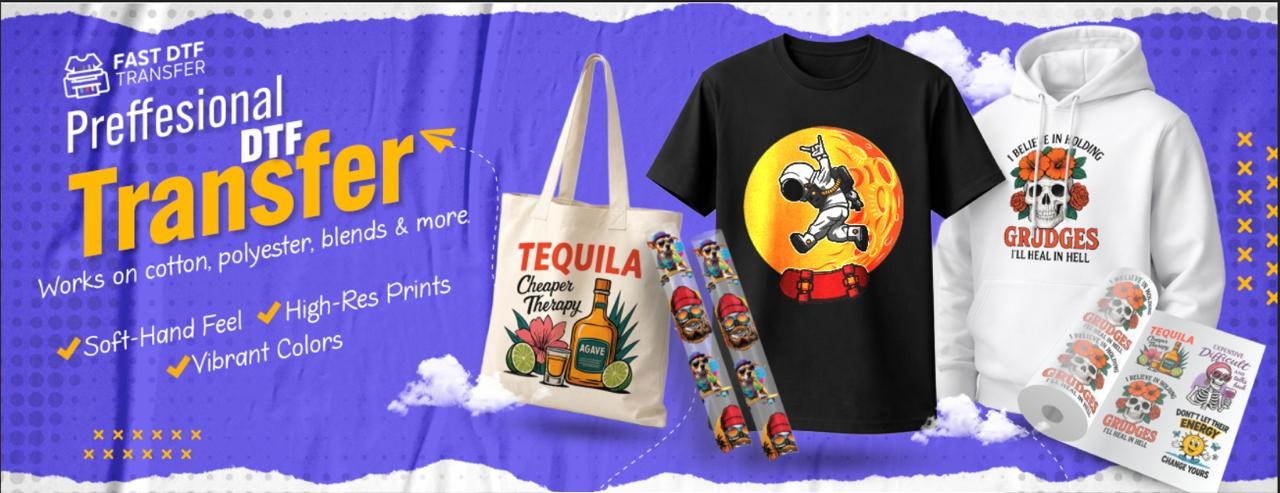
The custom apparel industry in the United States has evolved dramatically over the past decade. E-commerce growth, social media marketing, and the rise of micro-brands have changed how merchandise is designed, produced, and delivered. Instead of placing large bulk orders months in advance, many businesses now operate on demand, prioritizing flexibility, speed, and cost control.
At the center of this shift is a printing technology that has steadily gained traction across fulfillment centers, print shops, and independent brands: DTF printing services.
Direct-to-Film (DTF) printing offers a production workflow that aligns closely with modern retail dynamics. It reduces setup constraints, supports short production runs, and enables detailed full-color designs across various fabric types. For businesses navigating tight margins and fast product cycles, that combination is increasingly valuable.
The Shift Toward On-Demand Production
Traditional apparel production often required forecasting demand months in advance. Screen printing, for example, performs well at high volumes but becomes inefficient when order quantities are small. Setup costs, screen preparation, and color separation all add time and expense.
In contrast, modern brands increasingly operate with:
- Limited product drops
- Influencer collaborations
- Event-driven merchandise
- Small test batches before scaling
These models require agility. Production needs to respond quickly to trends without locking inventory into warehouses.
DTF printing services support this environment by allowing businesses to produce smaller batches without sacrificing quality or color accuracy. Because the process is digitally driven, designs can move from file to transfer quickly, reducing delays associated with traditional methods.
What Makes DTF Printing Technically Different
Direct-to-Film printing involves printing a design onto a specialized PET film using water-based pigment inks. An adhesive powder is applied to the printed layer, and the transfer is cured before being heat-pressed onto the garment.
This workflow eliminates several limitations found in other systems:
- No need for screen setup
- No complex color separation
- No fabric pre-treatment (in most cases)
- Compatibility with cotton, polyester, blends, and performance fabrics
From an operational perspective, this means businesses can maintain a single production pipeline while offering diverse garment options.
For companies evaluating scalable DTF printing services, the key appeal is consistency. Designs retain detail, gradients reproduce accurately, and prints remain flexible after application. Durability—when applied properly—meets the expectations of retail-grade apparel.
Speed As A Competitive Advantage
In today’s digital economy, timing often determines profitability. Viral moments fade quickly, and product launches tied to events require precise scheduling. Printing methods that slow fulfillment can limit growth opportunities.
DTF printing supports faster turnaround for several reasons:
- Minimal setup time
- No screen preparation
- Rapid file-to-print workflow
- Simplified production scaling
Businesses offering fast fulfillment options, including same-day or next-day transfers, can respond more effectively to customer demand spikes.
This is particularly relevant for:
- Print-on-demand stores
- Etsy sellers
- Shopify merchants
- Local apparel brands
- Event-based merchandise providers
When production speed improves without increasing defect rates, operational efficiency increases.
Cost Control And Margin Stability
Cost structure plays a significant role in production decisions. Screen printing typically becomes cost-effective at higher volumes, while low-volume runs inflate per-unit pricing.
DTF printing shifts that equation.
Because there is no plate or screen setup, smaller orders remain economically viable. This allows brands to:
- Test new designs without overcommitting
- Reduce excess inventory
- Adjust pricing strategies more dynamically
In a market where advertising costs continue to rise and customer acquisition is expensive, preserving margins is critical. Lower minimum production constraints help reduce risk during product experimentation.
Quality Expectations In Modern Apparel
Consumers increasingly expect professional-quality prints regardless of brand size. Independent creators now compete directly with established apparel companies in online marketplaces.
DTF printing has gained adoption partly because it supports high-resolution artwork and complex designs. Fine details, full-color illustrations, and intricate typography can be reproduced without requiring multiple production stages.
When evaluating print durability, businesses typically consider:
- Resistance to cracking
- Resistance to peeling
- Color retention after washing
- Stretch flexibility
DTF transfers, when applied correctly, perform competitively across these metrics. This performance consistency strengthens brand credibility, particularly for repeat customers.
Geographic Flexibility And Distributed Production
Another advantage of modern DTF printing services is geographic scalability. Because the workflow is digital and adaptable, production facilities can operate in multiple regions while maintaining similar quality standards.
For U.S.-based brands, this allows:
- Regional fulfillment strategies
- Faster shipping windows
- Reduced cross-country freight costs
As logistics expenses fluctuate, decentralized production becomes increasingly attractive. Fast transfer production in multiple states supports localized fulfillment without requiring complex infrastructure.
Supporting The Creator Economy
The creator economy continues to expand, with individuals building monetized audiences across YouTube, TikTok, Instagram, and subscription platforms. Merchandise has become a major revenue stream for creators seeking diversified income.
DTF printing aligns well with this model because it supports:
- Limited edition drops
- On-demand restocks
- Small test launches
- Design updates without retooling
Creators benefit from lower production barriers, while fulfillment partners can scale output if demand surges.
As brand communities become more niche and specialized, flexible production methods provide long-term advantages.
Operational Efficiency In E-Commerce
E-commerce platforms have reduced entry barriers for product sales, but fulfillment remains a complex component. Printing technology directly impacts how quickly orders move through the supply chain.
DTF printing integrates effectively into:
- Shopify fulfillment pipelines
- Amazon merchant workflows
- Custom order platforms
- B2B transfer supply chains
Because designs are printed onto film before application, production scheduling becomes more predictable. Transfers can be prepared in batches and applied as needed.
For companies prioritizing streamlined workflows, the predictability of DTF production supports inventory planning and labor optimization.
Market Outlook For DTF Printing In The U.S.
Industry adoption trends suggest that DTF printing will continue expanding in the U.S. market. While screen printing and other methods remain relevant for large-scale uniform orders, DTF fills a crucial gap between mass production and boutique customization.
Factors contributing to continued growth include:
- Expansion of small e-commerce brands
- Demand for lower minimum orders
- Faster consumer trend cycles
- Increased garment customization
As businesses prioritize agility over bulk scale, flexible production methods gain competitive relevance.
Conclusion
The apparel market in the United States is becoming more responsive, more data-driven, and more decentralized. Production methods must reflect those realities.
DTF printing services offer a balanced solution: digital flexibility, fabric compatibility, scalable output, and competitive durability. For brands navigating on-demand models and rapid product cycles, this technology supports both operational efficiency and creative freedom.
Rather than replacing traditional printing entirely, DTF complements existing methods by serving a segment of the market that values speed, customization, and lower volume thresholds.
As digital retail continues evolving, printing solutions that align with agile business models will remain essential components of the modern merchandise ecosystem.