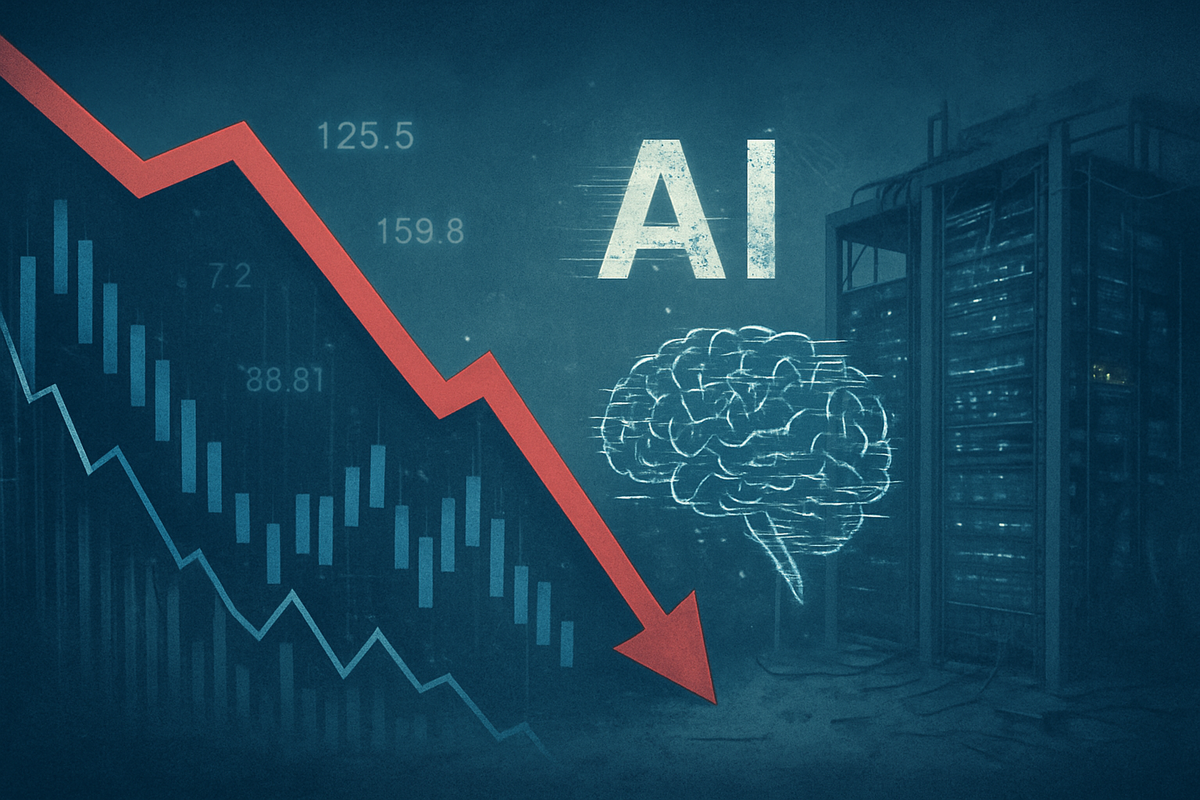
The technology sector is currently in the throes of a significant downturn, with a widespread sell-off across major tech stocks intensifying as "AI jitters" cast a long shadow over investor confidence. This market retreat, particularly pronounced in late 2025, is being exacerbated by growing apprehension regarding market valuations, the long-term profitability of artificial intelligence investments, and critical operational hurdles faced by industry giants such as Oracle (NYSE: ORCL). The confluence of these factors is prompting a reevaluation of the tech landscape, signaling a potential shift in investment strategies away from high-growth tech towards more stable sectors.
This period of heightened volatility reflects a broader unease concerning the sustainability of the recent tech rally, which saw valuations soar to unprecedented levels. As the market grapples with a weakening economic outlook and uncertainty surrounding monetary policy, the spotlight has turned sharply on the practical returns and infrastructure challenges associated with the burgeoning AI industry. The current climate suggests a critical juncture for tech companies, where robust fundamentals and tangible profitability will increasingly be scrutinized over speculative growth prospects.
Oracle's Data Center Delays Highlight Broader AI Infrastructure Challenges
The ongoing tech stock sell-off has seen the Nasdaq Composite experience substantial declines, extending a period of slipping U.S. stocks. On December 16, 2025, the Nasdaq ended down 0.6% at 23,057.41, reflecting a broader market trend where the S&P 500 also fell by 0.2% to 6,816.51, and the Dow dipped 0.1%. This retreat is fueled by concerns over slowing U.S. economic growth, a weakening labor market with unemployment rising to 4.6% in November, and uncertainty regarding future interest rate adjustments, despite a recent cut by the Federal Reserve in December 2025.
A significant catalyst for the tech sector's woes is the growing apprehension termed "AI jitters," which stems from fears of an impending "AI bubble" reminiscent of the dot-com bust. Investor scrutiny of AI spending has intensified amid reports, such as an August 2025 MIT study, indicating a staggering 95% of organizations reporting "zero return" on their estimated $30-$40 billion enterprise investments in Generative AI. The practice of "circular financing," where leading AI tech firms invest in their own customers, has also raised flags, with critics suggesting it artificially inflates stock valuations. Adding to the market unease, Broadcom (NASDAQ: AVGO) warned in December 2025 that growing sales of lower-margin custom AI processors were squeezing its profitability, sparking worries that the AI business might be less lucrative than anticipated.
At the heart of the current tech sector's struggles, and a major contributor to the "AI jitters," are the specific operational and financial challenges plaguing Oracle (NYSE: ORCL). The company's shares plunged after issuing a weak outlook and disclosing higher-than-expected capital expenditures for its aggressive, debt-funded AI infrastructure expansion. Oracle's earnings report revealed capital spending of approximately $12 billion, 40% higher than analyst expectations, and a raised fiscal year 2026 capital expenditure guidance by an additional $15 billion. These revelations led to Oracle's stock losing as much as 17%, erasing roughly $70 billion in market capitalization overnight.
A critical operational setback emerged on December 12, 2025, when reports indicated that Oracle had pushed back the completion dates for several data centers it is developing for OpenAI from 2027 to 2028. These delays, particularly at sites like Michigan, are attributed to shortages of skilled labor and materials, impacting Oracle's substantial commitments under the "Stargate" AI infrastructure program, a joint initiative with OpenAI and SoftBank (TYO: 9984). Further compounding Oracle's challenges, on December 17, 2025, Blue Owl Capital, Oracle's largest data center financing partner, withdrew its support for a planned $10 billion data center project in Saline Township, Michigan, intended to serve OpenAI. This breakdown was due to disagreements over lease terms and growing concerns about Oracle's increasing debt levels and massive AI investments, which include a disclosed 150% increase in escalated data center leases totaling $248 billion and a negative free cash flow of $10 billion. Analysts highlight Oracle's significantly high debt-to-equity ratio, noted at 500% compared to 9% for Alphabet (NASDAQ: GOOGL), raising alarms about its capacity to fund such vast expenditures.
Companies Navigating the AI Storm: Potential Winners and Losers
The continuous tech stock sell-off and the specific challenges faced by Oracle (NYSE: ORCL) are creating a distinct bifurcation in the market, distinguishing potential winners from losers in the evolving AI landscape. Companies with robust balance sheets, diversified revenue streams, and a clear, demonstrable path to profitability from their AI investments are likely to weather the storm more effectively. Conversely, those with high debt, speculative AI ventures, or significant reliance on a single, capital-intensive aspect of AI infrastructure, like Oracle's data centers, face considerable headwinds.
Among the potential losers, companies heavily invested in AI infrastructure development, particularly those with high capital expenditure and long payback periods, could suffer. Oracle's situation exemplifies this, as its aggressive, debt-funded expansion into AI data centers has led to significant investor concern over its ballooning debt and negative free cash flow. Other companies that have made substantial, unproven bets on generative AI without clear monetization strategies may also see their valuations compress. Startups and smaller AI firms relying on continuous venture capital funding could face a tougher fundraising environment as investors become more risk-averse and demand quicker returns.
Conversely, companies that provide essential, proven AI components or services, but without the massive infrastructure overhead, could emerge as relative winners. This might include chip manufacturers like Nvidia (NASDAQ: NVDA), despite some initial jitters, if demand for their core processing units remains strong and they can demonstrate sustainable profitability beyond custom AI processors. Software companies that integrate AI functionalities to enhance existing, profitable products, rather than building entirely new, speculative AI platforms, may also fare better. Furthermore, companies in more defensive sectors, or those with strong dividend yields, might attract capital fleeing the volatile tech sector, benefiting from a rotation out of growth stocks.
The financial services sector, particularly those involved in project financing, will also be closely watching developments. Blue Owl Capital's withdrawal of support for Oracle's Michigan data center project underscores a growing caution among lenders regarding the scale and risk associated with large-scale AI infrastructure investments. This could lead to stricter lending criteria and higher costs of capital for companies embarking on similar ventures, potentially slowing down the overall pace of AI infrastructure build-out across the industry.
Wider Significance: Reshaping the AI Landscape and Market Dynamics
The current tech stock sell-off, amplified by AI jitters and Oracle's (NYSE: ORCL) data center issues, carries wider significance, potentially reshaping the broader industry landscape and market dynamics. This event fits into a growing trend of investor skepticism towards speculative growth, particularly in nascent, capital-intensive sectors like advanced AI infrastructure. The exuberance seen in early 2025, driven by the promise of AI, is now giving way to a more pragmatic assessment of profitability, operational feasibility, and sustainable business models. This shift could mark a crucial turning point, moving the industry away from a "growth at all costs" mentality towards a focus on tangible returns and responsible capital deployment.
The potential ripple effects on competitors and partners are substantial. For companies like Microsoft (NASDAQ: MSFT), a key partner in OpenAI, the delays and financial concerns surrounding Oracle's data centers could necessitate a reevaluation of their own AI infrastructure strategies and partnerships. If Oracle struggles to deliver on its commitments, it could prompt other cloud providers, such as Amazon Web Services (NASDAQ: AMZN) and Google Cloud (NASDAQ: GOOGL), to accelerate their own AI infrastructure build-outs, potentially leading to increased competition and further capital expenditure across the sector. However, it could also serve as a cautionary tale, encouraging a more measured approach to expansion.
Regulatory bodies are also increasingly scrutinizing the AI industry, and events like Oracle's data center issues could intensify this oversight. Concerns about market concentration, the financial stability of key players, and the potential for an "AI bubble" have already been voiced by entities like the Dutch central bank. Such operational setbacks and financial strains could prompt regulators to consider stricter guidelines for AI infrastructure investments, debt levels, and even the transparency of AI development and deployment. This could lead to a more regulated environment, impacting everything from data privacy to the ethical implications of AI.
Historically, periods of rapid technological advancement have often been followed by market corrections, as seen during the dot-com bust of the early 2000s. The current "AI jitters," coupled with concrete operational challenges like Oracle's, bear some resemblance to those earlier periods, where speculative enthusiasm outpaced fundamental profitability. This event serves as a stark reminder that even transformative technologies require sound business execution and realistic financial planning. The market is effectively demanding a more mature approach to AI development, emphasizing sustainable growth over unbridled expansion.
What Comes Next: Navigating the Evolving AI Investment Landscape
The current tech stock sell-off and the specific challenges faced by Oracle (NYSE: ORCL) signal a period of significant adjustment and re-evaluation for the AI industry and the broader market. In the short term, we can expect continued volatility in tech stocks, particularly those with high valuations and unclear paths to AI profitability. Investors will likely remain cautious, favoring companies with strong balance sheets and proven business models over those with speculative AI ventures. This could lead to further capital rotation out of pure-play AI companies into more established tech giants with diversified revenue streams or even into defensive sectors.
In the long term, this period of correction could force strategic pivots and adaptations across the industry. Companies heavily invested in AI infrastructure, like Oracle, may need to reassess their expansion plans, potentially scaling back ambitious projects or seeking alternative financing arrangements. The emphasis will shift from sheer capacity to efficient, cost-effective, and profitable AI solutions. This could lead to a greater focus on optimizing existing infrastructure, improving operational efficiencies, and exploring partnerships that mitigate financial risk. For AI startups, securing funding may become more challenging, pushing them towards clearer monetization strategies and quicker paths to profitability.
Market opportunities may emerge for companies that can offer solutions to the very problems currently plaguing the industry. For example, firms specializing in skilled labor for data center construction, supply chain optimization for critical materials, or innovative financing models for large-scale AI projects could see increased demand. Furthermore, companies that can demonstrate tangible, measurable returns on their AI investments, even if smaller in scale, will likely gain investor confidence. The focus will shift from the promise of AI to its practical application and economic impact.
Potential scenarios and outcomes include a more mature and disciplined AI market, where sustainable growth is prioritized over speculative expansion. We might see a consolidation within the AI infrastructure space, with stronger players acquiring struggling ones, or strategic alliances forming to share the burden of massive capital expenditures. Conversely, if the "AI bubble" fears intensify, a more severe market correction could ensue, impacting a wider range of tech companies. The key will be how quickly companies can adapt to the new market realities, demonstrate value, and build resilient business models in the face of increased scrutiny and financial pressure.
Comprehensive Wrap-Up: A New Era of Scrutiny for AI Investments
The continuous tech stock sell-off, exacerbated by "AI jitters" and the very public operational and financial struggles of Oracle (NYSE: ORCL) with its data center expansion, marks a pivotal moment for the technology sector. The key takeaway is a clear shift in investor sentiment from unbridled enthusiasm for AI's potential to a more rigorous demand for demonstrable returns, operational efficiency, and financial prudence. The days of speculative investment based purely on the promise of AI appear to be waning, replaced by a critical examination of balance sheets, capital expenditures, and tangible profitability.
Moving forward, the market is likely to remain discerning, rewarding companies that exhibit robust fundamentals and a clear, sustainable strategy for integrating and monetizing AI. Oracle's situation, characterized by massive debt-funded expansion, significant capital expenditure overruns, and critical project delays, serves as a stark warning about the risks inherent in large-scale AI infrastructure bets. This event underscores that even the most transformative technologies are subject to the realities of execution, resource availability, and financial viability.
Investors should closely watch several key indicators in the coming months. These include the capital expenditure guidance of major tech players, particularly those involved in cloud and AI infrastructure; the success rates of AI projects in generating measurable returns; and any shifts in financing trends for large-scale tech initiatives. Regulatory developments concerning AI, including antitrust concerns and data governance, will also play a crucial role in shaping the investment landscape. Furthermore, the broader economic environment, including inflation, interest rates, and labor market trends, will continue to influence overall market sentiment towards growth stocks.
Ultimately, this period of correction, while challenging, could pave the way for a more mature and resilient AI industry. Companies that adapt by focusing on sustainable growth, operational excellence, and responsible capital allocation will likely emerge stronger. The current market climate is a powerful reminder that innovation, however groundbreaking, must be underpinned by sound business principles to achieve lasting success.
This content is intended for informational purposes only and is not financial advice