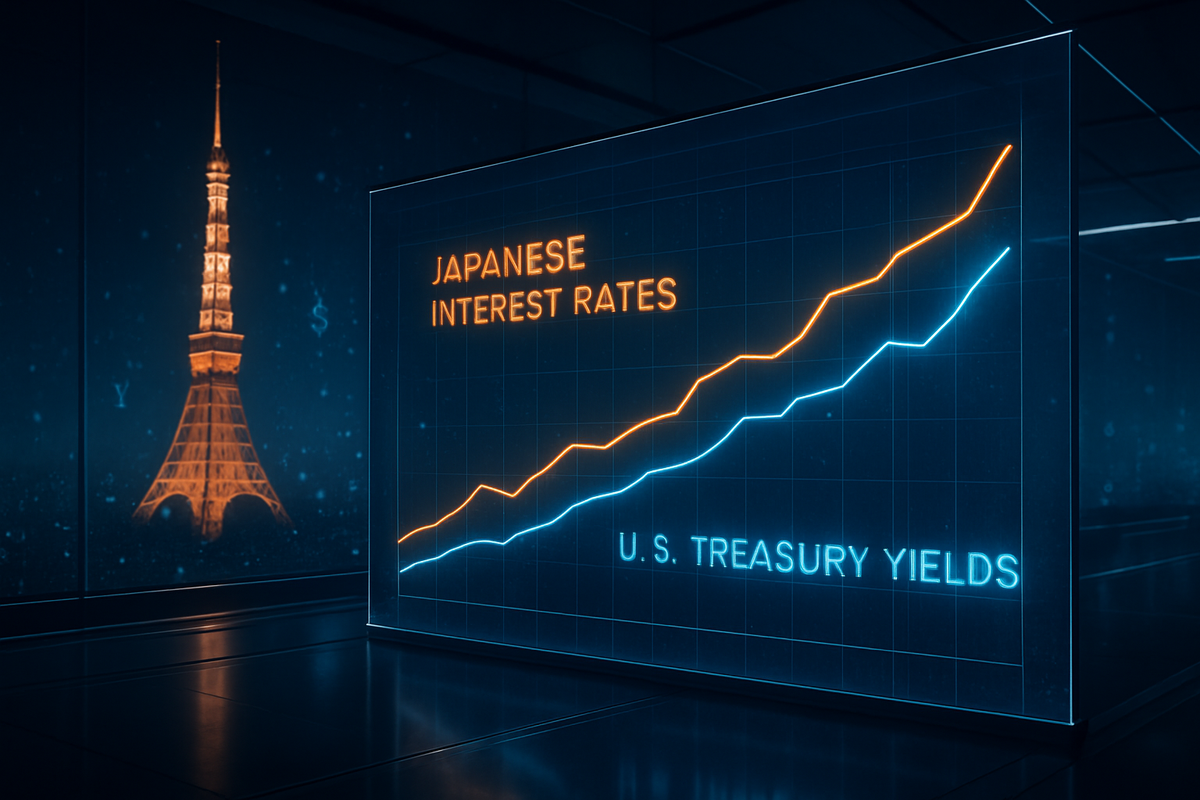
In a move that reverberated from the floor of the Tokyo Stock Exchange to the trading desks of Wall Street, the Bank of Japan (BoJ) delivered a landmark interest rate hike on December 19, 2025. Under the leadership of Governor Kazuo Ueda, the central bank raised its benchmark short-term interest rate by 25 basis points to 0.75%, marking the highest borrowing costs for the nation since 1995. This shift signals a definitive end to the era of ultra-loose monetary policy that has defined the Japanese economy for three decades, triggering an immediate upward move in global bond yields as investors recalibrated their expectations for the "yen carry trade."
The immediate implications were felt most acutely in the fixed-income markets, where the 10-year U.S. Treasury yield climbed toward 4.15% as Japanese capital began the long-anticipated process of repatriation. However, in a surprising display of resilience, the Dow Jones Industrial Average (NYSE: DIA) shrugged off the tightening of global liquidity, posting gains as domestic cooling inflation data in the United States provided a countervailing force of optimism for American equities.
A Decisive Break from the Past
The BoJ’s Policy Board reached a unanimous decision today to lift the uncollateralized overnight call rate from 0.50% to 0.75%. This represents the second hike of 2025, following a previous adjustment in January, and underscores a growing confidence in Japan’s "virtuous cycle" of rising wages and sustainable inflation. With the Japanese Consumer Price Index (CPI) hovering at 3.0%—well above the bank’s 2% target for over three years—Governor Kazuo Ueda signaled that the period of "emergency" stimulus is over.
The timeline leading to this moment has been one of cautious normalization. Since taking the helm, Ueda has methodically dismantled the complex architecture of Yield Curve Control (YCC) and negative interest rates. During his post-meeting press conference, Ueda maintained a "forward-leaning" stance, suggesting that if economic data remains consistent with forecasts, further hikes could be on the horizon. He noted that the current rate of 0.75% remains "significantly below" the neutral rate, which economists estimate to be between 1.0% and 2.5%, implying that Japanese monetary policy is still technically accommodative despite the hike.
Market participants were particularly focused on Ueda's comments regarding the U.S. economy. By stating that risks regarding American trade policy and economic growth had "declined," the Governor signaled that the BoJ no longer feels the need to remain in a defensive crouch. The reaction in Japan was one of validation; the Nikkei 225 index gained 1%, as domestic investors viewed the rate hike as a "seal of approval" for the health of the Japanese economy.
Winners and Losers in a Higher-Yield World
The shift in Japanese policy creates a complex landscape of winners and losers across the Pacific. U.S. financial institutions, such as JPMorgan Chase & Co. (NYSE: JPM) and Goldman Sachs Group Inc. (NYSE: GS), stand to benefit from the general upward pressure on global interest rates, which typically expands net interest margins. As U.S. Treasury yields rose in sympathy with Japanese Government Bonds (JGBs), the broader financial sector saw a wave of buying interest.
Conversely, Japanese exporters, long the beneficiaries of a weak yen, face a more challenging environment. A stronger yen—a natural consequence of higher domestic rates—makes Japanese goods more expensive abroad. Companies like Toyota Motor Corp (NYSE: TM) and Sony Group Corp (NYSE: SONY) may see their overseas earnings dampened if the yen continues its upward trajectory against the dollar. However, on the day of the announcement, the yen’s volatility actually provided some relief, as the hike had been largely priced in by currency traders, preventing a "flash crash" in the USD/JPY pair.
In the technology sector, the reaction was unexpectedly positive. Despite the threat of higher yields—which usually discount the future earnings of growth stocks—giants like Nvidia Corp (Nasdaq:NVDA) and Oracle Corp (NYSE: ORCL) led a rally in the Dow and Nasdaq. This was largely attributed to a "cooling" U.S. CPI report released simultaneously, which suggested the Federal Reserve might have room to cut rates in early 2026, effectively offsetting the tightening pressure coming from Tokyo.
The Unwinding of the Global Carry Trade
The broader significance of the BoJ's move lies in its impact on the "yen carry trade," a financial maneuver where investors borrow yen at low rates to invest in higher-yielding assets elsewhere. For years, this trade has been a primary source of liquidity for global markets, including U.S. Treasuries and high-growth tech stocks. As Japanese rates rise, the yield spread narrows, incentivizing Japanese institutional investors—who hold trillions in foreign debt—to bring their money home.
This event fits into a broader trend of "global monetary synchronization," where central banks are moving away from the extreme interventions of the post-2008 and post-COVID eras. The ripple effects are not just financial but structural. As the BoJ retreats from being the world’s "lender of last resort" for cheap capital, the cost of borrowing globally is likely to find a new, higher floor.
Historically, Japanese policy shifts have been precursors to periods of heightened market volatility. The "taper tantrum" of 2013 and the yen-induced volatility of early 2024 serve as reminders of how sensitive global markets are to Japanese liquidity. However, unlike previous episodes, the BoJ’s current approach has been characterized by extreme transparency, allowing markets to digest the change without the panic seen in decades past.
The Road to the Neutral Rate
In the short term, markets will be watching for the "repatriation effect." If Japanese life insurers and pension funds begin a mass sell-off of U.S. Treasuries to buy 10-year JGBs—which recently exceeded a 2.0% yield for the first time since 2006—U.S. yields could see a sustained leg up, regardless of Federal Reserve policy. This creates a potential challenge for the U.S. housing market and corporate borrowing costs.
Long-term, the strategic pivot for the BoJ will be finding the "terminal rate." If Japan successfully transitions to a 1% or 2% interest rate environment without triggering a recession, it will mark one of the most successful monetary policy pivots in history. Investors should watch for a "decoupling" where the BoJ continues to hike while the Federal Reserve and the European Central Bank begin to hold or cut, a reversal of the trend seen over the last two years.
Strategic adaptations will be required for global fund managers. The "set it and forget it" strategy of using yen as a funding currency is likely dead. We may see a shift toward other low-yield currencies, or perhaps a more fundamental move toward cash and short-term instruments as the era of "free money" officially enters the history books.
A New Era for Global Finance
The Bank of Japan’s decision on December 19, 2025, is more than just a 25-basis-point adjustment; it is a signal that the global economy has finally moved past the shadow of the Great Deflation. By raising rates to a 30-year high, the BoJ has reclaimed its ability to use monetary policy as a tool for economic management, rather than just a survival mechanism.
For the markets, the resilience of the Dow Jones and the measured rise in Treasury yields suggest that the world was ready for this move. The interconnectedness of global finance means that a butterfly flapping its wings in Tokyo can still cause a storm in New York, but for now, the storm appears to be a manageable one. Investors should remain vigilant, monitoring the USD/JPY exchange rate and the pace of Japanese capital repatriation as the primary indicators of market stress in the coming months.
The takeaway is clear: the floor for global interest rates has been raised. While the transition may be volatile, the normalization of Japanese policy is a necessary step toward a more stable and balanced global financial system.
This content is intended for informational purposes only and is not financial advice. Moving forward, investors should consult with financial professionals to understand how these global shifts affect their specific portfolios.