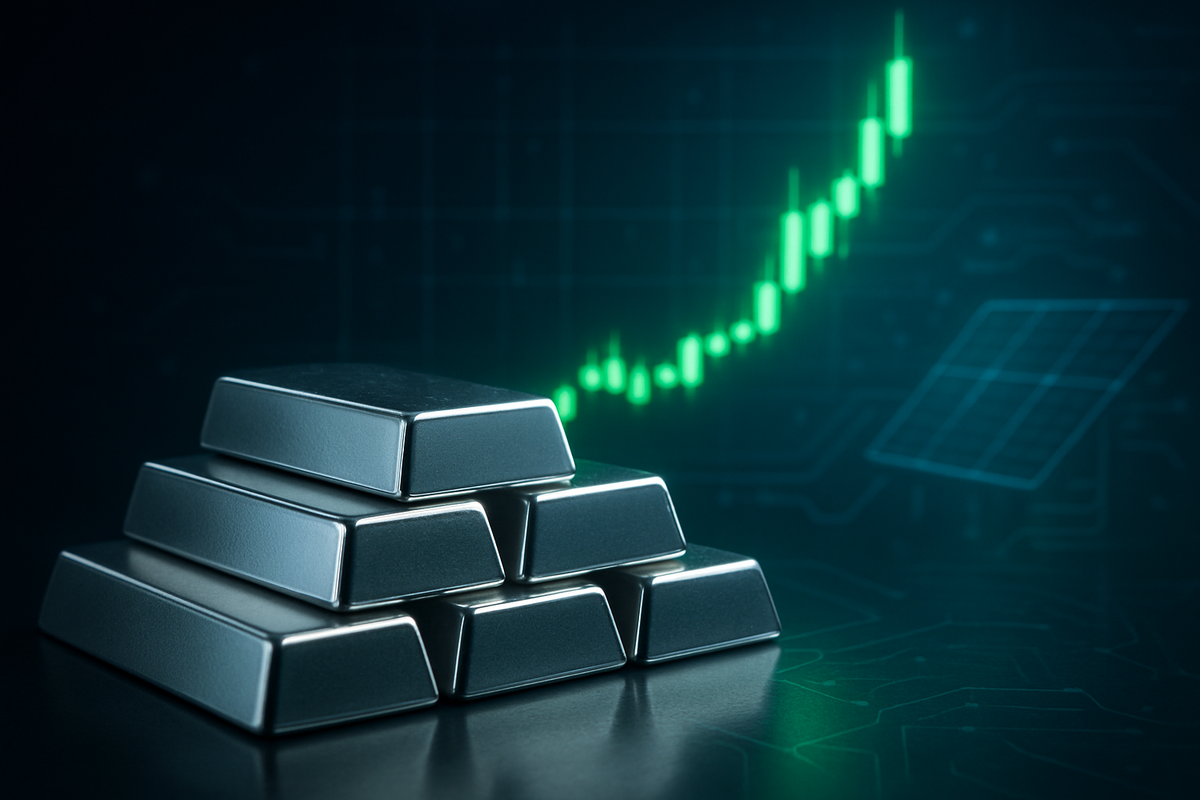
As the sun sets on 2025, the global financial markets are witnessing a generational shift in the commodities sector. Silver, often the volatile sibling of gold, has transitioned from a speculative asset into a strategic industrial titan. On December 29, 2025, silver prices reached a staggering all-time nominal high of $85.87 per ounce, marking a year-to-date surge of over 170%. While a late-December margin hike by the CME Group has cooled the rally slightly, the metal enters 2026 trading near $75, firmly established in a new "price-discovery" era that has rewritten the technical rulebooks.
This breakout is not merely a short-term spike; it is the culmination of a structural supply-demand imbalance that has been building for over half a decade. With silver officially added to the U.S. Critical Minerals list in late 2025 and China set to implement strict export licensing on refined silver starting January 1, 2026, the stage is set for a historic "silver squeeze" that many analysts believe will see the metal test the triple-digit barrier in the coming months.
A 45-Year Barrier Shattered: The Path to $85
The technical breakout of 2025 is being hailed by chartists as the completion of a massive, 45-year "Cup and Handle" pattern—a formation that began after the 1980 Hunt Brothers peak. Throughout the early 2020s, silver consolidated in a wide range, but the momentum shifted decisively in October 2025 when prices shattered the $50 psychological and historical resistance level. This "handle" release acted as a slingshot, propelling the metal through former ceilings with unprecedented velocity.
The timeline of this ascent was fueled by a "perfect storm" of catalysts. Early in 2025, silver cleared $35, a level that had capped advances for a decade. By mid-year, the global silver deficit reached a record 200 million ounces—the fifth consecutive year of structural shortfall. The situation reached a fever pitch in November when the U.S. Geological Survey (USGS) designated silver as a "Critical Mineral," acknowledging a 64% domestic reliance on imports for vital defense and green-energy technologies.
In the final weeks of December, a "vault drain" crisis was reported at major exchanges like the COMEX and LBMA. Industrial users, panicked by the impending Chinese export restrictions, scrambled to secure physical delivery. This led to a massive price disconnect, with silver in Shanghai trading at a $10 premium over Western markets. The resulting "short squeeze" pushed prices to the $85.87 peak before stabilizing as the market prepared for the new regulatory reality of 2026.
Winners and Losers: The Equity Divide
The silver surge has created a stark divide between the companies that pull the metal from the ground and those that rely on it for high-tech manufacturing.
The Winners: Miners and Streamers Mining equities with high "silver torque" have seen their valuations explode. Coeur Mining (NYSE: CDE) emerged as a market leader, delivering a 229% year-to-date return as its Rochester mine expansion reached full capacity just as prices peaked. Similarly, First Majestic Silver (NYSE: AG) saw its stock surge over 220% following its strategic acquisition of a stake in the Cerro Los Gatos mine, which tripled its cash flow in the high-price environment.
Streaming giant Wheaton Precious Metals (NYSE: WPM) has also been a primary beneficiary. With contractual costs locked in under $6 per ounce, Wheaton realized gross profit margins exceeding 80% in late 2025, sending its stock to an all-time high of $122.81. Analysts at major desks continue to rate these firms as "Strong Buys" heading into 2026, anticipating record-breaking EBITDA and free cash flow.
The Losers: Industrial Margin Squeeze Conversely, the tripling of silver costs has sent shockwaves through the technology and renewable energy sectors. Tesla (NASDAQ: TSLA) reported a significant decline in its EV segment net income for Q4 2025, as the silver required for conductivity in its battery systems and power electronics added hundreds of dollars to the production cost of every vehicle.
The solar industry has been hit even harder. Traditional manufacturers like JinkoSolar (NYSE: JKS) have seen silver paste costs jump from 5% to 14% of total production expenses. However, First Solar (NASDAQ: FSLR) has emerged as a "relative winner" in the space. Because First Solar utilizes thin-film technology—which requires 98% less silver than traditional silicon panels—it has gained a massive competitive cost advantage, allowing its stock to rise 14% while its competitors' margins cratered.
Beyond Speculation: The Strategic Shift
The 2025 breakout is fundamentally different from the speculative spikes of 1980 or 2011. While those rallies were driven by individual traders or monetary fears, the current move is anchored in "inelastic" industrial demand. Silver is now a "strategic tech-metal," essential for the AI revolution, 5G infrastructure, and the global green transition.
The inclusion of silver on the U.S. Critical Minerals list allows domestic projects to access expedited federal permitting and Defense Production Act funding. This policy shift reflects a growing concern over "resource sovereignty," especially as China—which controls nearly 70% of refined silver supply—moves to weaponize its dominance. The January 1, 2026, export licensing mandate is expected to tighten the global market further, potentially creating a permanent higher price floor above $50.
Furthermore, the "Triple Breakout" of 2025—which saw gold cross $4,500 and copper hit $11,000 per tonne—suggests a broader commodity supercycle. Because 80% of silver is produced as a byproduct of base metal mining, even record-high copper prices are failing to trigger new silver supply fast enough to meet the 20% surge in demand from the solar industry alone.
The 2026 Outlook: A March Toward $100?
As we look toward 2026, the primary question for investors is whether the rally has overextended or if the "real" squeeze is yet to come. Citigroup has recently revised its 2026 price target to $110 per ounce, citing an acute physical shortage and the potential for a "delivery bottleneck" in the March 2026 futures contracts.
While several mining projects, such as Endeavour Silver (NYSE: EXK)’s Terronera mine and AbraSilver's Diablillos project, are set to scale production in 2026, they are unlikely to bridge the 200-million-ounce deficit in the short term. The market is also watching for "silver thrifting"—efforts by EV and solar makers to substitute silver with copper or aluminum. However, analysts warn that mass-market readiness for these alternatives is still years away, leaving manufacturers with no choice but to pay the "silver tax."
The immediate focus for the first quarter of 2026 will be the implementation of China's export rules. If these licenses lead to a significant reduction in refined metal reaching Western vaults, the $85 peak of 2025 may quickly become the new baseline.
Final Thoughts for Investors
The technical breakout of 2025 has permanently altered the landscape for precious metals. Silver has successfully decoupled from its traditional role as a mere "gold proxy," trading instead on its own merits as a critical industrial component.
For investors, the key takeaways are:
- Focus on Torque: Primary silver miners and streamers remain the most direct way to play the price surge.
- Watch the Inventory: Declining stocks in COMEX and LBMA vaults are the most reliable indicators of the "squeeze" potential.
- Monitor the Substitution: Keep a close eye on technical breakthroughs in silver-free solar and EV components, as these will eventually dictate the long-term price ceiling.
As we enter 2026, the "Silver Slingshot" remains in motion. Whether the metal reaches $100 or consolidates at these elevated levels, the era of "cheap silver" appears to be a relic of the past.
This content is intended for informational purposes only and is not financial advice.