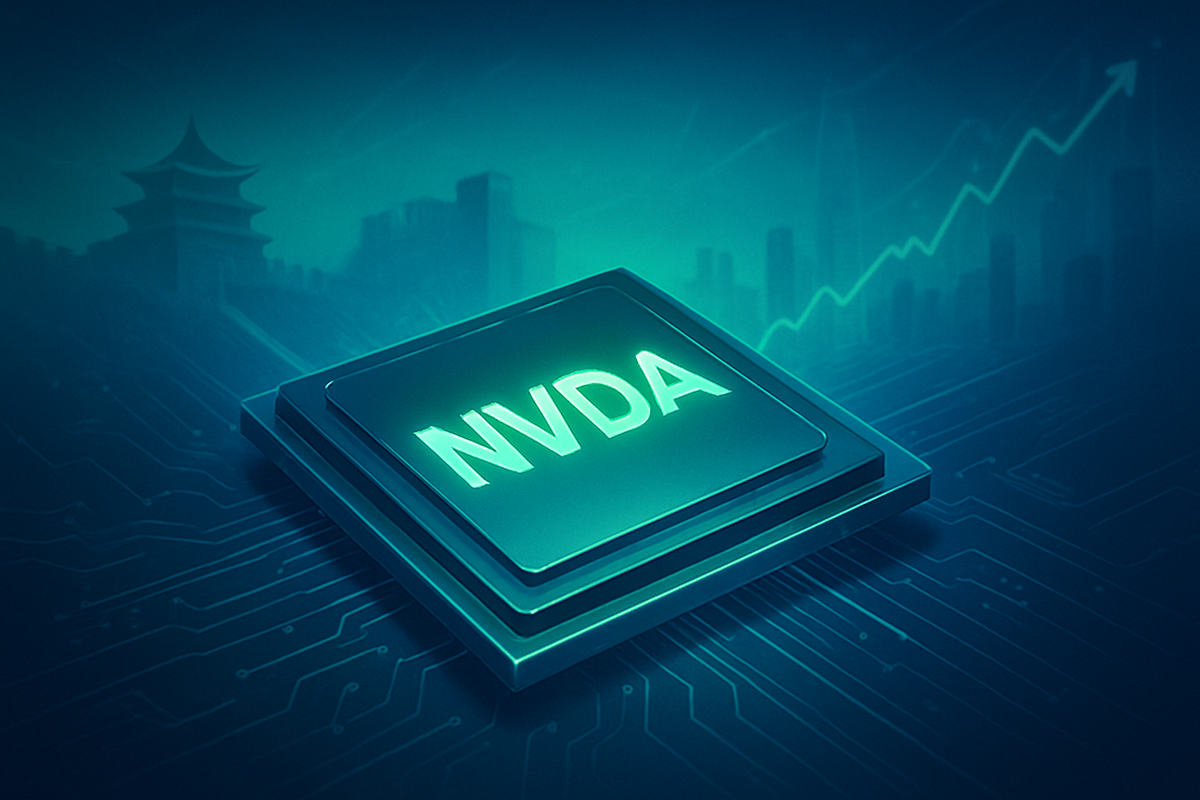
Nvidia (NASDAQ: NVDA) shares surged today, December 9, 2025, experiencing a significant positive movement following a landmark announcement from President Donald Trump. The President revealed a policy reversal, permitting the sale of Nvidia's advanced H200 AI accelerators to approved commercial customers in China. This pivotal decision has immediately injected optimism into the market, with Nvidia's stock climbing approximately 2% in early trading, signaling a potential multi-billion dollar revenue opportunity for the chip giant and a broader easing of U.S.-China tech tensions.
This unexpected shift in U.S. export policy reopens a critical market for Nvidia, which had previously faced a complete shutdown of advanced chip sales to China under the Biden administration's stringent national security restrictions. The move is poised to alleviate a major revenue overhang for Nvidia, as China historically represented a substantial portion—20-25%—of the company's data center sales before the implementation of strict export bans. Investors are now keenly watching how this renewed access will translate into tangible financial gains and reshape the competitive landscape in the global AI sector.
A Strategic Reversal: Unpacking the H200 Deal with China
The core of today's market excitement lies in the specific details of President Trump's announcement. The approval specifically greenlights the export of Nvidia's H200 chips to China, which are the company's second most powerful AI accelerators, offering a significant performance leap over the H20 chips previously tailored for the Chinese market. Crucially, however, the agreement maintains restrictions on Nvidia's most cutting-edge technologies, such as the Blackwell and the upcoming Rubin systems, ensuring a tiered approach to technology transfer.
This policy reversal marks a dramatic departure from the previous administration's stance, which had effectively choked off Nvidia's access to the lucrative Chinese market due to escalating national security concerns. Nvidia had even forecasted zero chip sales to China, anticipating billions in lost revenue. The timeline leading to this moment saw a period of intense lobbying and geopolitical maneuvering, culminating in President Trump's direct engagement with Chinese President Xi Jinping, who reportedly "responded positively" to the decision. Key players in this development include the U.S. Commerce Department, which is tasked with finalizing the details and vetting all buyers to ensure compliance with national security conditions, and, of course, Nvidia (NASDAQ: NVDA) itself, alongside its major market rivals.
A notable condition of this agreement is that the U.S. government will receive a 25% cut of the proceeds from these H200 sales to China, an increase from an earlier proposed 15% levy. This mechanism aims to balance commercial interests with governmental oversight and revenue generation. Initial market reactions have been largely positive, with U.S. stock futures, particularly in the technology sector, experiencing a boost. While analysts generally view the renewed China access as a significant structural catalyst, some express caution, citing the revenue cut, potential for Beijing's own restrictions on H200 access, and persistent competition from domestic Chinese chipmakers and other global tech giants developing their own AI hardware.
Market Winners and Losers: The Ripple Effect of Nvidia's China Reentry
Nvidia's (NASDAQ: NVDA) renewed access to the Chinese market for its H200 AI chips is poised to create a distinct set of winners and losers across the technology and semiconductor sectors. Clearly, Nvidia itself stands as the primary beneficiary. The company had previously absorbed a multi-billion dollar hit from export restrictions; this policy reversal reintroduces a vital revenue stream and significantly strengthens its growth visibility. Analysts are already recalibrating their models, with some suggesting a potential $25 billion to $30 billion annualized revenue opportunity if H200 volumes flow, which could substantially boost Nvidia's earnings per share. This move effectively removes a major overhang that had clouded the company's financial outlook.
Beyond Nvidia, other U.S.-based chip companies, such as Advanced Micro Devices (NASDAQ: AMD) and Intel (NASDAQ: INTC), are also likely to see positive spillover effects. The easing of restrictions on Nvidia could signal a broader trend towards relaxed export controls, potentially opening doors for these companies to sell their own advanced, albeit not most cutting-edge, chips into the Chinese market. This could alleviate some of the competitive pressures they face and expand their addressable markets, particularly in the lucrative data center and AI infrastructure segments. The increased stability in U.S.-China tech relations, even if partial, is generally beneficial for the entire semiconductor supply chain, from equipment manufacturers to material suppliers.
Conversely, domestic Chinese chipmakers, who have been aggressively developing their own AI capabilities in response to U.S. sanctions, might face renewed competitive pressure. While the H200 is not Nvidia's absolute top-tier chip, its availability could slow the adoption of nascent Chinese alternatives that might not yet match its performance or ecosystem support. Companies like Huawei, which has been making strides with its Ascend series, will need to redouble their efforts to compete. Furthermore, other global tech giants developing custom AI accelerators, such as Google (NASDAQ: GOOGL) with its Tensor Processing Units (TPUs) or Amazon (NASDAQ: AMZN) with its Inferentia chips, might find the competitive landscape in China slightly more challenging if Nvidia re-establishes a strong foothold, though their primary markets remain distinct. The 25% revenue cut for the U.S. government also means that a portion of the value generated from these sales will not directly benefit Nvidia's bottom line, representing a unique cost of doing business under the new policy.
Broader Implications: Navigating Geopolitics and Industry Evolution
The strategic decision to allow Nvidia (NASDAQ: NVDA) to sell its H200 AI chips to China carries profound broader implications, resonating across geopolitical landscapes, industry trends, and regulatory frameworks. This event fits squarely into the ongoing narrative of U.S.-China technological competition, signaling a potential, albeit cautious, de-escalation of trade tensions. It suggests a pragmatic shift in U.S. policy, attempting to balance national security interests with the commercial imperative of American technology companies to access vast international markets. This tiered approach—allowing advanced but not bleeding-edge chips—could set a precedent for future technology export policies, creating a "managed competition" rather than an outright technological decoupling.
The ripple effects on competitors and partners are significant. For U.S. semiconductor companies, it offers a glimmer of hope for renewed access to a critical market, potentially boosting revenues and investment in R&D. However, it also creates a complex operating environment where companies must navigate evolving regulatory nuances and geopolitical sensitivities. For Chinese companies, while access to Nvidia's H200 is beneficial for their immediate AI infrastructure needs, it simultaneously reinforces the imperative to accelerate their indigenous chip development programs. The long-term goal for China remains self-sufficiency, and this temporary access might only spur greater investment in domestic alternatives to avoid future supply chain vulnerabilities.
Regulatory and policy implications are substantial. The 25% revenue share for the U.S. government sets a novel precedent for state involvement in commercial technology exports, potentially inspiring similar models in other strategic industries. It highlights the increasing intertwining of national security, economic policy, and corporate strategy. Historically, this situation draws parallels to past periods of controlled technology transfers during the Cold War, albeit with a modern, commercially driven twist. The emphasis on "approved customers" and the Commerce Department's vetting process underscores a continued commitment to national security, even as commercial avenues are reopened. This creates a unique dual-track system where current-generation chips generate revenue for Nvidia and the U.S. government, while the next-generation technologies remain protected for other markets.
The Road Ahead: Opportunities, Challenges, and Strategic Pivots
Looking ahead, the implications of Nvidia's (NASDAQ: NVDA) renewed access to the Chinese market are multifaceted, presenting both short-term opportunities and long-term strategic challenges. In the short term, Nvidia is poised for an immediate revenue boost as it re-engages with a market that was previously closed off. This influx of capital will likely be reinvested into further R&D, strengthening its lead in AI chip innovation and potentially accelerating the development of its next-generation architectures like Rubin. For the broader market, this move could foster increased investor confidence in the tech sector, particularly for companies with significant international exposure, signaling a potential easing of geopolitical headwinds.
However, the long-term outlook is more nuanced. Nvidia will need to strategically pivot to manage a "tiered revenue stream" model, where its H200 chips are sold in China under specific conditions, while its most advanced systems are reserved for other global markets. This requires careful product segmentation, marketing, and supply chain management. Market opportunities will emerge for companies that can support Nvidia's expanded operations in China, including data center providers, AI software developers, and system integrators. Conversely, challenges include the inherent volatility of geopolitical relations, the risk of China imposing its own restrictions on H200 access, and the persistent drive by Beijing to foster its domestic chip industry, which could eventually erode Nvidia's market share.
Potential scenarios range from a stable, albeit controlled, long-term trade relationship for specific chip technologies to a more volatile environment where policies could shift again based on evolving geopolitical dynamics. Nvidia will need to continuously innovate and demonstrate superior performance to maintain its edge against both global competitors and increasingly capable Chinese domestic alternatives. Investors should watch for further details on the Commerce Department's vetting process, the actual volume of H200 sales, and any reactions from China regarding its own industrial policies. The success of this strategic pivot will dictate Nvidia's sustained growth trajectory in a complex global market.
Wrapping Up: A New Chapter in U.S.-China Tech Relations
Today's announcement marks a significant turning point for Nvidia (NASDAQ: NVDA) and the broader semiconductor industry, heralding a new, albeit carefully managed, chapter in U.S.-China technology relations. The primary takeaway is the reopening of the crucial Chinese market for Nvidia's H200 AI chips, a move that promises to significantly bolster the company's revenue and reinforce its leadership in the global AI hardware race. This decision, driven by President Trump, underscores a pragmatic shift in U.S. policy, balancing national security concerns with the economic interests of American tech giants. While a 25% revenue share for the U.S. government adds a unique dimension to these sales, the overall sentiment is one of renewed optimism for Nvidia's growth prospects.
Moving forward, the market will assess how effectively Nvidia can capitalize on this re-entry while navigating the complexities of a tiered product strategy and evolving geopolitical landscapes. The event's lasting impact extends beyond Nvidia, potentially signaling a broader, cautious de-escalation of U.S.-China tech tensions that could benefit other American chipmakers and the wider technology sector. However, the impetus for China to accelerate its domestic chip development remains strong, ensuring that the competitive landscape will continue to evolve rapidly.
Investors should closely monitor several key indicators in the coming months: the actual sales volumes of H200 chips into China, any further policy pronouncements from both the U.S. and Chinese governments regarding technology trade, and the competitive responses from both global rivals and burgeoning Chinese domestic players. Nvidia's ability to maintain its innovation pipeline and strategically adapt to this new operating environment will be paramount to its sustained success. This event solidifies Nvidia's position as a critical player in the AI revolution, but also highlights the intricate interplay between technology, commerce, and global politics.
This content is intended for informational purposes only and is not financial advice