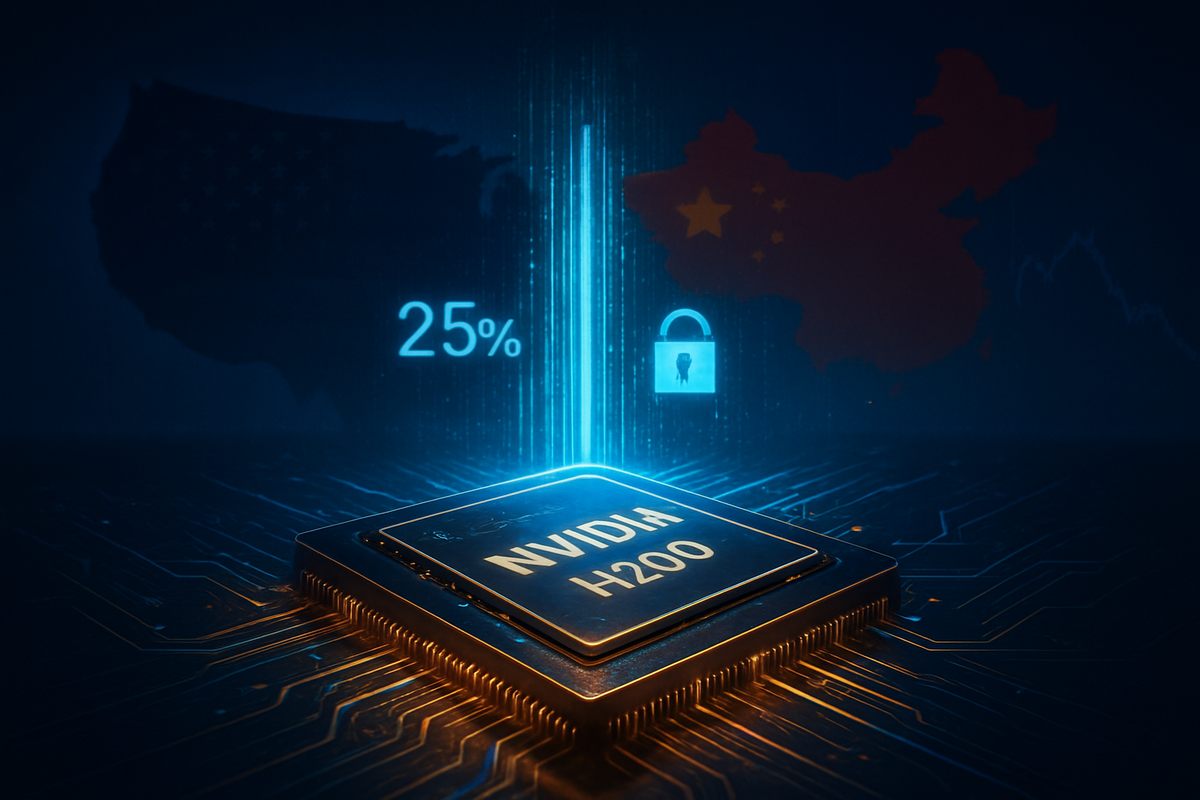
In a move that signals a tectonic shift in global technology policy, the Trump administration has officially authorized the export of high-end artificial intelligence semiconductors, specifically the Nvidia Corporation (NASDAQ: NVDA) H200 chips, to the Chinese market. This reversal of the previous blanket ban comes with a complex web of "national security requirements" and a significant fiscal caveat: a 25% federal surcharge on every chip sold. While the policy provides a potential new revenue stream for American chipmakers, it has been met with immediate skepticism from Wall Street.
Shares of Nvidia (NASDAQ: NVDA) fell 1.4% in trading following the announcement, closing at approximately $183.14. Investors expressed concern over the logistical hurdles of the new framework and reports that Beijing may be moving to block the imports from the other side. The immediate implication is a landscape where high-end AI hardware is no longer strictly forbidden in China, but rather "controlled and taxed," a strategy designed to maintain U.S. dominance while recapturing market share lost to domestic Chinese alternatives during the embargo.
The Pivot: A Case-by-Case Thaw in the Tech Cold War
The policy shift began on January 13, 2026, when the U.S. Department of Commerce’s Bureau of Industry and Security (BIS) issued a revised licensing policy. This update moved from a "presumption of denial" to a "case-by-case review" for the H200 architecture. This was followed on January 14 by a national security proclamation from President Trump, which introduced a 25% "surcharge"—effectively a government-mandated cut of the sales price—on all high-end AI semiconductors exported to China. This surcharge applies not only to Nvidia but also to competitors like Advanced Micro Devices, Inc. (NASDAQ: AMD), whose MI325X chips are expected to fall under similar review.
The timeline reflects a calculated effort by the administration, reportedly led by White House AI advisor David Sacks, to pivot away from total decoupling. The goal is to make Chinese tech firms dependent on American-designed hardware that is intentionally kept one or two generations behind the "state-of-the-art" systems reserved for the U.S. market. By allowing the sale of H200s, the administration hopes to drain capital from Chinese domestic chip projects. However, the market’s cool reaction on January 14—marked by Nvidia's 1.4% decline—highlights the fear that these new rules are too cumbersome to be effective.
Winners, Losers, and the "Trump Surcharge"
Nvidia (NASDAQ: NVDA) stands as the most prominent potential "winner" in terms of volume, yet the market’s negative reaction suggests the victory may be pyrrhic. While the opening of the Chinese market—which once accounted for a quarter of Nvidia’s revenue—is a positive, the 25% surcharge and the "50% Rule" (limiting China exports to half of U.S. domestic sales) create significant headwinds. The surcharge, in particular, threatens to squeeze margins or make the H200 so expensive that Chinese buyers might still prefer domestic options like Huawei’s Ascend series.
On the losing side, the logistical burden falls heavily on manufacturers like Taiwan Semiconductor Manufacturing Company (NYSE: TSM). Under the new requirements, chips intended for China must first route through the United States for testing and verification by a third-party laboratory. This "U.S. Routing" requirement adds weeks to delivery times and increases insurance and freight costs. Meanwhile, domestic Chinese semiconductor startups may see their funding dry up if major Chinese tech giants can again source high-performance American silicon, though this depends entirely on whether Beijing allows the H200s to pass through its own customs.
Strategic Shifts: Redefining Global AI Leadership
This event marks a departure from the "small yard, high fence" approach of previous years toward a more transactional "toll-road" model. By imposing the 50% Rule, the Trump administration is using export policy to directly subsidize the domestic AI ecosystem; Nvidia cannot sell more to China than it sells to American companies. This ensures that the United States remains the primary hub for AI computing power, while the 25% surcharge generates billions in federal revenue that the administration has suggested could be used to fund domestic chip fabrication.
Furthermore, the requirement for third-party verification in the U.S. represents a significant regulatory precedent. It shifts the burden of proof from the government to the corporation, requiring Nvidia to prove that every chip is "clean" of unauthorized modifications before it leaves American soil. This level of granular oversight on commercial hardware is nearly unprecedented in the history of the semiconductor industry and reflects a new era where technology and national treasury interests are inextricably linked.
The Road Ahead: Logistics, Retaliation, and Future Architectures
As the new BIS rules formally take effect on January 16, 2026, the short-term focus will be on the "U.S. Routing" infrastructure. Analysts at major firms are watching closely to see how quickly third-party labs can be certified to handle the volume of H200 shipments. There is a high risk of "lumpy" revenue in the coming quarters as the first batches of chips navigate this new bureaucratic maze. Furthermore, reports from Beijing suggest that Chinese customs authorities may retaliate by "disapproving" H200 imports on their end, citing their own national security concerns.
In the long term, the success of this policy depends on Nvidia’s ability to manage its product roadmap. With "Blackwell" and the upcoming "Rubin" architectures currently restricted to the West, Nvidia must balance the demand for H200s in China without cannibalizing its higher-margin sales in the U.S. and Europe. Strategic pivots may be required if Beijing successfully blocks these imports, potentially forcing Nvidia to further "neuter" its China-specific chips or find new ways to comply with the 25% surcharge without losing its competitive edge.
A High-Stakes Balancing Act for the AI Era
The approval of H200 exports to China is less a "free trade" victory and more a complex geopolitical gambit. By replacing a total ban with a high-tariff, high-oversight framework, the U.S. government is attempting to weaponize market access. The 1.4% dip in Nvidia’s stock price is a clear signal that the investment community remains wary of the friction this policy introduces. The 25% surcharge and the logistical bottlenecks of U.S.-based testing are significant hurdles that could dampen the expected revenue boost from the Chinese market.
Investors should closely monitor the "50% Rule" compliance reports and any official statements from the Chinese Ministry of Commerce in the coming weeks. The ultimate impact of this event will not be measured by the initial approval, but by the actual volume of chips that successfully clear both U.S. and Chinese customs. As the AI arms race continues, the H200 export saga will serve as a definitive case study in how the U.S. intends to manage the delicate balance between national security and economic dominance in the 21st century.
This content is intended for informational purposes only and is not financial advice