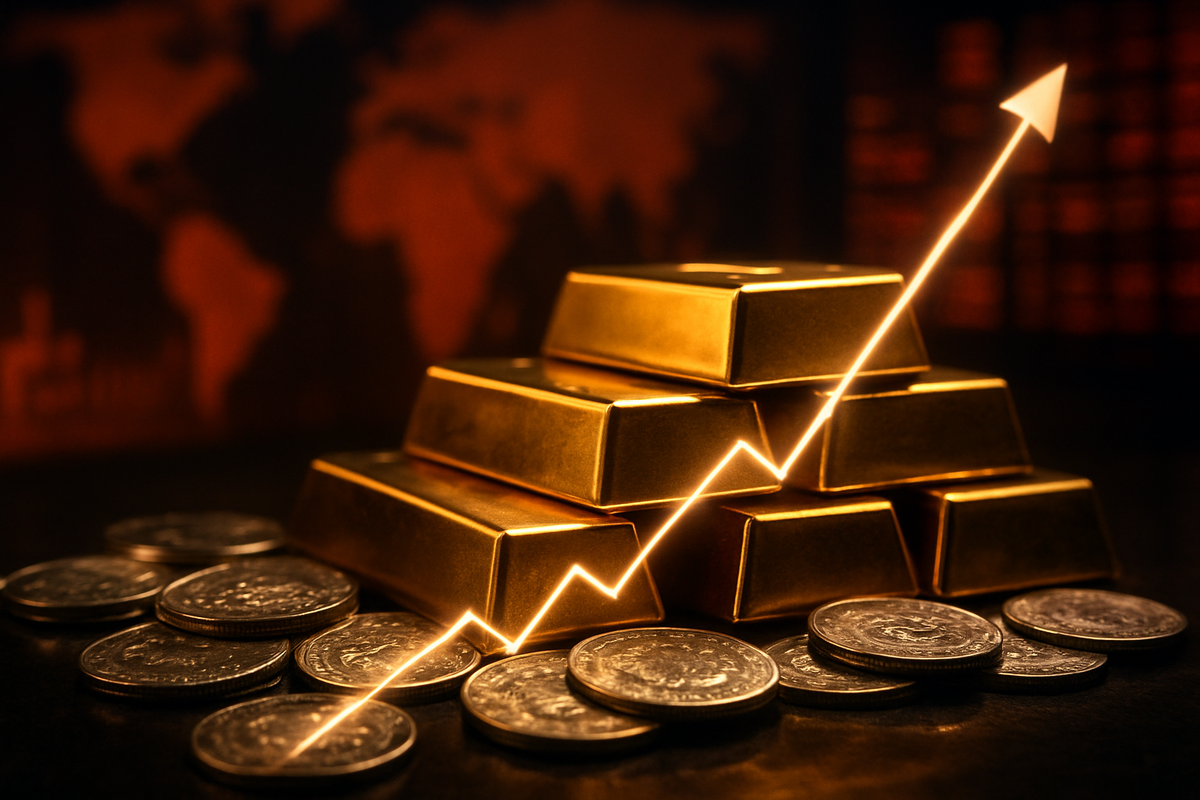
As of January 20, 2026, the global commodities markets are witnessing an unprecedented flight to safety. Gold prices have surged to a staggering record high of $4,740 per ounce, while silver has shocked the industrial world by climbing toward $95.50 per ounce. This dramatic appreciation in precious metals comes as a direct response to a "perfect storm" of international instability, characterized by the dramatic capture of Venezuelan leadership and escalating military threats from Iran, which have collectively sent shockwaves through traditional equities and currency markets.
Despite a domestic U.S. economy that shows a surface-level resilience—propped up by massive fiscal spending and a robust labor market—investors are increasingly wary of the underlying structural risks. The combination of "policy-induced" inflation and a deteriorating global diplomatic landscape has forced both institutional and retail investors to seek refuge in hard assets. The "January Surge" of 2026 is no longer just a market correction; it has become a full-scale migration into the most ancient forms of wealth preservation.
Geopolitical Catalysts and the Timeline of Turmoil
The immediate catalyst for this month's price explosion was the geopolitical earthquake that struck on January 3, 2026. U.S. forces successfully captured Venezuelan President Nicolás Maduro, an event that led to the immediate installation of a transition government and the subsequent "collaboration" of U.S.-backed interests with the Venezuelan oil sector. While the move was intended to stabilize the region and secure energy supplies, the initial reaction was one of extreme volatility. Market participants, fearing a prolonged civil conflict or a regional proxy war, immediately poured capital into gold, pushing it past the $4,500 mark within forty-eight hours of the announcement.
Simultaneously, the Middle East reached a new flashpoint. Iran, currently grappling with widespread domestic unrest, has blamed Western interference for its internal instability and has issued formal threats of retaliatory strikes against U.S. military assets in the Persian Gulf. The looming threat of a closure of the Strait of Hormuz—a vital artery for global energy and trade—has added a massive "risk premium" to both gold and silver. This geopolitical tension is superimposed on a market already primed for a rally after the "Generational Bull Market" of 2025, which saw gold and silver rise 75% and 166% respectively over the previous year.
The economic backdrop of this surge is equally complex. On July 4, 2025, the U.S. government signed the "One Big Beautiful Bill" (OBBBA), a $5.5 trillion legislative package that made the 2017 tax cuts permanent and introduced new exemptions for overtime and tips. While this stimulated short-term GDP growth, it has ballooned the federal deficit to levels that have many bondholders nervous. With annual inflation hovering near 3.1% and the Federal Reserve facing a leadership transition in May 2026, the uncertainty surrounding the future of the U.S. dollar has made the "de-dollarization" trend of central banks shift from a slow crawl to a frantic sprint.
Corporate Winners and the Industrial Squeeze
The primary beneficiaries of this price surge are the major mining corporations, which are currently seeing their balance sheets transformed by record-high margins. Newmont (NYSE: NEM), the world's largest gold miner, saw its shares hit a 52-week high above $114 this week. Under the new leadership of CEO Natascha Viljoen, who assumed the role on January 1, 2026, the company has successfully pivoted to a "Tier 1" asset strategy, divesting non-core holdings just in time to capitalize on the $4,700-per-ounce gold environment.
Barrick Gold (NYSE: GOLD) has similarly seen a massive reversal in fortune. After resolving a contentious $436 million settlement with the Malian government in late 2025 regarding the Loulo-Gounkoto complex, the company has restored its full production capacity. With gold at these levels, Barrick is reporting record free cash flow, exceeding $1.5 billion in its most recent quarterly reporting period. Meanwhile, Pan American Silver (NASDAQ: PAAS) has emerged as the premier winner in the silver space. Following its savvy acquisition of MAG Silver in late 2025, PAAS now controls a significant stake in the high-grade Juanicipio mine, just as silver prices approach the $100 mark.
However, the surge is not without its victims. Industrial users of silver, particularly in the green energy and technology sectors, are facing a severe "margin squeeze." Companies like First Solar (NASDAQ: FSLR) and other photovoltaic manufacturers are struggling with soaring input costs, as silver is a critical component in solar cells. Furthermore, the electronic manufacturing sector is feeling the heat, with industrial demand colliding with a structural silver deficit that has now entered its fifth consecutive year. China’s implementation of export controls on physical silver on January 1, 2026, has only worsened this supply-side crisis, making it increasingly difficult for tech firms to secure the metal at any price.
Wider Significance: The "Everything Rally" vs. The "Fear Trade"
This event is a significant departure from historical norms where gold typically performs best during periods of economic recession. In early 2026, we are witnessing a rare "Everything Rally," where equities remain high due to fiscal stimulus, yet precious metals are hitting record highs due to systemic fear. This decoupling suggests that the market no longer views gold merely as an inflation hedge, but as a "systemic insurance policy" against geopolitical collapse and currency debasement.
The significance of silver's rise cannot be overstated. Unlike gold, which is primarily a monetary asset, silver is now being classified as a "strategic metal" essential for the AI-driven data center boom and the continued electrification of the global transport fleet. The current rally reflects a realization that supply—hampered by years of underinvestment in new mining projects—cannot keep pace with the exponential growth in industrial demand. This is reminiscent of the Hunt Brothers' silver squeeze of 1980, though this time the squeeze is driven by global industrial requirements rather than speculative hoarding.
Furthermore, the Greenland acquisition dispute between the U.S. and European nations has added a layer of trade uncertainty that has not been seen in decades. As the U.S. imposes new tariffs on European goods as leverage, the breakdown of traditional Western alliances is forcing European investors to diversify out of the dollar and into gold. This "policy uncertainty" is becoming a permanent fixture of the market, suggesting that the highs we are seeing today may become the new floors of tomorrow.
The Road to May 2026: What Comes Next?
In the short term, the market's eyes are fixed on the Strait of Hormuz. Any actual military engagement in the region or a formal blockade would likely catapult gold toward the $5,000 mark and silver well beyond $100. However, the most critical domestic event will be the appointment of the new Federal Reserve Chair in May 2026. The market is currently pricing in extreme volatility as it waits to see if the new Chair will prioritize fighting the 3.1% "sticky" inflation or focus on supporting the labor market as it begins to show the first signs of softening under the weight of high interest rates.
Strategic pivots will be required for both investors and corporations. For mining companies, the challenge will be managing the "resource nationalism" that often follows a price surge, as governments in mining-heavy regions seek to increase taxes and royalties. For industrial users, the move toward "silver-free" or "low-silver" technology is likely to accelerate, though such transitions often take years of R&D that many companies cannot afford in the current environment.
We may also see a historic intervention by the U.S. Treasury if the dollar's status continues to be challenged by the gold rally. While a return to a gold standard remains a fringe theory, the discussion of using gold reserves to back new debt issuances is no longer confined to the shadows of the financial world. The "scarcity trade" is now the dominant theme of the 2026 market.
Summary and Investor Outlook
The surge of January 2026 represents a landmark moment in financial history. Gold at $4,740 and silver at $95 are symbols of a world in transition—one where the old certainties of a U.S.-led global order and a stable dollar are being tested by geopolitical upheaval in South America and the Middle East. The resilience of the U.S. economy, while impressive, appears to be built on a foundation of debt and stimulus that many investors are no longer willing to trust without the insurance of precious metals.
Key takeaways for the coming months include:
- Geopolitical Primacy: Watch Venezuela and Iran as the primary drivers of the "risk-off" sentiment.
- The Silver Deficit: Pay close attention to industrial inventory levels, as the silver shortage is now a structural reality rather than a speculative theory.
- Central Bank Activity: The pace at which non-Western central banks accumulate gold will determine if this rally has the legs to reach even higher psychological levels.
For the savvy investor, the coming months will require a delicate balance. While the mining sector offers massive upside in a high-metal-price environment, the broader industrial impacts of these costs could lead to significant volatility in the tech and green energy sectors. As we approach the middle of 2026, the only certainty is that the "lustre" of gold and silver has never been brighter or more necessary for a balanced portfolio.
This content is intended for informational purposes only and is not financial advice.