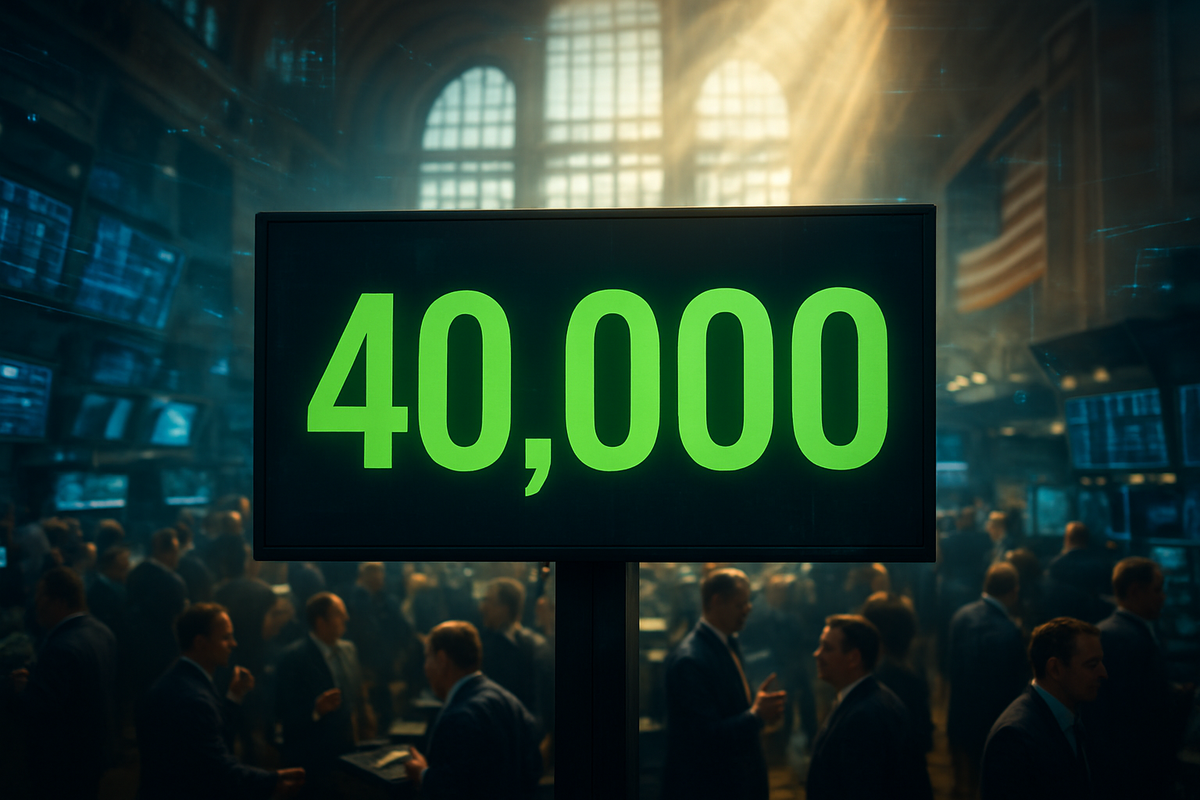
In May 2024, the financial world witnessed a historic realignment of market expectations as the Dow Jones Industrial Average (DJI) breached the 40,000-point threshold for the first time in its 128-year history. This milestone, achieved during the third week of May, was far more than a numerical curiosity; it served as a definitive psychological anchor for a market that had spent years wrestling with the ghosts of high inflation and the looming threat of a recession. As the index crossed this barrier, it signaled to the world that the "blue-chip" core of the U.S. economy had not only weathered the most aggressive interest rate hiking cycle in forty years but was actually beginning to thrive within it.
The immediate implications of the Dow’s ascent to 40,000 were profound, effectively silencing many of the remaining "hard landing" skeptics. The breakthrough was catalyzed by a "Goldilocks" environment of cooling inflation and robust corporate earnings, suggesting that the Federal Reserve's delicate balancing act was succeeding. For investors, the milestone validated a shift in strategy toward quality and diversified industrial strength, moving beyond the narrow tech-heavy rallies that dominated the early 2020s and underscoring the resilience of the broader American consumer and industrial base.
The Breach: A Timeline of the 40,000 Conquest
The road to 40,000 was a grueling 874-trading-day journey that began when the index first hit 30,000 in November 2020. The final push occurred on May 16, 2024, when the index notched an intraday high of 40,051.05 following a blowout earnings report from Walmart Inc. (NYSE: WMT). Although the index dipped slightly before the closing bell that day, it officially secured its first historic close above the mark on Friday, May 17, 2024, ending at 40,003.59. This achievement followed a critical Consumer Price Index (CPI) report released just days earlier, which showed inflation slowing to 3.4%, providing the necessary oxygen for a market-wide rally.
This moment was the culmination of several overlapping narratives. Throughout early 2024, the market had been "climbing a wall of worry" regarding "sticky" inflation and the possibility that the Federal Reserve would keep rates "higher for longer." However, the strength of the labor market and steady GDP growth—which eventually accelerated to 3.0% in the second quarter—provided a bedrock of support. Key stakeholders, including institutional asset managers and retail investors, viewed the 40,000 mark as a signal that the 2022 bear market was firmly in the rearview mirror.
Initial reactions from the floor of the New York Stock Exchange were a mix of celebration and analytical caution. While traders cheered the symbolic victory, analysts like Art Hogan of B. Riley Financial Inc. (NASDAQ: RILY) noted that the milestone served as a "gold star" for corporate America, proving that earnings power remained intact despite elevated borrowing costs. The transition from 39,000 to 40,000 happened in just under three months, illustrating how quickly momentum can build when the narrative shifts from fear of a downturn to the anticipation of a sustained expansion.
A Divergent Index: The Engines and the Anchors of the Rally
The ascent to 40,000 was a tale of extreme divergence within the Dow’s 30 components. The clear winners were those companies that successfully leveraged the twin pillars of the 2024 economy: the artificial intelligence boom and the resilient high-income consumer. Microsoft Corp. (NASDAQ: MSFT) and Amazon.com Inc. (NASDAQ: AMZN), which joined the index in early 2024, provided significant upward pressure as their cloud computing and AI divisions saw massive growth. Financial heavyweights like Goldman Sachs Group Inc. (NYSE: GS) and American Express Company (NYSE: AXP) also benefited from a "higher-for-longer" rate environment that boosted net interest margins while credit quality remained surprisingly stable.
Walmart Inc. (NYSE: WMT) arguably played the most pivotal role in the final hours of the breakout. Its May earnings report revealed a consumer base that was trading down to find value but still spending aggressively, a trend that bolstered confidence in the overall economy. Other stalwarts like Caterpillar Inc. (NYSE: CAT) and UnitedHealth Group Inc. (NYSE: UNH) provided the steady, "old economy" growth that the Dow is built upon, reflecting a broad-based recovery that reached across sectors from construction to healthcare.
However, the rally was not a rising tide that lifted all boats. Several legacy components acted as significant anchors, preventing the index from reaching the 40,000 mark even sooner. Boeing Co. (NYSE: BA) was the most notable laggard, struggling with safety crises and production caps that saw its stock fall nearly 30% in the first half of the year. Similarly, Intel Corp. (NASDAQ: INTC) found itself sidelined during the AI gold rush, facing massive foundry costs and competitive pressures that eventually led to its removal from the index later in 2024, replaced by the AI titan Nvidia (NASDAQ: NVDA). Nike Inc. (NYSE: NKE) also struggled as it faced stiff competition from newer athletic brands, highlighting that even within a record-breaking index, individual corporate missteps could still lead to underperformance.
The Broader Significance: The "Soft Landing" and Industrial Evolution
The historical significance of Dow 40,000 lies in its timing. It occurred at a juncture where the global economy was questioning whether a developed nation could defeat 40-year-high inflation without triggering a spike in unemployment. The Dow's milestone was the market's way of declaring the "soft landing" had been achieved. Unlike the 30,000 milestone, which was fueled by pandemic-era stimulus and near-zero interest rates, the move to 40,000 was built on the back of genuine corporate productivity and a transformation of the industrial base through digital integration.
This event also signaled a shift in the composition of "industrial" power. The Dow, once dominated by smoke-stack industries, was increasingly being driven by software-as-a-service, data centers, and fintech. The inclusion of Amazon and the subsequent addition of Nvidia marked a modernization of the index, ensuring that it remained a relevant barometer for the 21st-century economy. The "ripple effect" of this milestone was felt across global markets, as international investors regained confidence in U.S. equities as a safe haven that could offer both growth and stability.
Compared to historical precedents, such as the Dow’s first break of 10,000 in 1999 or 20,000 in 2017, the 40,000 mark was characterized by less "irrational exuberance" and more "rational resilience." While 1999 was defined by speculative tech fervor, the 2024 rally was backed by companies with massive cash flows and fortress balance sheets. Regulatory and policy implications were also notable; the rally suggested that the U.S. economy had become less sensitive to the Federal Reserve’s traditional tools, leading to discussions about whether the "neutral rate" of interest had permanently shifted higher.
Beyond 40,000: The Future of the Blue-Chip Benchmark
Looking back from the vantage point of January 2026, the May 2024 breakout appears as the starting gun for a new era of market performance. In the short term, the milestone required a strategic pivot from many money managers who had been overweight in cash or defensive bonds. It forced a re-entry into the equity markets, providing the liquidity that sustained the bull market through the latter half of 2024 and into 2025. The "challenges" that emerged were primarily around valuation, as the index's price-to-earnings ratios began to stretch, requiring even stronger earnings growth to justify the new baseline.
The long-term legacy of Dow 40,000 has been the normalization of high-performance expectations for the American industrial sector. It opened the door for the index to eye even higher targets, supported by the ongoing integration of generative AI across the Dow’s diverse components—from Salesforce (NYSE: CRM) to Home Depot (NYSE: HD). Market opportunities have increasingly shifted toward companies that can demonstrate "operational excellence"—the ability to maintain margins even if the "easy money" era never fully returns.
Potential scenarios that were debated at the time—such as a sudden inflationary rebound or a geopolitical shock—did occasionally cause volatility, but the 40,000 level established a new "floor" for market sentiment. The milestone proved that the Dow could survive the obsolescence of some of its oldest members (like Intel) while absorbing the hyper-growth of its newest members (like Nvidia), showcasing a structural adaptability that remains the hallmark of the American financial system.
Conclusion: A Testament to Market Adaptability
The Dow Jones Industrial Average’s breach of 40,000 in May 2024 remains one of the most significant financial markers of the mid-2020s. It was a victory of corporate earnings over macro-economic anxiety, proving that the U.S. economy possessed a deep-seated resilience that few had predicted during the dark days of the 2022 bear market. The key takeaway for investors was clear: the American consumer and the blue-chip companies that serve them are remarkably adaptable, capable of thriving even when the cost of capital is high.
Moving forward, the 40,000 milestone serves as a reminder that market headlines often lag behind economic reality. By the time the Dow hit the mark, the economy had already been showing signs of strength for months. For those watching the markets today in 2026, the lesson remains the same: focus on the fundamental health of the companies within the index rather than the volatility of the day. The journey to 50,000 will likely be paved with similar skepticism, but the resilience shown in May 2024 provides the blueprint for how the market continues to climb the wall of worry.
This content is intended for informational purposes only and is not financial advice