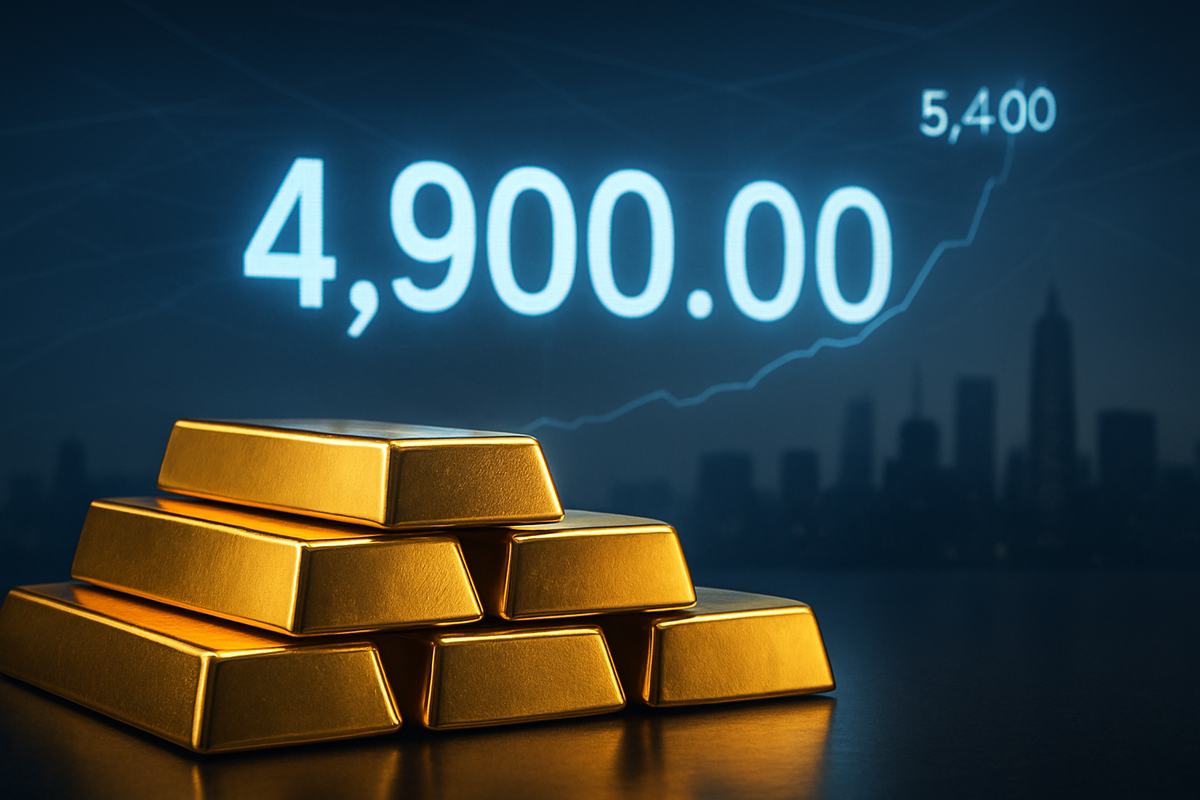
In a move that has sent shockwaves through global financial centers, gold prices officially shattered the $4,900 per ounce mark during early morning trading on Monday, January 26, 2026. This historic breach represents a psychological and technical milestone that many analysts thought was years away, marking a nearly 60% increase in the precious metal's value over the last eighteen months. The surge comes as a "perfect storm" of fiscal instability, geopolitical fragmentation, and a fundamental shift in how both private and public sectors view reserve assets.
Responding to the breakout, Goldman Sachs (NYSE: GS) immediately upgraded its year-end gold price forecast from $4,900 to a staggering $5,400 per ounce. The investment bank cited a massive wave of private sector diversification and the necessity of hedging against "unprecedented global policy risks." As traditional fiat-based portfolios face pressure from rising sovereign debt levels and trade-related volatility, gold has re-emerged not just as a defensive play, but as a central pillar of the modern institutional balance sheet.
The Breach: A Timeline of the Golden Bull
The ascent to $4,900 was fueled by a convergence of factors that intensified throughout 2025. The rally began in earnest during the third quarter of last year, as the Federal Reserve moved deeper into a rate-cutting cycle to combat stagnating growth, effectively lowering the opportunity cost of holding non-yielding assets. By December 2025, gold was consistently testing the $4,500 resistance level, supported by a "floor" established by central bank purchases. This morning’s breakthrough occurred at 8:14 AM ET, triggered by a combination of a weaker-than-expected manufacturing report and heightened rhetoric regarding renewed trade tariffs in the Pacific.
Key players in this movement include a new "coalition of buyers." While central banks—most notably from Poland, China, and India—have been the primary drivers of the gold market for years, the current leg of the rally is being propelled by institutional private capital. Hedge funds and family offices, which had previously remained on the sidelines during the initial 2024 run-up, are now aggressively reallocating. Market reaction was instantaneous: gold futures spiked by 2.4% within minutes of the $4,900 breach, leading to a temporary trading halt in several derivative products as liquidity struggled to keep pace with the influx of buy orders.
The velocity of the move caught many short-sellers off guard, resulting in a "short squeeze" that further accelerated the price action. Analysts at Goldman Sachs noted that the previous resistance at $4,800 has now turned into a formidable support floor. They argue that the "fear of missing out" (FOMO) has transitioned from retail speculative circles to the highest levels of institutional asset management, where "debasement trades" are becoming the standard protocol for 2026.
Winners and Losers in the $5,000 Gold Era
The most direct beneficiary of this price action is the SPDR Gold Shares (NYSE Arca: GLD) ETF, the world’s largest gold-backed exchange-traded fund. As the primary vehicle for institutional and retail exposure to physical bullion, GLD has seen record-breaking inflows over the past 48 hours, with its total assets under management reaching levels that rival major equity indices. For investors who cannot take physical delivery of bullion, GLD has become the "de facto" currency for stability in an era of fluctuating fiat values.
In the mining sector, the surge is creating a windfall for major producers. Newmont (NYSE: NEM) and Barrick Gold (NYSE: GOLD) have seen their margins expand at an exponential rate. Since most major miners based their 2026 capital expenditure budgets on a gold price of roughly $3,500 per ounce, the current $4,900+ price environment is generating massive free cash flow. This surplus is expected to be returned to shareholders through aggressive dividend hikes and share buybacks, though some analysts warn that rising energy and labor costs in the mining sector could eat into these gains if inflation remains persistent.
Conversely, the "losers" in this scenario include traditional consumer-facing industries and fixed-income heavy portfolios. The jewelry industry is facing a significant demand destruction as the price of a standard wedding band becomes prohibitive for middle-class consumers. Furthermore, the relentless rise in gold prices serves as a "silent indictment" of the U.S. Treasury market. As investors swap government bonds for gold, the relative demand for sovereign debt may continue to wane, potentially forcing interest rates higher to attract buyers—a move that would paradoxically increase the fiscal stress that drove investors to gold in the first place.
Broader Significance: The Great Diversification
The shattering of $4,900 is more than just a number; it represents a fundamental shift in the global monetary order. We are witnessing what many economists call the "Phase Two" bull market—the democratization of the gold hedge. While the 2023-2024 rally was largely a central bank story, the 2025-2026 surge is about the private sector realizing that the "safety" of the U.S. dollar and the Euro is no longer a given. With U.S. national debt surpassing $38 trillion and global trade becoming increasingly fragmented due to tariff wars, gold has become the only "neutral" asset that carries no counterparty risk.
This trend mirrors the historical precedents of the late 1970s, yet on a much larger, globalized scale. Unlike the 1970s, where gold's rise was primarily driven by U.S. domestic inflation, the current movement is a global rejection of policy unpredictability. Central banks are expected to continue their diversification at record rates, with many aiming to have 20% or more of their reserves in bullion. This institutionalization of gold as a reserve asset creates a "feedback loop" where higher prices validate the diversification strategy, leading to even more buying.
From a regulatory standpoint, the rise of gold is likely to trigger increased scrutiny of precious metal markets. We may see new policy debates regarding the "taxation of windfalls" for mining companies or potential interventions in the gold futures market to dampen volatility. However, as long as the underlying drivers—debt, tariffs, and geopolitical tension—remain unresolved, gold’s status as the ultimate "policy insurance policy" appears secure.
The Path to $5,400: What Comes Next
In the short term, market participants should expect a period of high volatility as the market digests the $4,900 breach. A "retest" of the $4,800 level is possible, providing a potential entry point for those who missed the initial surge. However, the long-term outlook remains decidedly bullish. Goldman Sachs’ $5,400 target is predicated on the assumption that central bank buying will remain at or above 1,000 metric tons per year and that the Federal Reserve will continue its easing cycle through at least the third quarter of 2026.
Strategic pivots are already underway across the financial landscape. Corporations with large cash piles are increasingly looking at "Treasury-alternative" allocations, which include gold and other hard assets. We may also see an increase in M&A activity within the mining sector, as companies like Franco-Nevada (NYSE: FNV) look to secure streaming and royalty deals at these elevated price points. The primary challenge for the market will be liquidity; as more physical gold is locked away in central bank vaults and long-term institutional holdings, the "available" supply for daily trading could tighten, leading to even more explosive price movements.
Market Wrap-Up and Investor Outlook
The ascent of gold to $4,900 and the subsequent march toward $5,400 marks a turning point for the decade. The key takeaway for investors is that the gold market has transitioned from a speculative "fear trade" to a structural "diversification trade." As Goldman Sachs points out, the "stickiness" of current positions suggests that this is not a bubble destined to burst, but a re-rating of the asset's value in a high-risk world.
Moving forward, the market will be watching the Federal Reserve’s upcoming policy meetings and the next round of central bank reserve data with intense focus. Any sign of a slowdown in central bank accumulation could provide a temporary cooling effect, but the overarching theme of 2026 remains one of hedging against systemic instability. Investors should keep a close eye on the performance of the SPDR Gold Shares (NYSE Arca: GLD) and major miners as barometers of institutional sentiment. In a world of "unprecedented policy risk," gold has proven once again why it has remained the ultimate store of value for millennia.
This content is intended for informational purposes only and is not financial advice.