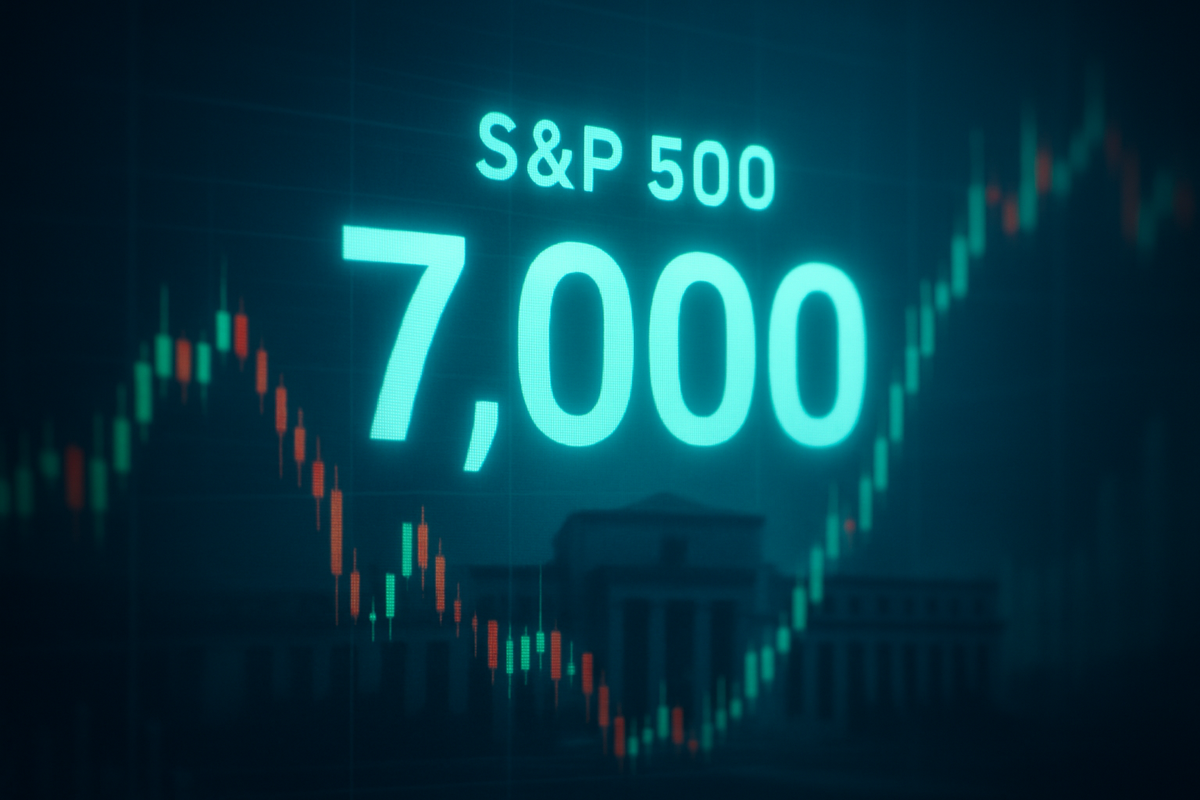
The S&P 500 (NYSE Arca: SPY) is currently locked in a high-stakes tug-of-war with the 7,000 psychological resistance level, a milestone that has proven to be a formidable barrier for bulls in early 2026. As of late January, the index has repeatedly flirted with this historic peak, reaching intraday highs near 6,986 before retreating, as investors weigh the exhaustion of the long-running tech-led rally against a looming leadership shift at the nation’s central bank.
This technical stalemate arrives at a precarious moment for the U.S. economy. While underlying growth remains resilient, the "air is getting thin" at these valuations. The market’s inability to decisively pierce the 7,000 mark has triggered a notable rotation out of large-cap growth stocks and into long-neglected sectors, suggesting that the broader market is preparing for a period of heightened volatility as the "Powell Era" draws to a close.
A Technical Standoff and the Race for the Fed
The S&P 500’s struggle at 7,000 is not merely a numbers game; it is a reflection of growing uncertainty surrounding the Federal Reserve. Jerome Powell’s term as Chair is set to expire on May 15, 2026, and the White House has already signaled an aggressive transition plan. Reports surfacing this week indicate that a successor may be named within days—months earlier than traditional timelines—to facilitate a lengthy confirmation process and potentially establish a "Shadow Chair" to influence policy before Powell officially departs.
The timeline of this transition has historically been a harbinger of market turbulence. Since the start of January, the index has entered a cooling phase, with the Relative Strength Index (RSI) hovering around 53, indicating that the frantic momentum of late 2025 has dissipated. Traders are now laser-focused on the support zone between 6,800 and 6,900. Specifically, the 6,920 level has emerged as a critical "pivot zone," while the 6,840–6,865 range—which includes the 50-day Simple Moving Average—serves as a vital safety net for the current uptrend.
Leading the shortlist to replace Powell are figures like Rick Rieder of BlackRock (NYSE: BLK), Kevin Warsh, and Christopher Waller. Each brings a different philosophy to the table, and the market is already pricing in the "political risk premium" associated with these picks. The anticipation of a new regime is keeping institutional investors on the sidelines, waiting to see if the next Chair will maintain the Fed's hard-won independence or succumb to political pressures for lower rates.
Winners and Losers in the Rotation
The stall at 7,000 has created a clear divide in the market. The primary losers in this environment have been the "Magnificent Seven" giants, such as NVIDIA (NASDAQ: NVDA) and Microsoft (NASDAQ: MSFT). These tech behemoths, which propelled the index through much of 2025, are showing signs of exhaustion. NVIDIA, in particular, has seen its year-to-date gains evaporate as investors lock in profits at the 7,000 resistance, fearing that the AI-driven premium has reached its limit. Similarly, Apple (NASDAQ: AAPL) is facing intense scrutiny ahead of its late-January earnings report, which many view as the last hope for a 7,000 breakout.
On the winning side, the Russell 2000 (NYSE Arca: IWM) has become the unlikely darling of early 2026. Small-cap stocks have surged roughly 8% this month, significantly outperforming the S&P 500's modest 1.5% gain. This "catch-up trade" suggests that capital is fleeing over-concentrated tech positions in favor of domestic-oriented companies that could benefit from potential deregulation under a new Fed regime.
Financial giants like JPMorgan Chase (NYSE: JPM) and Goldman Sachs (NYSE: GS) are also seeing mixed reactions. While a steeper yield curve could boost net interest margins, these institutions are particularly sensitive to the stability of the Treasury market. Any hint that a new Fed Chair might be less committed to fighting inflation could lead to a spike in long-term yields, complicating the outlook for bank balance sheets and the broader mortgage market.
The 15% Precedent and Historical Context
The current market anxiety is rooted in a sobering historical pattern. Research from Ned Davis Research highlights that the S&P 500 has historically experienced an average correction of 15% within the first six months of a new Federal Reserve Chair's tenure. This "testing of the new Chair" is a recurring theme in market history, as investors look to see how the new appointee reacts to a sudden downturn or an inflationary spike.
The most recent parallel is the early tenure of Jerome Powell in 2018, which saw a sharp "Christmas Eve Massacre" drawdown when the market felt the Fed was being too hawkish. As we approach the mid-2026 transition, strategists warn that the 15% figure is a baseline risk. The confluence of a record-high index level and a leadership change creates a "perfect storm" for a significant pullback.
Furthermore, the potential for a "Shadow Chair" arrangement is an unprecedented move in modern central banking. This strategy, aimed at diluting the outgoing Chair's authority, could introduce a period of dual-track signaling that confuses the markets and erodes the Fed’s credibility. If the market perceives a threat to Fed independence, the 6,800 support level could quickly fail, opening the door to a deeper correction toward the 6,720 floor.
What Comes Next: Pivots and Scenarios
In the short term, the market's direction hinges on the 6,920 support level. If the S&P 500 can hold this floor, it may consolidate for several weeks before making another attempt at 7,000. However, a break below 6,800 would likely signal the start of a broader "de-risking" event. Investors should prepare for a volatile February, especially as the White House formalizes its Fed nomination.
Long-term, the market's health depends on the confirmation process. A "market-friendly" nominee like Rieder might soothe nerves and allow the S&P 500 to finally clear 7,000. Conversely, a more controversial pick could accelerate the 15% correction timeline. Strategic pivots for investors might include increasing exposure to defensive sectors like healthcare or staples, while maintaining a cautious stance on high-beta tech until the Fed's path becomes clearer.
Navigating the 7,000 Frontier
The struggle at 7,000 is a classic example of a "wall of worry." While the S&P 500 remains within striking distance of new records, the combination of technical resistance and structural change at the Federal Reserve creates a challenging environment for investors. The key takeaway is that the market is no longer moving in a monolith; the era of "easy money" and tech dominance is being tested by both price action and policy.
Moving forward, the focus remains on the 6,800–6,900 support zone and the identity of the next Fed Chair. Investors should watch for signs of further rotation and be prepared for the historical "Fed test" correction. The coming months will determine whether 7,000 is a temporary ceiling or a launchpad for the next phase of the bull market.
This content is intended for informational purposes only and is not financial advice