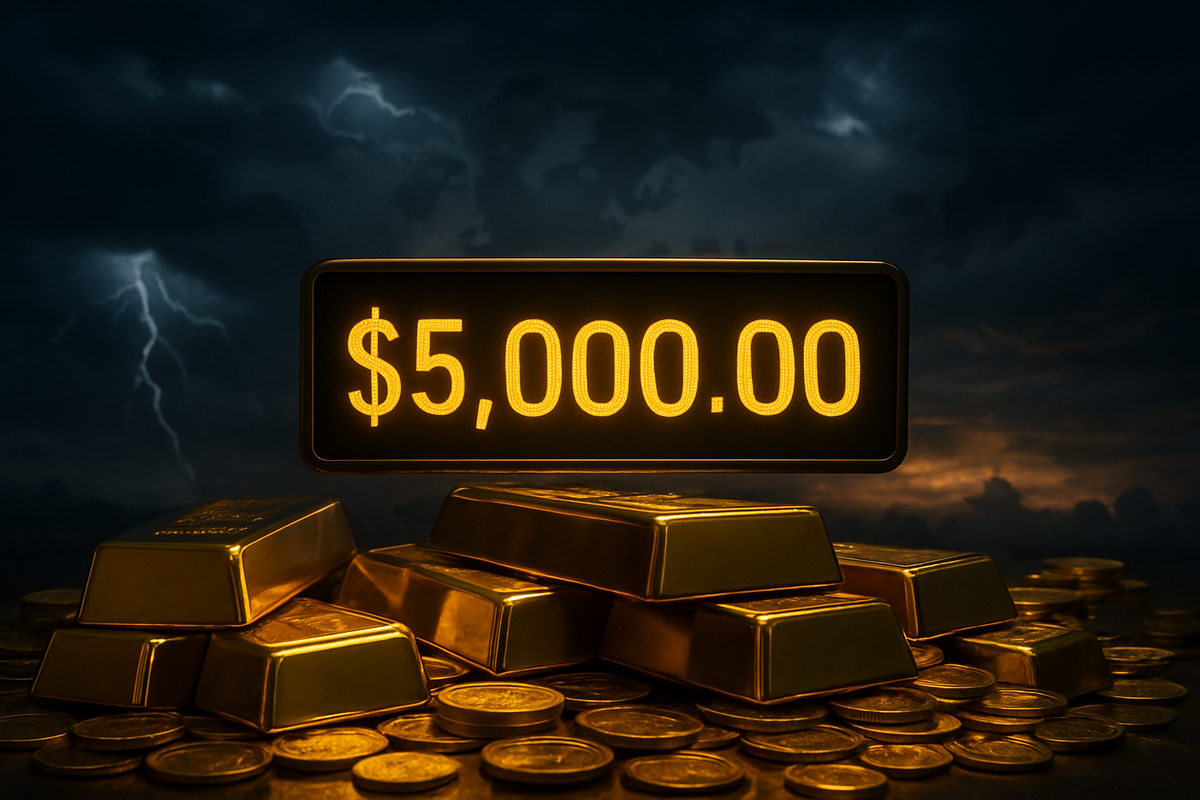
In a historic move that has sent shockwaves through global financial markets, gold prices have officially breached the psychological and technical barrier of $5,000 per ounce. This monumental breakout, occurring in the final weeks of January 2026, marks a 150% increase from the levels seen just two years ago and signals a profound shift in the global perception of value, stability, and the role of the U.S. dollar in international trade.
The immediate implications of this surge are being felt across the globe. For investors, the "yellow metal" has transformed from a passive defensive asset into a high-octane performance driver, while for central banks, it has become the ultimate weapon in a growing "de-dollarization" arsenal. However, the $5,000 milestone is more than just a number; it is a clear warning sign from the markets that the post-pandemic era of relative economic predictability has been replaced by a "New Age of Uncertainty," characterized by structural inflation and escalating geopolitical fragmentation.
The Road to $5,000: A Perfect Storm of Catalysts
The journey to $5,000 was not a sudden spike but the culmination of a "perfect storm" that began intensifying in late 2025. The primary driver has been an unprecedented level of central bank accumulation. Led by nations such as Poland, Brazil, and Kazakhstan, global central banks have been treating gold as a strategic reserve priority. In early 2026, the Governor of the National Bank of Poland made headlines by announcing plans to expand gold reserves to 700 tons, citing the urgent need to insulate the domestic economy from a volatile U.S. dollar and the ongoing instability in Eastern Europe.
Geopolitical tensions reached a breaking point in the fourth quarter of 2025, providing the final push gold needed to clear its previous resistance levels. The "Justice Mission 2025" military drills conducted by China around Taiwan and a sudden, unexpected diplomatic rift between the U.S. and the European Union over trade tariffs—dubbed the "Greenland Dispute"—triggered a massive flight to safety. When the U.S. signaled potential 25% tariffs on European allies, investors abandoned traditional currency pairs in favor of gold and the Swiss franc, viewing bullion as the only asset free from counterparty risk and political whims.
Simultaneously, the Federal Reserve’s monetary policy pivot played a crucial role. Despite the IMF projecting a slight decline in global headline inflation, "sticky" core inflation in the United States forced the Fed to maintain a delicate balancing act. As the Fed began cutting rates toward a target of 3.0% in early 2026 to prevent an industrial slowdown, real yields plummeted. This significantly lowered the opportunity cost of holding non-yielding gold, making it the preferred destination for institutional capital that had previously been parked in Treasury bonds.
Winners and Losers in the $5,000 Gold Era
The mining sector has entered what analysts are calling a "Golden Age." Leading the pack is Newmont (NYSE: NEM), the world’s largest producer, which saw its stock price surpass $106 as it successfully maintained its All-In Sustaining Costs (AISC) far below the current spot price. By keeping costs between $1,400 and $1,600 per ounce, Newmont has unlocked record-breaking profit margins. Similarly, Agnico Eagle Mines Limited (NYSE: AEM) has become a market darling due to its strict "no-hedge" policy, allowing shareholders to capture the full benefit of the price surge. Trading near $214, Agnico's focus on low-risk jurisdictions like Canada and Finland has made it a top pick for risk-averse institutional investors.
Barrick Gold Corporation (NYSE: GOLD) has also seen its share price surge over 180% year-over-year, using its massive free cash flow to initiate aggressive share buyback programs. However, the path hasn't been entirely smooth for Barrick; the company continues to navigate operational complexities in regions like Mali, highlighting that even in a bull market, jurisdictional risk remains a factor for the "majors."
Conversely, the "Golden Squeeze" has created significant casualties. Mid-market retailers like Signet Jewelers Limited (NYSE: SIG), the parent company of Kay Jewelers and Zales, are facing a fundamental crisis. Unlike ultra-luxury brands, Signet’s core customers are highly sensitive to price. With the raw material cost of a basic gold wedding band now exceeding previous retail prices, Signet has been forced to pivot aggressively toward lab-grown diamonds and lower-carat alloys to survive. In the tech sector, giants like Apple Inc. (NASDAQ: AAPL) and Samsung (KOSPI: 005930) are grappling with what some are calling an "AI Tax." Gold’s conductivity is essential for the high-performance connectors used in AI servers and high-end smartphones. At $5,000 an ounce, the aggregate cost of these materials is adding hundreds of millions of dollars in production expenses, threatening to squeeze margins or force unpopular price hikes on consumers.
A Structural Shift in the Global Macro Landscape
The breach of $5,000 signifies more than just a peak in a commodity cycle; it reflects a broader trend of "fiscal dominance" where government debt levels in major economies have reached a point of no return. Markets are increasingly pricing in the reality that central banks may be forced to tolerate higher inflation to keep debt servicing costs manageable. This event mirrors historical precedents, such as the gold rush of the late 1970s, but with a modern twist: the integration of gold into the digital and technological infrastructure of the 21st century.
Furthermore, the surge is causing a massive "current account" headache for major gold-importing nations. In India and Turkey, where gold is deeply woven into the cultural fabric, the soaring import bill is widening trade deficits and putting downward pressure on local currencies. This has led to a paradoxical situation where the central banks' gold reserves are worth more on paper, but the broader economy is suffering from the inflationary pressure of a weakening currency. We are also seeing a rise in "urban mining"—a trend where companies like Umicore (EBR: UMI) are seeing increased demand for their services in recycling gold from electronic waste as a cheaper alternative to newly mined bullion.
The Horizon: Where Does Gold Go From Here?
In the short term, market analysts at J.P. Morgan and Goldman Sachs suggest that a technical correction is likely. After such a parabolic move, gold may consolidate around the $4,800 to $5,000 support level as traders take profits. However, the long-term outlook remains decidedly bullish. Many firms have already revised their year-end 2026 targets to as high as $6,000 per ounce, citing the "permanent" nature of the geopolitical shifts and the ongoing trend of reserve diversification away from the dollar.
The next strategic pivot for the industry will likely be "dematerialization." As gold becomes prohibitively expensive for industrial use, we can expect a wave of innovation in material science, with companies hunting for synthetic or composite alternatives for semiconductors and medical devices. For investors, the emergence of "Gold-Backed Digital Assets" (GBDAs) is expected to accelerate, providing a way for retail investors to own fractional shares of the metal in an increasingly expensive market.
Summary of the New Monetary Reality
The ascent of gold to $5,000 per ounce is a landmark event that marks the end of the post-Cold War era of dollar hegemony and the beginning of a more fragmented, multi-polar financial system. The key takeaways for the market are clear: central banks are no longer just "watching" gold—they are hoarding it; inflation is structural, not transitory; and geopolitical risk is now a permanent component of asset pricing.
Moving forward, the market will be characterized by higher volatility and a widening gap between companies that can pass on material costs and those that cannot. Investors should keep a close watch on the upcoming "Greenland Dispute" negotiations and the Federal Reserve’s spring meeting. While the $5,000 mark is a historic milestone, in this new economic landscape, it may eventually be viewed as just the beginning of gold's climb into a new stratosphere of value.
This content is intended for informational purposes only and is not financial advice