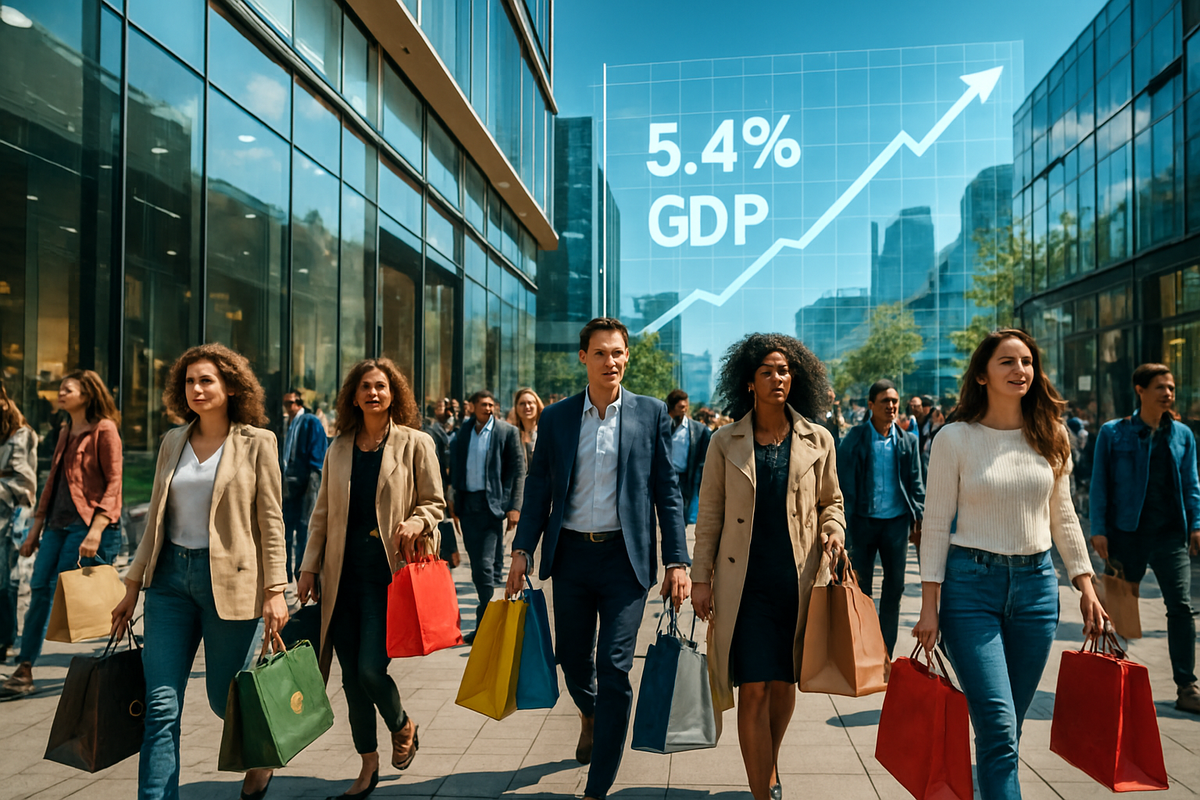
As of January 26, 2026, the narrative of the "exhausted" American consumer has once again been proven premature. Despite a volatile end to 2025 marked by a 43-day federal government shutdown and escalating trade tensions, the latest retail data reveals a consumer base that is not just surviving, but thriving. The headline 0.6% jump in retail sales reported for November 2025—which finally reached the public this month following administrative delays—has provided a massive tailwind for economic growth projections, suggesting that the U.S. economy remains the global engine of resilience.
This unexpected strength in spending has forced a radical upward revision of growth forecasts. While many analysts predicted a winter chill for the economy, the Atlanta Fed’s GDPNow model is currently tracking fourth-quarter 2025 growth at a staggering 5.4%. While private-sector economists remain more conservative, the data clearly indicates that the combination of real wage gains and a record-breaking stock market has created a "wealth effect" that is successfully offsetting the "macro uncertainties" that dominated headlines throughout last year.
Behind the Numbers: A Tale of Resilience and Delays
The path to these latest figures was anything but smooth. The 0.6% jump in November retail sales was a significant beat over the 0.4% consensus estimate, but the reporting itself was delayed by a nearly six-week federal government shutdown that paralyzed the Census Bureau. When the data finally broke on January 14, 2026, it revealed a consumer that refused to pull back during the critical early holiday window. This momentum carried into December, which saw a 0.4% headline increase, though the "control group" sales—a crucial metric that strips out volatile gas and auto figures to feed directly into GDP calculations—surged by a robust 0.7%.
The timeline of this resilience is particularly noteworthy. Throughout the summer and fall of 2025, the Federal Reserve maintained a cautious stance, even as they began a cycle of modest rate cuts that brought the federal funds rate down to the 3.5%–3.75% range. Consumers, however, didn't wait for permission to spend. The rebound was driven by a 1.9% spike in sporting goods and a nearly 1% rise in clothing and accessories, signaling that discretionary "lifestyle" spending has returned to the forefront. Stakeholders, from the National Retail Federation to big-bank analysts at JPMorgan Chase & Co. (NYSE: JPM), have noted that the "shutdown shock" failed to materialize in the checkout lines, as households leaned into their improved balance sheets.
The Winners and Losers of the Spending Spree
In this environment of robust demand, the clear winners are the retail giants that have mastered the "value-convenience" hybrid. Amazon.com, Inc. (NASDAQ: AMZN) continues to dominate the non-store retail category, which saw growth between 0.4% and 1.2% over the holiday period, as its logistics network successfully bypassed many of the supply chain hiccups caused by late-year port congestion. Similarly, Walmart Inc. (NYSE: WMT) has emerged as a primary beneficiary of "trade-down" behavior from middle-income families and steady demand from its core base, reporting high traffic and strong margins as it heads into the new fiscal year.
Conversely, the picture is more complicated for sectors sensitive to interest rates and housing cycles. Home Depot, Inc. (NYSE: HD) and Lowe's Companies, Inc. (NYSE: LOW) have faced headwinds, with building materials and garden equipment sales sliding roughly 2.0% in the latest reports. Analysts suggest that while consumers are happy to buy clothes and gadgets, they remain hesitant to commit to major home renovations while mortgage rates hover in the mid-6% range. Furthermore, luxury retailers are seeing a "polarized" performance; while high-net-worth spending remains solid, the "aspirational" luxury shopper is increasingly turning to "Buy Now Pay Later" platforms, creating potential credit risks for lenders if the labor market continues its recent "fragile" trend toward 4.6% unemployment.
Wider Significance: Tariffs, Taxes, and the Fed's Next Move
The broader significance of this spending surge lies in its collision with new policy realities. The recently passed "One Big Beautiful Bill Act" (OBBBA) is expected to inject further stimulus through personal and business tax cuts by mid-2026, which may provide a "second wind" for the economy. However, this optimism is tempered by the specter of "Tariff Pass-Through." Economists at Goldman Sachs Group, Inc. (NYSE: GS) warn that as retailers deplete old inventories, the costs of new trade duties—including recent Greenland-related tariffs—will likely be passed on to consumers in the first half of 2026, potentially adding 50 basis points to headline inflation.
This puts the Federal Reserve in a precarious position. The central bank had been planning a series of "soft landing" rate cuts for 2026, but the sheer strength of the 5.4% GDPNow estimate could force them to pause. If the consumer continues to spend at this clip, inflation might stabilize well above the 2% target, currently sitting at 2.7%. Historically, such periods of late-cycle consumer strength have often preceded a cooling period as the "lagged effects" of monetary policy finally take hold, but the 2025-2026 cycle has consistently defied historical precedents.
The Road Ahead: 2026 Outlook and Strategic Pivots
Looking forward to the remainder of 2026, the market is bracing for a potential shift in momentum. While Q4 2025 was a triumph of resilience, the consensus for full-year 2026 GDP growth sits between 2.1% and 2.5%. This represents a controlled deceleration rather than a crash. Companies are already pivoting their strategies to account for the "fragile" labor market; we are likely to see more automation in the retail sector as firms try to protect margins against rising wage pressures and the potential for higher import costs.
Investors should prepare for a "wait-and-see" first quarter. The short-term opportunity lies in firms that can provide essential value and those that are insulated from tariff-heavy supply chains. However, the long-term challenge will be the "credit cliff" for lower-income consumers. As the reliance on deferred payment options grows, any significant uptick in the unemployment rate—which Fed Vice Chair Bowman recently warned is becoming more sensitive—could turn the currently robust spending into a liability for the financial sector.
Closing Thoughts for the 2026 Investor
In summary, the 0.6% retail sales jump is more than just a number; it is a testament to the structural strength of the U.S. consumer in the face of political and macroeconomic discord. The likely outperformance of Q4 GDP provides a solid foundation for the market as we enter 2026, but the "goldilocks" era of low inflation and high growth is facing its sternest test yet from trade policy and labor market cooling.
Moving forward, the market's trajectory will be determined by whether the "One Big Beautiful Bill Act" provides enough of a cushion to offset tariff-induced inflation. Investors should keep a close watch on the monthly PCE inflation prints and the "control group" retail figures in the coming months. For now, the consumer is the undisputed champion of the American economy, but in 2026, even champions eventually need a breather.
This content is intended for informational purposes only and is not financial advice.