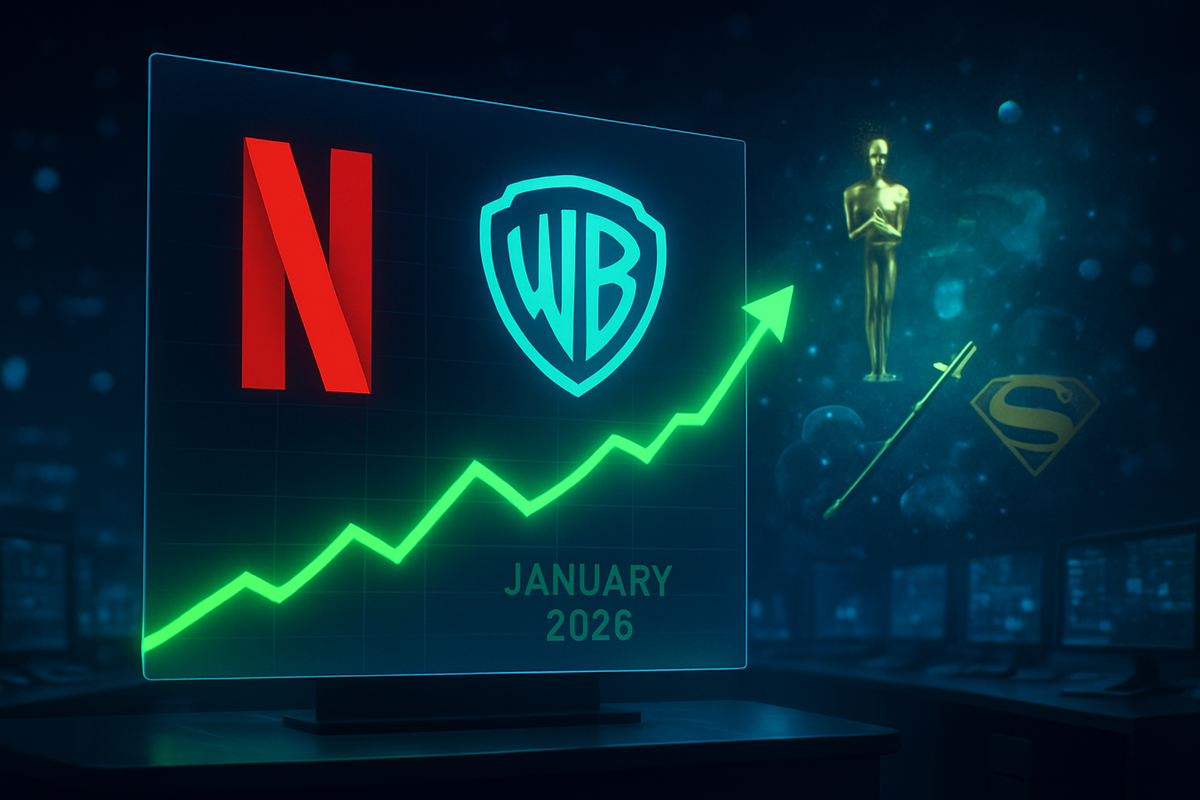
As the calendar turns to 2026, investors in Netflix (NASDAQ: NFLX) are once again looking toward a phenomenon known as the "January Superpower." Historically, the streaming giant has dominated the first month of the year, averaging a staggering 14.7% gain in January over the last two decades. However, as of January 7, 2026, this seasonal tailwind is colliding with the most transformative moment in the company’s history: a pending $82.7 billion acquisition of Warner Bros. Discovery’s (NASDAQ: WBD) streaming and studio assets.
The immediate implications are a tug-of-war between historical technical strength and fundamental uncertainty. While the stock has dipped roughly 3% in the opening week of the year—currently trading near $91.00 following a 10-for-1 stock split in 2025—technical indicators like the Relative Strength Index (RSI) have plummeted to 29. This "oversold" signal, combined with the approach of Q4 earnings on January 20, suggests that the "January Superpower" may not be dead, but rather coiled like a spring, waiting for a catalyst to trigger its traditional mid-month rally.
The Seasonality Narrative vs. The Q4 Earnings Catalyst
The "January Superpower" is no mere superstition; it is backed by 20 years of market data. Since 2005, Netflix has finished January in the green 71% of the time, with legendary surges such as the 73.5% climb in 2012 and a 15.9% jump as recently as 2024. This year, the market is looking to the Q4 2025 earnings report, scheduled for release on January 20, to validate the stock's premium valuation. Analysts are projecting a consensus Earnings Per Share (EPS) of $0.55 on a post-split basis, representing a 28% year-over-year increase, with revenues expected to hit $11.97 billion.
The timeline leading to this moment has been defined by Netflix’s aggressive pivot from a pure-play streamer to a diversified media conglomerate. On December 5, 2025, Netflix shocked the industry by announcing its definitive agreement to acquire the "crown jewels" of Warner Bros. Discovery—including HBO, Max, and the historic Warner Bros. film studios. This week, the WBD Board reaffirmed its commitment to the Netflix deal, successfully rebuffing a hostile rival bid from a consortium led by Paramount Global (NASDAQ: PARA). This corporate drama has kept the stock volatile, even as the "January effect" attempts to take hold.
Key players in this saga extend beyond the C-suite. Institutional investors are currently divided; while some see the WBD acquisition as the final move to secure an unassailable content library (adding Harry Potter and Game of Thrones to Netflix’s roster), others, including analysts at CFRA, have downgraded the stock to "Hold." The skepticism stems from the massive debt load and the complexity of spinning off WBD’s linear networks, such as CNN and TNT, into a separate entity known as "Discovery Global" by late 2026.
Winners and Losers in the New Streaming Order
The ripple effects of Netflix’s "January Superpower" and its massive acquisition are creating clear divisions across the media landscape. Netflix itself stands as the primary potential winner, provided it can execute the integration of HBO’s prestige content without diluting its own brand. By absorbing WBD’s assets, Netflix aims to move from a "Big Three" participant to the undisputed leader of a new streaming oligopoly. However, the short-term "loser" in this scenario has been the stock’s price stability, as the market digests the $82.7 billion price tag.
Disney (NYSE: DIS) is emerging as a formidable counter-force. Having achieved consistent profitability in its streaming division by late 2025, Disney is now being viewed by firms like Wells Fargo as a "Top Tactical Pick" for early 2026. With a projected $24 billion content spend this year and the full integration of Hulu and ESPN into a single interface, Disney is positioned to capture any investors who are spooked by Netflix’s acquisition-related volatility. While Netflix fights for scale, Disney is fighting for "quality of earnings," a shift that has attracted value-oriented investors.
Amazon (NASDAQ: AMZN) also stands to gain as the industry consolidates. As Netflix focuses on merging two massive content libraries, Amazon has quietly dominated the ad-supported tier (AVOD) market. Projections suggest Amazon will earn over $5 billion in Prime Video ad revenue in 2026 alone. By using "Agentic AI" to revolutionize how users discover content, Amazon has surpassed Netflix in total U.S. household penetration. For Amazon, the Netflix-WBD merger is a welcome distraction that allows them to further entrench their commerce-bundled entertainment model.
Broader Significance: The Era of the Streaming Oligopoly
The events of early 2026 signal the end of the "Streaming Wars" as we knew them and the beginning of a "Big Three" era. The industry is transitioning from a fragmented market of a dozen apps to a consolidated landscape dominated by Netflix/WBD, Disney, and Amazon. This shift mirrors the historical consolidation of the Hollywood studio system in the early 20th century. The move to acquire WBD is Netflix’s admission that original content creation alone is no longer enough; owning deep, legacy IP is the only way to maintain a "moat" against tech giants like Apple and Amazon.
Furthermore, the integration of Artificial Intelligence has moved from a futuristic concept to an operational necessity. In 2026, AI is being used to slash production costs and personalize ad delivery to an unprecedented degree. Netflix’s ability to apply its superior data algorithms to the HBO and Warner Bros. libraries could redefine how "prestige" content is monetized. Regulatory scrutiny remains a looming shadow, however, as the Department of Justice is expected to take a hard look at the Netflix-WBD merger's impact on competition in the digital advertising space.
The historical precedent for this moment can be found in the 2019 Disney-Fox merger. Much like that deal, Netflix is betting that the short-term financial strain of a massive acquisition will be outweighed by the long-term power of a "must-have" content bundle. The difference in 2026 is the maturity of the market; with subscription fatigue at an all-time high, the success of this deal hinges entirely on the ad-supported tier, which now accounts for the majority of new sign-ups for both Netflix and its competitors.
What Comes Next: Strategic Pivots and Market Hurdles
In the short term, all eyes remain on January 20. If Netflix beats earnings expectations and provides a clear roadmap for the WBD integration, the "January Superpower" could see the stock reclaim its lost ground and surge toward the consensus price target of $130.00. However, the road ahead is fraught with strategic pivots. Netflix must successfully manage the "Discovery Global" spinoff, ensuring that the declining linear assets do not drag down the valuation of the high-growth streaming business.
Long-term, the challenge will be "content digestion." Integrating two vastly different corporate cultures—the data-driven, "move fast" ethos of Netflix and the legacy, talent-centric tradition of HBO—will be a multi-year process. Market opportunities may emerge in international expansion, where the combined Netflix-WBD library will have no equal, but challenges persist in the form of rising churn rates as consumers become more selective with their monthly spending.
Investors should also watch for potential "copycat" moves. If the Netflix-WBD deal proceeds smoothly, it may trigger a final wave of consolidation involving smaller players like Paramount or NBCUniversal. The scenario for the remainder of 2026 is one of "execution over expansion." The companies that can prove they can turn massive libraries into consistent free cash flow will be the ones that survive the transition to the oligopoly phase.
Wrap-Up: The Investor’s Watchlist
The first week of 2026 has been a masterclass in market complexity. While the "January Superpower" suggests a rally is imminent, the fundamental shift of the WBD acquisition has introduced a level of risk not seen in Netflix’s recent history. The key takeaway for investors is that the seasonality of the stock is currently being tested by a "generational" corporate event. The historical 14.7% gain is a high bar to clear, but the oversold technical conditions suggest that a post-earnings bounce is a distinct possibility.
Moving forward, the market will be less focused on subscriber counts and more focused on "ARPU" (Average Revenue Per User) and ad-tier scaling. Netflix’s transformation into a legacy-media-owning behemoth is a high-stakes gamble that could either cement its dominance for the next decade or lead to a prolonged period of stagnation as it pays down debt.
For the coming months, investors should watch for three things: the final regulatory approval of the WBD deal, the growth rate of the ad-supported tier in the Q4 report, and any signs of "bundle" partnerships with rivals like Disney or Amazon. The "January Superpower" may be under pressure, but in the world of streaming, Netflix has a habit of writing its own endings.
This content is intended for informational purposes only and is not financial advice.