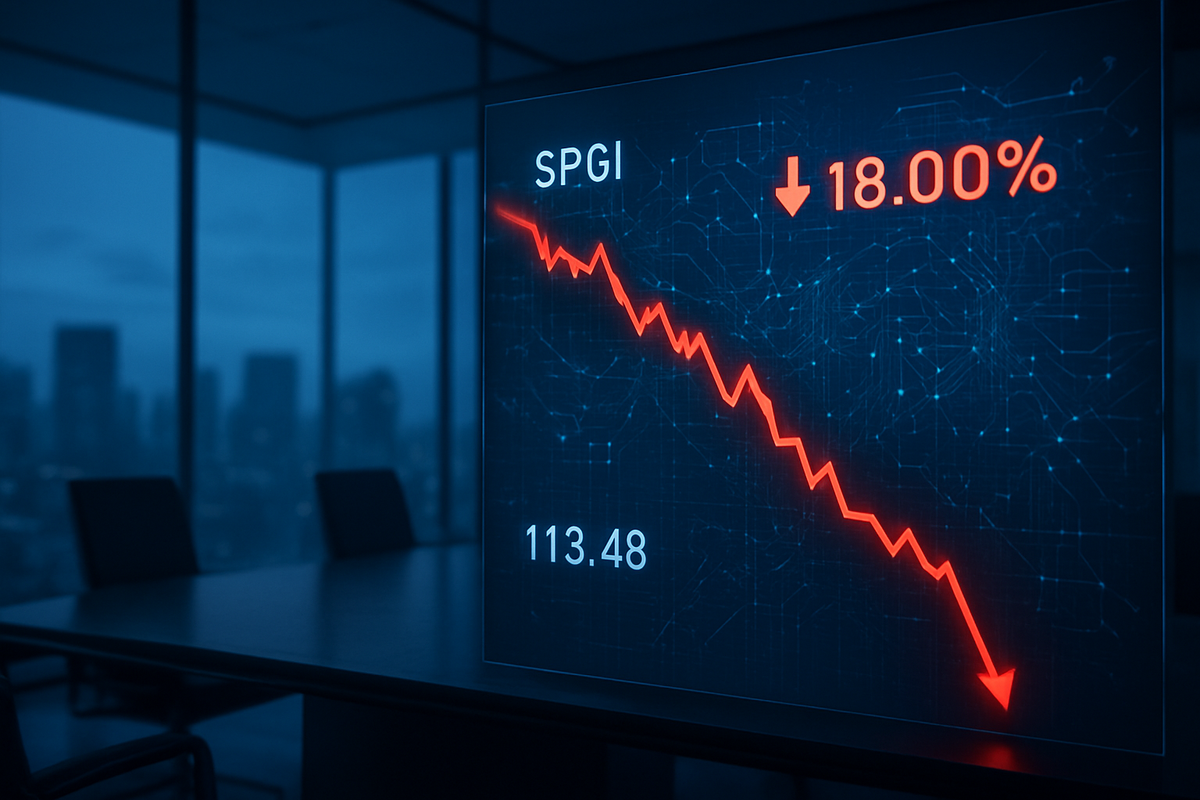
The financial markets were jolted on Tuesday as S&P Global (NYSE: SPGI) witnessed a dramatic sell-off, with shares cratering as much as 18% during intraday trading. The sharp decline followed the release of the company’s fourth-quarter 2025 earnings report, which, while fundamentally solid, was overshadowed by a 2026 financial outlook that failed to meet the lofty expectations of Wall Street analysts.
The immediate implications of this sell-off are profound, wiping out billions in market capitalization for a company often viewed as a "bulletproof" titan of the financial services industry. As investors digest the news, the focus has shifted from S&P Global's recent past to its immediate future, raising questions about whether the high-growth "toll bridge" model of the credit and data markets is facing a structural slowdown.
The Guidance Gap: Decoding the 18% Slide
The catalyst for the exodus was S&P Global’s 2026 adjusted earnings per share (EPS) guidance. The company forecasted a range of $19.40 to $19.65, a figure that landed decisively below the consensus estimate of $19.96. This discrepancy, while seemingly marginal in isolation, triggered a re-evaluation of the company’s valuation multiples. Investors had priced SPGI for near-perfection, fueled by a 2024-2025 period that saw a massive resurgence in bond issuance as corporate "maturity walls" forced heavy refinancing.
Earlier in the day, the company reported fourth-quarter 2025 results that actually exceeded some performance metrics. Revenue for the full year 2025 grew by 8% to $15.34 billion, and the adjusted operating margin expanded to 50.0%. However, the narrative quickly turned to the "normalization" of the Ratings segment. After two years of hyper-growth in credit issuance, management signaled that the pace of new bond ratings would likely cool in 2026, creating a growth vacuum that other segments—like Market Intelligence—are struggling to fill.
Furthermore, the timing of the sell-off coincides with the final preparations for the spin-off of the company’s Mobility division, scheduled for the first half of 2026. While the spin-off is intended to streamline the business and improve overall margins, the short-term loss of the segment’s $1.6 billion revenue stream, combined with the conservative 2026 guidance, has left the market feeling exposed.
The Ripple Effect: Winners and Losers in the Data Arms Race
In the wake of S&P Global's stumble, the competitive landscape is being recalibrated. Moody’s Corporation (NYSE: MCO), the closest rival to SPGI in the credit ratings duopoly, saw its shares trade in sympathy, though it remains a potential "winner" if it can provide more optimistic guidance in its upcoming call. Historically, Moody’s has maintained slightly higher margins and a more concentrated focus on ratings, making it a potential haven for investors who still believe in the credit cycle but are wary of S&P Global's broader data integration challenges.
MSCI Inc. (NYSE: MSCI) stands as another key player to watch. As a dominant force in institutional benchmarks and ESG data, MSCI has historically boasted superior profitability, with gross margins exceeding 80%. If the sell-off in SPGI is driven by a general fear of slowing data demand, MSCI may suffer; however, if the issue is specific to S&P Global’s integration of its various acquisitions, MSCI could see an influx of capital from investors seeking "cleaner" growth in the indexing space.
On the losing side, FactSet Research Systems (NYSE: FDS) and other financial data providers may face increased scrutiny. S&P Global’s Market Intelligence segment has faced rising pressure from AI-native data agents that threaten to replace traditional terminals like Capital IQ. If the market perceives SPGI’s guidance miss as a sign that its pricing power is eroding in the face of AI disruption, smaller competitors like FactSet may find it increasingly difficult to defend their own valuation multiples in a "wait-and-see" environment.
Macro Winds and the AI Shadow
The sell-off in S&P Global fits into a broader trend of "expectation management" currently sweeping the financial services sector. After the frantic pace of 2024—the year often dubbed the "Year of Refinancing"—the market is now entering a phase of stabilization. The historical precedent for this is found in the post-2021 period, where a surge in activity was followed by a sharp contraction as interest rates rose. In 2026, the challenge is not necessarily rising rates, but the absence of a clear catalyst to drive the next leg of volume growth.
Furthermore, the shadow of Artificial Intelligence looms large over the "Market Intelligence" segment. Analysts are increasingly concerned that the traditional subscription model for financial data is being challenged by large language models (LLMs) that can aggregate and analyze data at a fraction of the cost of legacy terminals. S&P Global’s 2026 guidance likely reflects the increased capital expenditure required to transform its tech stack into an AI-first platform, a necessary but expensive pivot that is weighing on near-term earnings.
From a regulatory standpoint, the concentration of the ratings market remains under a microscope. While the 18% drop is a blow to shareholders, it does not alleviate the pressures from global regulators who are pushing for more transparency and competition in the credit space. Any sign that the dominant players are struggling to maintain growth could invite further regulatory intervention or support for alternative rating models, particularly in the burgeoning private credit market.
Navigating the New Normal: The Road Ahead
In the short term, S&P Global management must work to regain investor confidence by demonstrating that the 2026 guidance is a "floor" rather than a ceiling. A strategic pivot toward more aggressive AI integration and a seamless execution of the Mobility spin-off will be critical. If the company can prove that its data remains indispensable even in an AI-driven world, the current sell-off may eventually be viewed as a massive overreaction and a buying opportunity for long-term value seekers.
However, the long-term challenge is more structural. The transition from a "transaction-heavy" business model (Ratings) to a "technology-first" model (Market Intelligence) is fraught with execution risk. Market participants will be watching for any signs of margin compression or a loss of "mindshare" among investment bankers and portfolio managers. The next several quarters will be a litmus test for whether SPGI can maintain its status as a premier growth stock or if it is maturing into a slower-growth utility.
Closing the Ledger
The events of February 10, 2026, serve as a stark reminder that even the most entrenched market leaders are not immune to the gravity of valuation. S&P Global’s sharp descent was not a result of a failing business, but a clash between a solid operational reality and an overly optimistic market sentiment. The 2026 guidance miss highlights the shifting dynamics of the credit markets and the disruptive potential of AI in the data sector.
Moving forward, investors should watch for the completion of the Mobility spin-off and the company’s subsequent "clean" earnings reports. The ability of the Ratings segment to find a new equilibrium in a post-refinancing world will be the primary driver of the stock's recovery. For now, the "financial toll bridge" has encountered a significant roadblock, and the market’s reaction suggests that the road to recovery may be longer than many had hoped.
This content is intended for informational purposes only and is not financial advice.