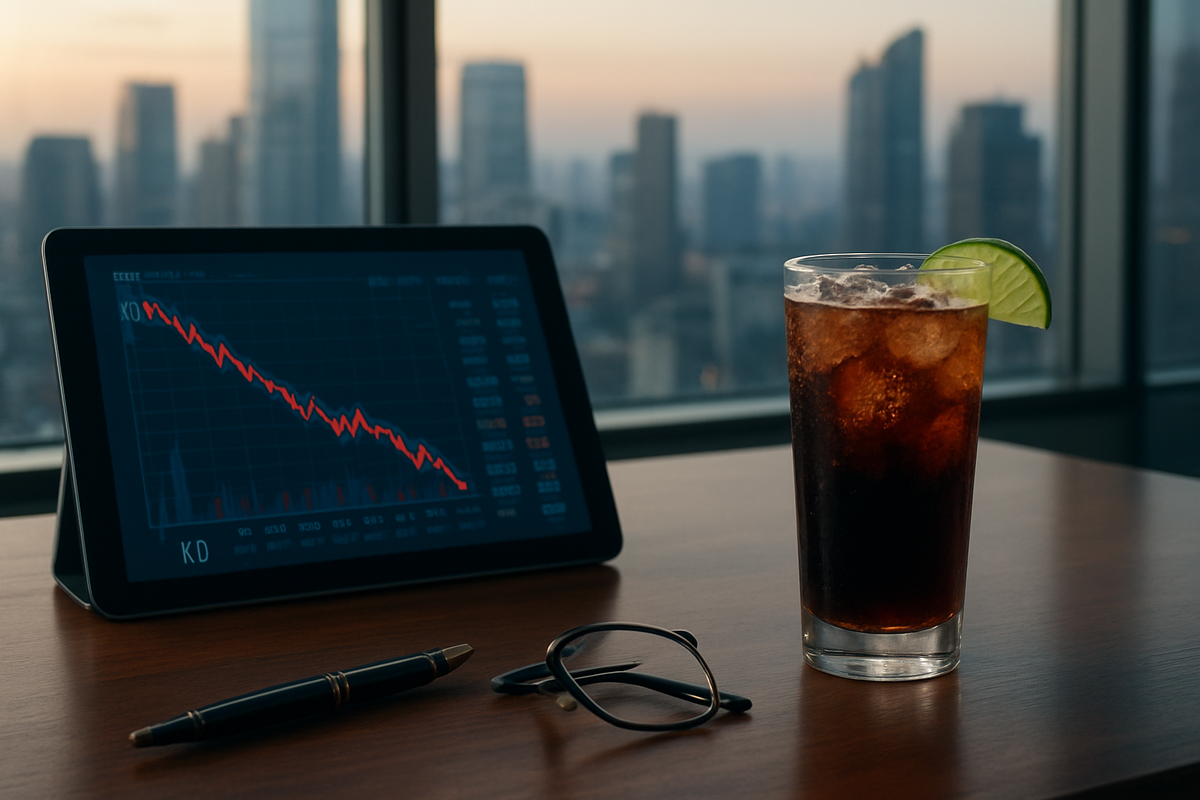
ATLANTA — Shares of The Coca-Cola Company (NYSE: KO) faced a rare pullback on Tuesday, sliding 1.4% as the beverage giant reported fourth-quarter 2025 earnings that left investors craving more. While the company maintained its status as a cornerstone of the consumer staples sector, a combination of missed revenue targets and a conservative outlook for 2026 triggered a sell-off, even as the broader markets continued to hover in record-high territory.
The decline marks a sobering moment for the "Big Red" machine, which has spent much of the last two years navigating a volatile landscape of high inflation and shifting consumer habits. Despite an earnings beat on the bottom line, the company’s inability to meet aggressive top-line revenue expectations—coupled with a 2026 guidance midpoint that fell short of analyst forecasts—suggests that even the world’s most recognized brand is not immune to the cooling of global consumer demand.
Navigating the Volume Stall: A Closer Look at the Q4 Report
The financial results released early on February 10, 2026, painted a picture of a company in transition. Coca-Cola reported fourth-quarter net revenues of $11.8 billion, a 2% increase that nonetheless trailed the Wall Street consensus of $12.05 billion. While organic revenues—a key metric that strips out the impact of acquisitions and currency fluctuations—grew by 5%, this represented a notable deceleration from the double-digit growth seen in early 2024.
The primary culprit behind the revenue miss was a stagnation in unit case volume, which grew by only 1% globally. Market analysts pointed to a "volume stall" in critical regions, specifically North America and parts of Asia, where high price points have finally begun to test the limits of consumer loyalty. Furthermore, the company took a significant $960 million non-cash impairment charge related to its BODYARMOR trademark, a move that severely dented GAAP operating margins, which fell to 15.6% from 23.5% a year prior.
Despite these hurdles, there were pockets of strength. Coca-Cola Zero Sugar continued its dominant run with 13% volume growth, and the company’s comparable earnings per share (EPS) of $0.58 managed to beat the $0.56 estimate. However, the market focused squarely on the future. Management’s 2026 organic revenue guidance of 4–5% was viewed as overly cautious by some, particularly as the midpoint of its growth forecast failed to ignite the enthusiasm typically seen during a "flight to safety" market rotation.
Winners and Losers in the Beverage Battle
The fallout from Coca-Cola’s earnings ripple through the wider beverage and retail sectors. While Coca-Cola investors felt the sting, competitors such as PepsiCo, Inc. (NASDAQ: PEP) and Keurig Dr Pepper (NASDAQ: KDP) are facing their own unique challenges in early 2026. PepsiCo, which has been under pressure from activist investors, recently announced aggressive price cuts of up to 15% on its core snack brands to regain market share from burgeoning private-label competitors. This "price war" in the snack aisle could force Coca-Cola to further subsidize its promotional spending to keep its beverage pairings competitive.
In the "better-for-you" category, the landscape is shifting rapidly. While Coca-Cola’s Fairlife protein brand remains a leader, Keurig Dr Pepper is aggressively expanding its footprint with the acquisition of GHOST Energy and the launch of protein-infused sodas like SkyPop. Meanwhile, retailers like Walmart Inc. (NYSE: WMT) and Costco Wholesale Corporation (NASDAQ: COST) appear to be the quiet winners of the current economic environment. As national brands like Coca-Cola raise prices, store-branded "private label" alternatives have reached record market share, now accounting for nearly 25% of the total industry value.
Conversely, the Consumer Staples Select Sector SPDR Fund (NYSE: XLP) has surged 13% year-to-date, as investors rotate out of a cooling technology sector and into the perceived safety of staples. Within this context, Coca-Cola’s 1.4% dip is seen by some as a company-specific correction rather than a sector-wide retreat, as investors pick "winners" based on volume recovery rather than just pricing power.
The Broader Context: Inflation, Wellness, and the AI Market
Coca-Cola’s current predicament reflects three major trends reshaping the global economy in 2026. First is the "pricing ceiling." For two years, beverage companies relied on price hikes to drive revenue; however, 2026 has proven that the consumer’s "limit" has been reached. The industry is now forced to pivot back to volume-driven growth, which is significantly harder to achieve in a mature market.
Second is the persistent influence of health and wellness, accelerated by the widespread adoption of GLP-1 weight-loss medications. This trend has created a permanent headwind for high-sugar beverages, forcing Coca-Cola to rely almost entirely on its "Zero Sugar" and functional beverage portfolios for growth. The $960 million impairment of BODYARMOR suggests that even established "healthy" brands are finding it difficult to maintain their premium valuations in a crowded market.
Finally, the event highlights the strange "decoupling" of the 2026 market. With the S&P 500 hitting the 7,000-point milestone thanks to an AI-driven supercycle, traditional "Blue Chip" companies like Coca-Cola are being judged by a different set of rules. While tech companies are rewarded for future potential, staples are being punished for even the slightest hint of near-term stagnation.
The Road Ahead: Innovation and Efficiency
Looking forward, the mantle of leadership at Coca-Cola is expected to lean heavily on incoming CEO Henrique Braun. The strategic pivot for late 2026 and 2027 will likely involve a massive "complexity reduction" of the company’s portfolio, cutting underperforming regional brands to focus on high-margin functional drinks. There is also an increasing focus on AI-driven pricing optimizations—using real-time data to adjust promotional spending at the zip-code level to prevent further volume loss to private labels.
In the short term, the company must stabilize its North American operations. The introduction of "affordability" packaging—such as 7.5-ounce mini-cans—is a tactical move to keep the brand accessible to lower-income households. If these value-based initiatives fail to drive a volume rebound by the second quarter, analysts warn that the stock could see further downward pressure, potentially testing its 200-day moving average.
A Balanced View for Investors
The takeaway for the market on February 10, 2026, is one of disciplined caution. Coca-Cola remains a cash-flow powerhouse, with a projected free cash flow of $12.2 billion for the coming year. However, the era of "easy growth" through price increases has ended. The 1.4% drop in share price serves as a reminder that in a record-high market, there is no room for a "mixed" quarter.
Investors should watch the company’s unit case volume closely over the next six months. A recovery in volume, particularly in the emerging markets of India and Latin America, will be the signal that Coca-Cola has successfully navigated the 2026 "consumer crunch." For now, the "Real Thing" faces a real challenge in proving that its growth story can keep pace with a market that is increasingly looking toward the next frontier of technology and wellness.
This content is intended for informational purposes only and is not financial advice.